

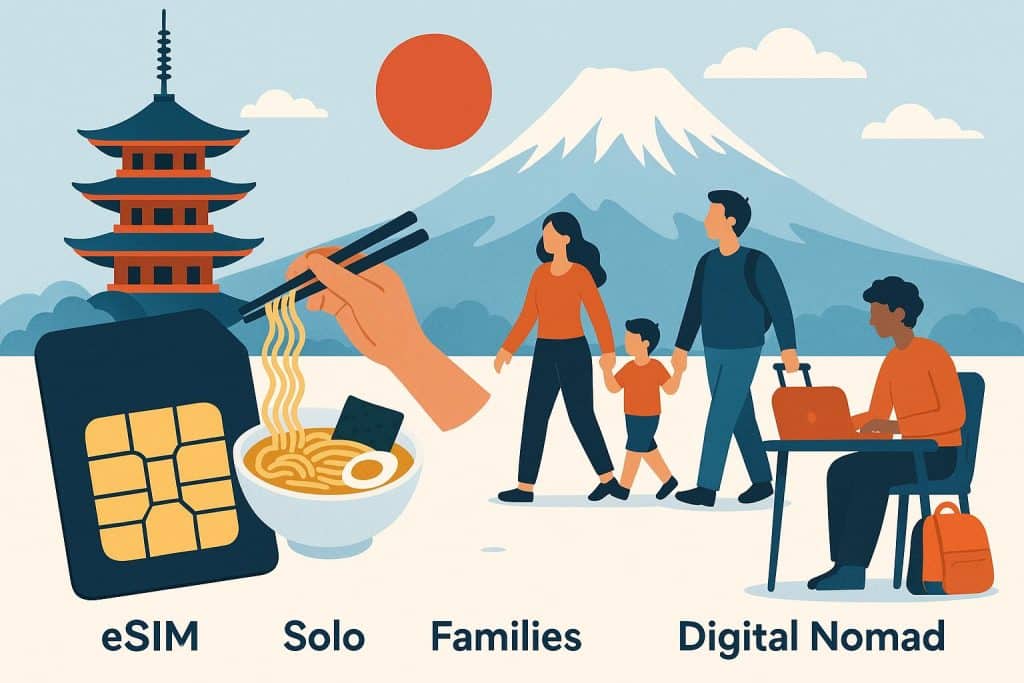
Japan is one of the easiest countries to explore once you’re on the ground – as long as your phone is actually online. Between train transfers, restaurant reservations, translation apps and cashless payments, mobile data in Japan is no longer a nice-to-have; it’s infrastructure.
In 2026, the simplest way to get that connectivity is a Japan-specific eSIM. There’s no single “winner” for every trip, but some providers clearly suit certain traveller types better than others. This guide walks through what to look for and which Japan eSIMs tend to work well for different travel styles.
Why the “best” Japan eSIM depends on you
Most Japanese eSIMs don’t run their own networks. Instead, they give you access to one or more of Japan’s major carriers: NTT Docomo, KDDI au, SoftBank and Rakuten Mobile.
The experience you get depends on a few things:
- Where do you go – big cities vs countryside or ski resorts?
- How long you stay – a 5-day city break vs a 4-week work trip.
- How you use data – light maps and messages vs video calls and hotspotting.
For short trips, mostly in Tokyo or Osaka, almost any reputable Japan eSIM will work. For longer stays, heavier use or more rural itineraries, the details start to matter.
Japan eSIMs at a glance
The table below shows several widely used Japan eSIM options in 2026 and what they’re generally good at. Prices are indicative and based on recent comparison guides; they shift with promos and exchange rates, so always check current offers.
| Provider / Plan | Example plan (approx.) | Networks used | Notable traits | Works well for… |
|---|---|---|---|---|
| Mobal 5G Unlimited eSIM | Unlimited on-device 5G, 3–31 days, ≈ ¥3,000–12,300 | KDDI 5G | High-capacity option with hotspot; Japan-only focus | Heavy data use, families, and remote workers |
| Mobal Voice + Data eSIM | 30–90 days with ~7 GB/month + JP number | Docomo / SoftBank | Includes a real Japanese mobile number; flexible stays | Long stays, work/study, needing local calls/SMS |
| Nomad | 5 GB / 30 days ≈ 10 USD | KDDI, SoftBank | Low-cost fixed-data, simple app | Short city trips on a budget |
| Airalo | 5 GB / 30 days ≈ 11 USD | SoftBank, KDDI | Well-known app; Japan and Asia regional eSIMs | Existing Airalo users, multi-country Asia trips |
| Travelsim Asia | 5 GB / 30 days ≈ 10–11 USD | Docomo, KDDI, SoftBank, Rakuten | Multi-network access, fixed data, no throttling | Rural / hidden-gem trips, coverage-first travellers |
| Ubigi | 10 GB / 30 days ≈ 17 USD; 30-day unlimited ≈ 59–66 USD | Docomo, KDDI | Strong 30-day and unlimited packs | Month-long stays and business travel |
| Saily | 20 GB / 30 days ≈ 25 USD | Mainly SoftBank | Slick app, ad-blocking and security extras | Remote workers who value UX/security |
| Holafly | 7-day unlimited ≈ 23–26 USD | KDDI | Simple day-based “unlimited”, hotspot capped | One-device users who want simplicity over price |
With that overview in mind, let’s look at how these options map to different kinds of trips.
Solo foodies in Tokyo or Osaka (5–7 days)
If you’re flying in for a week of ramen, sushi counters and late-night yakitori, you’re mostly using your phone for:
- Maps and train apps.
- Restaurant searches and reservations.
- Photos, social media and messaging.
For this kind of trip, 5 GB over 7–10 days is usually enough, especially if you use hotel Wi-Fi for heavier uploads.
Good fits:
- Nomad 5 GB / 30 days – one of the cheapest straightforward options (~10 USD), running on KDDI and SoftBank.
- Airalo 5 GB / 30 days – slightly more expensive but convenient if you already use the Airalo app for other countries.
If you know you’ll be streaming a lot of video or hotspotting a laptop, a short-duration Mobal 5G Unlimited eSIM is another option; you pay more than for a 5 GB pack, but you don’t have to watch a data meter.
Two-week “Golden Route” (Tokyo–Kyoto–Osaka and surrounds)
Many first-time itineraries follow some version of the “Golden Route”: a few days in Tokyo, a few in Kyoto, perhaps Osaka and day trips to Nara, Hakone or Nikko.
For 12–14 days with regular map use, daily messaging and some photo/video sharing, 10–20 GB is a sensible target.
Options that tend to work well:
- Travelsim Asia fixed-data plans – around 5 GB for 10–11 USD and scaling up, with access to Docomo, KDDI, SoftBank and Rakuten. No throttling as long as you stay within your allowance, and the multi-network setup helps if you detour into smaller towns.
- Ubigi 10 GB / 30 days – about 17 USD on Docomo and KDDI, with the option to upgrade to an unlimited 30-day plan if you realise you’re using more than expected.
Travellers who take a lot of video or frequently tether laptops might consider a higher-capacity plan, such as Mobal’s 5G Unlimited eSIM, accepting a higher price in exchange for not worrying about gigabytes.
Families with multiple devices
Family trips typically mean several phones, perhaps tablets and at least one laptop. Data use can spike unexpectedly when kids stream or when everyone is uploading photos at once.
There are two main approaches:
- Several smaller fixed-data eSIMs
- For example, each parent uses a 10 GB Airalo or Nomad plan and children mostly rely on Wi-Fi.
- This can be the cheapest option, but requires some discipline about who uses mobile data when.
- One high-capacity plan acting as a “family hotspot”
- A plan such as Mobal 5G Unlimited eSIM can sit on one phone, which then shares data via hotspot with the rest of the family (within the provider’s tethering limits).
- This is easier to manage and is often more predictable for trips with heavy usage, but may cost more than multiple small packs if your family barely uses data.
The “best” here depends on your kids’ habits and whether you expect people to go off exploring separately.
Long stays, work or study in Japan
If you’re staying for several weeks or months – for language school, work or a longer slow-travel itinerary – your needs look different from those of a one-week visitor.
Key questions become:
- Will you need a Japanese phone number for deliveries, landlords, banks or job interviews?
- How much data do you realistically use each month for calls, cloud tools and streaming?
Most travel eSIMs are data-only. One exception is Mobal’s Voice + Data eSIM, which includes:
- A real Japanese mobile number.
- Tourist-style plans around 30–90 days with roughly 7 GB per month.
- Longer-stay options (1–30 GB per month) on Docomo or SoftBank, without a traditional long-term contract.
That combination makes it one of the more straightforward choices if you need both data and a local number for everyday life. Independent reviews and expat guides often highlight its usefulness for services that require a Japanese number (delivery apps, bike rentals, some applications, and property viewings). If you need lots of data plus a Japanese phone number for banking, deliveries or landlords, Mobal is often the best eSIM for Japan for longer work or study stays.
If you only need data and already use a provider like Ubigi elsewhere, a Ubigi unlimited 30-day plan on Docomo/KDDI is another option for long stays.
Rural trips, ski resorts and island escapes
Japan’s big cities are well covered by all major carriers. Once you head into the mountains, onto smaller islands, or far into the countryside, coverage differences become more noticeable.
Broadly:
- NTT Docomo still has the widest nationwide coverage, particularly in rural and mountainous regions.
- KDDI au and SoftBank also have extensive networks, and in many places you won’t see a practical difference.
- Multi-network eSIMs like Travelsim Asia and some Nomad plans, which can connect to multiple carriers, give you better odds of picking up a signal when you move around.
For trips that focus on ski resorts, remote hot-spring towns or out-of-the-way food regions, it’s worth checking which underlying network your chosen eSIM uses and favouring Docomo or multi-network access when possible. Mobal’s 5G Unlimited eSIM, which uses KDDI, also covers a large portion of the country, but anyone planning particularly remote routes should double-check coverage maps in advance.
How to install and use a Japanese eSIM
The setup process is broadly similar across providers.
- Check your phone
- Confirm it supports eSIM (newer iPhones, recent Google Pixels and many Android flagships do) and that it’s unlocked.
- Buy your plan on Wi-Fi before you travel
- Most Japan-focused providers, such as Mobal, Airalo or Nomad, email you a QR code and basic instructions once you’ve paid.
- Install but don’t activate yet
- On iOS, go to Settings → Mobile Data → Add eSIM and scan the QR code.
- On Android, use your SIM manager to add an eSIM.
- On arrival in Japan
- Set the eSIM as your default line for mobile data.
- Turn off data roaming on your home SIM so it doesn’t quietly use your domestic plan abroad.
- Test and tweak
- Open a map or browser to check it works.
- If it doesn’t, double-check any APN settings in the provider’s instructions and toggle airplane mode to force a reconnect.
Once it’s running, you can keep your home number active for calls and SMS while relying on the eSIM for data.
Do you really need “unlimited”?
“Unlimited” plans sound comforting, but they’re not always necessary. For most travellers doing sightseeing, using maps, translation and some social media, a well-sized fixed-data plan is enough and often better value.
Unlimited-style plans make more sense when:
- You work remotely and do daily video calls.
- You plan to hotspot a laptop frequently.
- You’re travelling as a group and using one phone as a shared hotspot (within the provider’s rules).
Even then, it’s worth reading the fine print: many “unlimited” offers slow your speed after a daily fair-use cap. Plans like Mobal’s 5G Unlimited eSIM, which explicitly advertise no on-device data caps at 5G speeds (with separate hotspot limits), stand out for heavier users, but they are overkill for someone who just checks train times and posts the occasional photo.
Putting it all together
If you want a simple framework:
- Short city break, on a budget: 5 GB fixed-data eSIM from Nomad or Airalo.
- Two weeks on the Golden Route: 10–20 GB fixed data from Travelsim Asia or Ubigi, or a higher-capacity option like Mobal 5G Unlimited if you don’t want to monitor usage.
- Family or heavy-data use: one larger plan (for example, from Mobal) used as a hub, or several mid-size fixed-data plans if everyone is fairly light in their usage.
- Work/study and long stays: consider Mobal Voice + Data if you need a Japanese number, or Ubigi if you only need data.
- Rural and ski trips: favour Docomo or multi-network access (Travelsim Asia, some Nomad plans) for better coverage.
- There’s no single best eSIM for every trip to Japan. But once you match your choice to how you actually travel – how long you’re here, what you do online, and where you’re going – staying connected becomes one of the easiest parts of your journey.