

From the 1970s to the early 1980s, high divorce rates were like candy for American comedians and popular culture analysts. Jokes and sardonic observations about marriage and divorce dynamics were taken out of context from demographic projections. In 1975, many sociologists estimated that up to 44% of legal spousal relationships would end up in divorce; however, the trend has been reversing for decades.
According to statistics compiled by Bowling Green State University, the divorce rate per 1,000 married women jumped from 14.9 in 1970 up to its highest recorded point of 22.6 in 1980. In October 2025, the Pew Research Center reports that the divorce rate had fallen to 14.4. This statistical shift highlights more than a demographic change; it also underscores the importance of understanding your legal options for marital dissolution. From a broad perspective shaped by jurisdiction, you have two distinct paths: legal separation and divorce.
Main Differences Between Legal Separation and Divorce
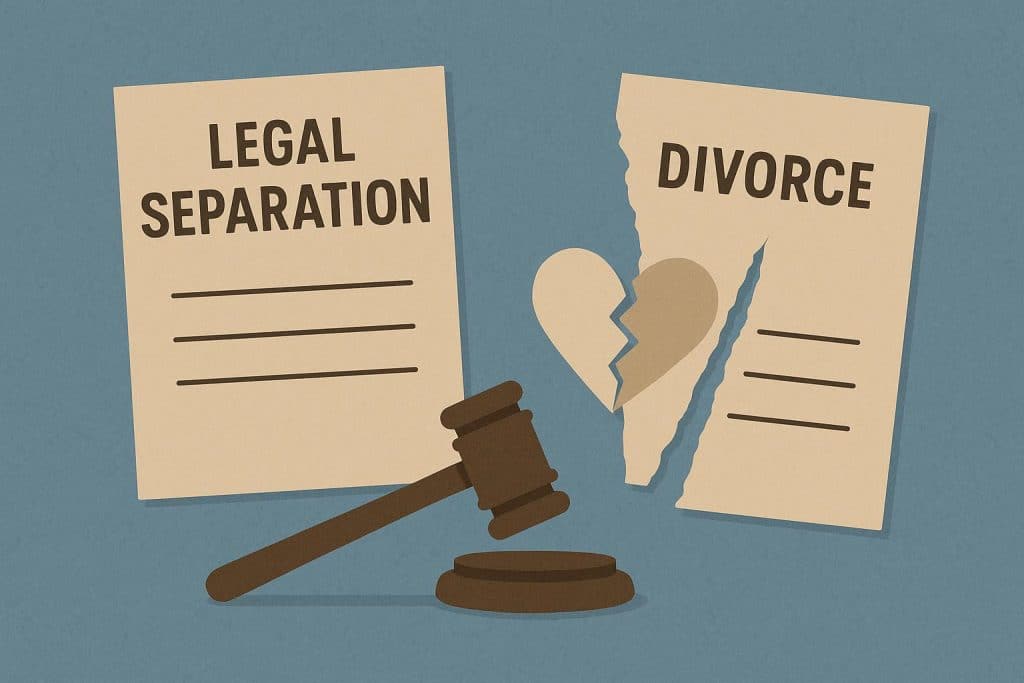
When you consult a divorce lawyer like the experienced attorneys at Davis & Associates, the first aspect to consider is the legal status of the civil union and marital contract. Only single people can marry, so you would need a dissolution court order returning you to that former status. A legal separation, on the other hand, is a court order that puts the marriage on hold without ending it or changing your status. Depending on the state where you are filing for dissolution, a separation may be statutorily required for a term lasting between two and 24 months before the family judge issues your divorce papers.
With a legal separation, you must live apart from your spouse and obey the court order dictating your rights and duties; however, you remain legally married. Because the marital bond remains intact, you can’t remarry or enter a new domestic partnership without converting the separation into a dissolution.
To a significant extent, getting divorced means dissolving a civil contract. Under broad legal principles, a marriage is viewed by the state as a binding legal agreement with statutory rights, obligations, and protections regarding property, inheritance, tax status, and next-of-kin decision-making. When you get married in any state, the government is a party in the marital contract. You can’t simply abandon a marriage by mutual agreement; even in states that manage DIY programs for uncontested divorce proceedings, you still need a formal judicial decree. In other words, a court must oversee the process and sign off on it, considering the demands of both spouses before releasing them from marital duties and responsibilities, including the structure of the joint financial entity and distribution of liabilities and assets acquired during the union.
Dissolving Common Law Marriages
In states that allow marriages to form without formal ceremonies, terminating the marriage becomes more complex. In 2026, these jurisdictions include Colorado, Iowa, Kansas, Montana, Rhode Island, Texas, and Utah. These are states allowing couples to enter into a legally binding marriage without a license or ceremony if they meet specific criteria, including a tacit mutual agreement, cohabitation, and public representation as spouses.
The legal reality of common law marriages is their validity; they hold the same legal status as ceremonial marriages, so they must be dissolved through a court order and decree. If you are in one of these domestic partnerships, you cannot simply walk away; you must petition a family court for a formal dissolution or legal separation to divide property, determine support, and establish child custody.
In states that recognize common law marriages, the legal separation process flows almost the same as a divorce; nonetheless, a divorce lawyer may need to clear an additional hurdle for you. Before the judge can issue a separation order for dividing assets or calculating spousal support, you must first legally prove the union. In some cases, family law firms gather clear and convincing evidence for the court. You might have to show joint tax returns, shared bank accounts, or property deeds. Once the family court officially recognizes the validity of the common law marriage, the judge can then move forward with evaluating the merits of legal separation.
The court-ordered separation agreement establishes spousal boundaries, assigns separate liabilities, and stops the accumulation of further marital property. You can turn this legal option into a strategy for living apart and protecting your future financial interests while retaining benefits like joint tax filing status or health insurance policy coverage. If you eventually decide to end the relationship permanently, the separation agreement becomes the same as a divorce decree.
Understanding Statutory Legal Separation Requirements
In some states, legal separations are required by statute before the judge can issue a divorce decree; for example, Arkansas mandates 18 months, and North Carolina a year. The separation period encourages couples to weigh their legal options and prevent impulsive splits.
In other states, legal separations are completely optional. California is very flexible in this regard. Under the California Family Code, a legal separation is a distinct petition you can file for religious, financial, or health reasons; it is not a prerequisite for divorce. If you want to get divorced in the Golden State, you can file for dissolution immediately on the grounds of irreconcilable differences. You are not required to live apart or get a separation order first; however, you must still comply with the state’s standard six-month administrative waiting period before receiving a certificate for marriage and immigration purposes.
“No-Fault” Divorce States
No-fault states handle legal separations and dissolutions differently. In Colorado, Delaware, and Vermont, for example, there is no legal concept of blame. Their statutes determine whether you must go through a separation period before the final decree.
In Colorado, the mandatory six-month legal separation process can feature child custody and asset division proceedings; then, you can convert it into a dissolution through a streamlined process. In Delaware, the legal grounds for separation involve establishing that the marriage was irretrievably broken, which the family court judge will accept after you have been separated for six months. In Vermont, you can file for an indefinite separation to protect financial or religious interests, but the court will order you to separate for at least six months before you can file for dissolution.