

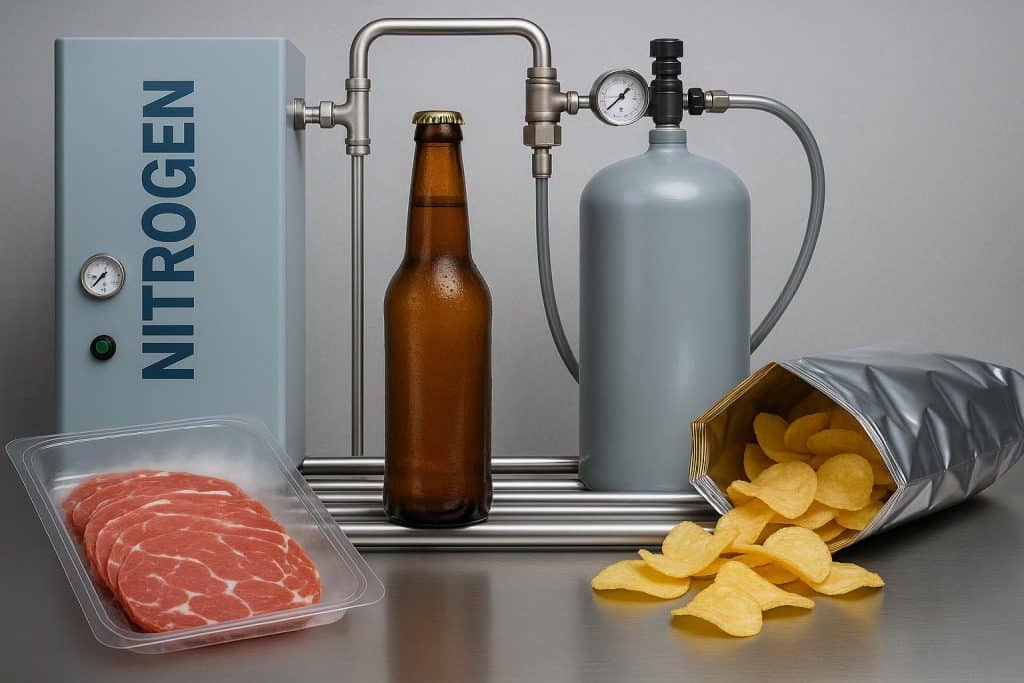
In an age where quality, efficiency and sustainability are among the highest priorities for producers, the application of nitrogen in food and beverage operations has become more than a technical detail. This guide explores how nitrogen gas is used across the industry and what benefits on-site nitrogen production offers.
Understanding nitrogen in food preservation
Nitrogen is valuable because it displaces oxygen, which is one of the main causes of oxidation in food products. Oxidation can lead to spoilage, rancidity, off-flavors and degradation of appearance.
By replacing oxygen with nitrogen, producers can slow down bacterial growth and delay the natural decay process that affects perishable items. This makes nitrogen especially important in packaging applications where freshness, color and texture must be maintained until the moment of consumption.
In snack foods, dairy, baked goods and fresh produce, nitrogen flushes help maintain product integrity by creating an oxygen-free environment inside packaging. This controlled atmosphere can significantly enhance shelf life and reduce food waste.
Advancing packaging with modified atmosphere techniques
Modified atmosphere packaging (MAP) is one of the most widely used techniques in food manufacturing. Here, nitrogen is combined with other gases to tailor the internal atmosphere of food packages to suit specific products.
By fine-tuning gas mixtures, producers can slow down oxidation and growth of aerobic microbes, preserving color, aroma and nutritional value. This approach is effective for a wide range of products, from leafy greens and fresh fruit to cured meats and coffee beans. The consistency provided by nitrogen is a cornerstone of high-quality MAP strategies.
Nitrogen’s importance in beverages
In beverage production, nitrogen serves several functions. It is used in bottling and canning to purge oxygen from containers before filling, preventing oxidation that could dull flavors or alter delicate profiles.
For speciality drinks and certain beers, nitrogen can also influence mouthfeel and texture, offering a smoother or creamier experience compared to carbon dioxide alone. In operations where beverages are blended, dispensed or carbonated, nitrogen supports stable production and consistent quality.
One example is the use of a nitrogen generator for beverage factory setups, where on-site generation ensures precise control over gas purity and pressure during filling and packaging processes.
The advantages of on-site nitrogen generation
Producing nitrogen on-site has become increasingly attractive for food and beverage manufacturers. On-site nitrogen generators offer a reliable and continuous source of nitrogen with minimal need for external supply chain dependencies.
These systems produce nitrogen directly from compressed air using technologies like pressure swing adsorption or membrane separation, delivering high-purity nitrogen tailored to specific production needs.
By generating nitrogen on demand, companies can avoid costly deliveries, free up storage space previously dedicated to cylinders and reduce environmental impact associated with transport and packaging waste.
On-site systems also enhance safety by eliminating the hazards linked to handling high-pressure gas cylinders. The continuous and automated nature of these generators ensures a consistent nitrogen supply, further improving operational efficiency across packaging and production lines.