

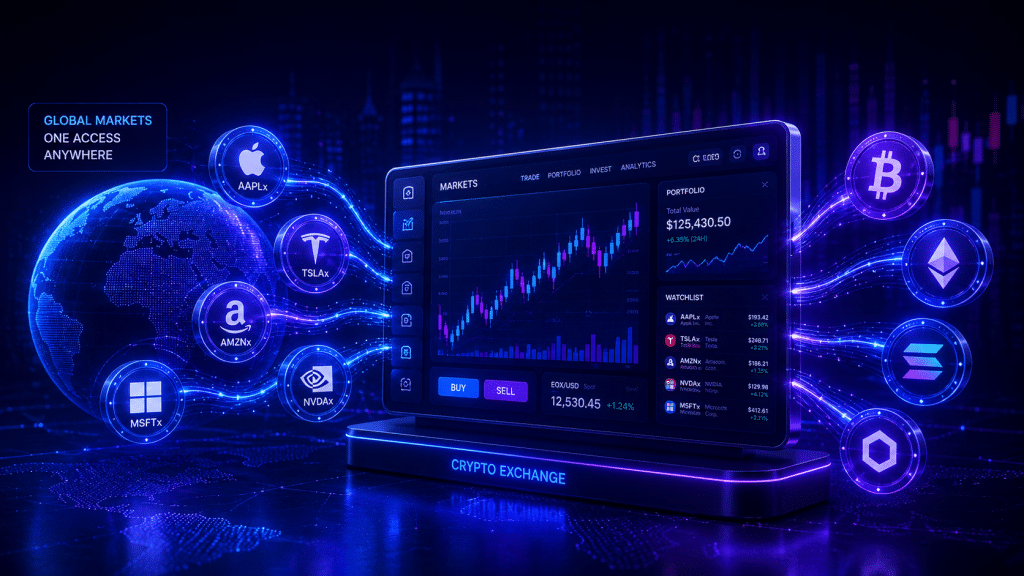
A simple look at why investors are looking for new ways to access global stocks
For many investors, global investing sounds easy. They want to buy U.S. technology stocks, large global ETFs, or shares of companies listed in other markets. But in real life, cross-border securities access is often not simple.
Some investors cannot easily open a foreign brokerage account. Some face high fees, slow account approval, limited local broker support, currency conversion problems, or strict capital controls. In some regions, access to U.S. stocks and ETFs is still limited or expensive.
This is why tokenized stocks are getting more attention.
Tokenized stocks are digital tokens that track or represent traditional shares or ETFs. They are usually issued on blockchain networks and can be traded through a crypto exchange, wallet, or related digital asset platform.
In 2025 and 2026, this market started moving quickly. Kraken expanded xStocks to more than 100 tokenized U.S. stocks and ETFs, and said it aimed to expand to more than 500 by the end of 2026. Binance also announced in June 2026 that it had expanded its platform to include trading of U.S. stocks and ETFs.
So the question is simple: can tokenized stocks fill the global allocation gap for investors?
Let’s break it down.
What Are Tokenized Stocks?
Tokenized stocks are blockchain-based assets linked to traditional stocks or ETFs.
In a simple example, a token may track the price of Apple, Tesla, Nvidia, or the S&P 500 ETF. Some products are backed 1:1 by real shares held in custody. Others may be structured as derivatives or synthetic products that give price exposure but not direct ownership.
This difference is very important.
A real share usually gives investors certain rights. These may include voting rights, dividend rights, legal ownership claims, and investor protections under securities law. A tokenized stock may not always provide the same rights.
For example, Bybit’s xStocks FAQ says xStocks are tokenized representations of real-world U.S. stocks and ETFs, and that each token is backed 1:1 by the underlying asset. Kraken’s xStocks page says xStocks are available only to non-U.S. retail clients in select countries and are not accessible in the U.S., Canada, the U.K., or Australia at this time.
For readers following market infrastructure, tokenized stocks are important because they show how traditional securities may slowly move into blockchain-based trading systems.
Why Cross-Border Investors Are Interested
The biggest reason is access.
Many global investors want exposure to U.S. equities, but traditional access can be difficult. A local broker may not offer enough overseas stocks. A foreign broker may require extra documents. Bank transfers may be slow. Currency conversion may add cost. Settlement may take time.
Tokenized stocks offer a different experience.
They can be traded through digital platforms. They may support fractional investment. They may offer longer trading hours than traditional stock markets. Some platforms also allow users to manage crypto, stablecoins, and stock exposure in one account.
This is attractive for younger investors and crypto-native users. They may already hold stablecoins. They may already use centralized exchanges. They may prefer a mobile-first experience instead of a traditional brokerage interface.
For these users, tokenized stocks can feel like a bridge between crypto and traditional finance.
Why Crypto Exchanges Want Tokenized Stocks
Crypto exchanges are no longer satisfied with only offering Bitcoin, Ethereum, and altcoins.
They want to become broader financial platforms. If an exchange can offer crypto, stablecoins, tokenized stocks, ETFs, yield products, and payment tools, it can become a daily financial app instead of only a trading venue.
This is why tokenized securities matter to exchanges.
A crypto exchange can use tokenized stocks to attract users who want more than crypto speculation. Some users may not want to trade meme coins or high-risk tokens. But they may want exposure to Nvidia, Tesla, Apple, or the S&P 500.
This creates a new growth path.
A platform that already has crypto users can offer traditional market exposure without asking users to leave the ecosystem. Users can move from stablecoins to tokenized stocks, from tokenized stocks back to crypto, and from crypto into other products.
That is why crypto exchange platforms are paying close attention to tokenized equities.
Can Tokenized Stocks Solve the Global Allocation Problem?
They can solve part of the problem, but not all of it.
Tokenized stocks can help with access. They can make it easier for users in certain markets to gain exposure to U.S. equities or ETFs. They can reduce some friction around account opening, minimum investment size, and trading hours.
They may also improve settlement efficiency. Blockchain rails can support faster movement of assets, better transparency, and more programmable financial products.
But access is not the same as full investor protection.
This is the biggest point investors must understand.
Some tokenized stock products may not give voting rights. Some may not give direct dividend rights. Some may depend heavily on the issuer, custodian, broker, or platform. If the issuer fails, the platform changes rules, or regulators intervene, investors may face risk.
Reuters reported that the rush to tokenize stocks has raised investor protection concerns, especially because some tokenized products can lack traditional shareholder rights and protections.
So tokenized stocks may fill the access gap, but they do not automatically fill the legal ownership gap.
Why Regulation Is the Main Challenge
Tokenized stocks sit between two worlds.
On one side, they look like crypto assets because they move on blockchain networks and trade on digital platforms. On the other side, they reference traditional securities, which are highly regulated.
This creates a difficult question: should they be treated like crypto tokens, securities, derivatives, depositary receipts, or something else?
The U.S. SEC has said tokenized securities still sit within securities law when they represent securities such as stocks, bonds, notes, options, or other regulated instruments.
Stock exchanges have also pushed regulators to take the issue seriously. In 2025, the World Federation of Exchanges urged major regulators to increase oversight of tokenized stocks, warning that some products may simulate stock exposure without giving the same shareholder rights or legal protections.
This is why the market cannot grow only through technology. It also needs legal clarity.
The Difference Between Real Ownership and Price Exposure
This is the most important difference for investors.
When you buy a traditional share through a regulated broker, you usually own a legal interest in that share through the brokerage and custody system. You may receive dividends. You may have voting rights. You may be protected by securities regulations.
When you buy a tokenized stock, you must ask: what exactly do I own?
Do I own a claim on a real share?
Do I own a derivative contract?
Do I only get price exposure?
Can I redeem the token?
Who holds the underlying stock?
What happens if the issuer or exchange fails?
Can regulators block the product in my country?
Robinhood’s EU stock token page, for example, says its stock tokens are derivative contracts between the user and Robinhood, priced by reference to underlying securities, and do not grant rights to those underlying securities.
This does not mean all tokenized stock products are bad. It means investors must read the structure carefully.
Why Tokenized Stocks May Still Grow
Even with these risks, tokenized stocks may continue to grow.
The demand is real. Investors want easier access to global markets. Crypto users want more practical financial products. Exchanges want new revenue. Traditional finance companies want to test blockchain settlement and 24-hour market infrastructure.
There is also institutional interest.
Nasdaq has been pushing tokenized securities ideas that would preserve material shareholder rights, and Reuters reported in May 2026 that the SEC was preparing plans around trading crypto versions of stocks.
This shows the market is moving beyond small experiments. The next phase may be more regulated, more transparent, and more connected to traditional market infrastructure.
If that happens, tokenized stocks could become more trusted.
Final Thoughts
Tokenized stocks are not a perfect replacement for traditional brokerage accounts. They do not automatically give investors the same rights, protections, or legal ownership as ordinary shares.
But they do solve a real problem.
Many investors around the world still face barriers when trying to access global markets. They want U.S. stocks, ETFs, and diversified international exposure, but the traditional system can be slow, expensive, or restricted.
Tokenized stocks can help fill part of that gap. They offer easier access, fractional exposure, longer trading windows, and a familiar experience for crypto-native users.
The winners will likely be the platforms that combine access with trust. Investors will not only ask whether they can trade tokenized stocks. They will ask whether the product is backed, regulated, transparent, redeemable, and legally clear.
That is why the future of tokenized stocks will depend on more than blockchain technology. It will depend on regulation, investor protection, exchange credibility, and the quality of the underlying structure.
For now, tokenized stocks are best understood as a bridge. They are not yet the full global securities system. But they may become one of the most important channels connecting crypto users with traditional markets.