

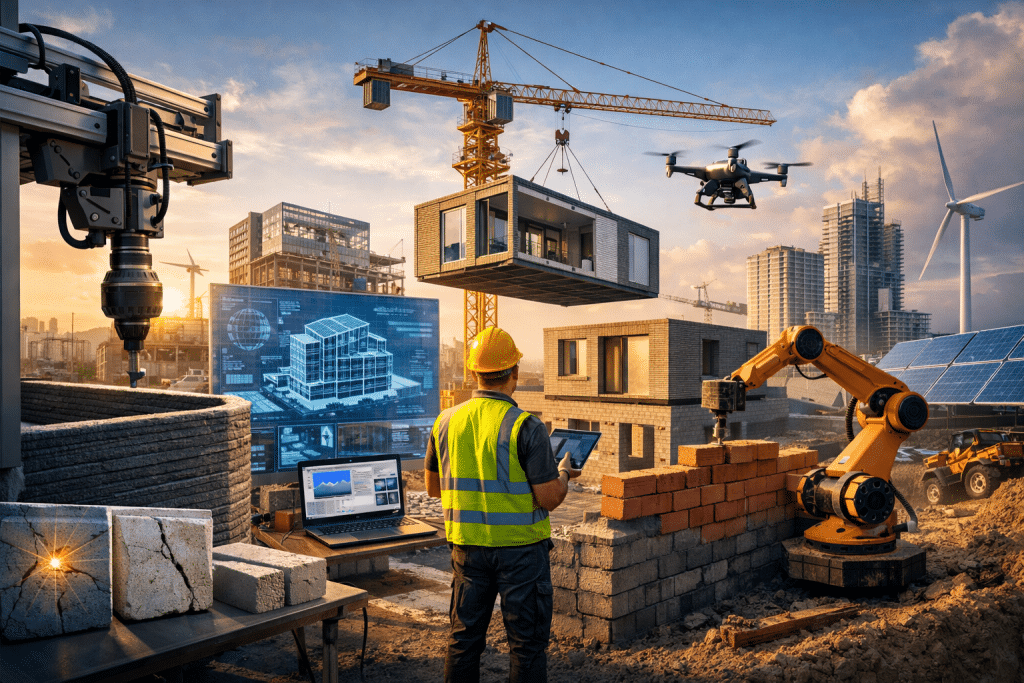
The construction industry has undergone a massive transformation over the past decade. Driven by technological advancements, sustainability concerns, and the demand for faster project completion, modern construction techniques are changing the way buildings and infrastructure are designed and built. Traditional methods that once dominated the industry are now being replaced or enhanced by innovative approaches that improve efficiency, safety, and cost-effectiveness.
Today, construction companies are leveraging advanced tools, digital planning systems, and new materials to streamline operations. These innovations not only reduce construction time but also minimize waste and enhance structural durability. From automation and modular construction to sustainable building techniques, modern construction practices are shaping the future of the industry.
Below are the top 10 modern construction techniques that are transforming the construction landscape worldwide.
1. Building Information Modeling (BIM)
Building Information Modeling (BIM) is one of the most revolutionary advancements in construction technology. BIM allows architects, engineers, and contractors to create a detailed digital representation of a building before the actual construction begins. This digital model includes structural elements, electrical systems, plumbing layouts, and other critical components.
With BIM, stakeholders can collaborate in real time, identify potential design conflicts, and reduce costly mistakes during construction. The technology also helps improve project planning and allows teams to visualize the final outcome before breaking ground.
2. Advanced Construction Estimation Technologies
Accurate cost estimation is essential for successful construction projects. Modern estimation tools use advanced software and data analytics to predict costs more precisely than traditional manual methods. These technologies analyze materials, labor costs, timelines, and project risks to create reliable project budgets.
Many companies now rely on industrial estimating services to manage complex cost calculations and improve financial planning. These services help contractors make informed decisions, reduce project delays, and maintain better control over project expenses. As construction projects grow larger and more complex, accurate estimation tools have become a vital part of modern construction management.
3. Modular Construction
Modular construction has become increasingly popular due to its efficiency and speed. Instead of building structures entirely on-site, modular construction involves manufacturing building components in a controlled factory environment. These modules are then transported to the construction site and assembled like building blocks.
This method significantly reduces construction time, minimizes material waste, and improves quality control. Because the modules are built indoors, weather conditions have less impact on the construction schedule. Modular construction is commonly used for residential buildings, hotels, hospitals, and office complexes.
4. Smart Project Planning and Cost Control
Effective project planning is essential for keeping construction projects on schedule and within budget. Modern construction firms use advanced project management software and digital tools to track progress, manage resources, and improve coordination among teams.
In many cases, companies rely on construction estimating services in usa to ensure accurate budgeting and cost forecasting throughout the project lifecycle. These services help contractors identify potential financial risks early and make necessary adjustments before problems escalate. With better cost control and planning, construction companies can complete projects more efficiently while maintaining high-quality standards.
5. 3D Printing in Construction
3D printing technology is revolutionizing the construction industry by enabling the rapid creation of building components and even entire structures. Using specialized printers and construction-grade materials such as concrete, builders can produce walls, structural elements, and decorative features with incredible precision.
One of the major advantages of 3D printing is reduced material waste. The technology only uses the exact amount of material needed for the structure. Additionally, 3D printing can significantly shorten construction timelines, making it an ideal solution for affordable housing and emergency shelters.
6. Prefabrication
Prefabrication involves manufacturing building components off-site and assembling them at the construction site. While similar to modular construction, prefabrication typically focuses on specific building elements such as walls, staircases, and roof sections.
This technique improves efficiency, enhances safety, and ensures consistent quality. By producing components in a controlled environment, construction companies can reduce errors and maintain higher standards of workmanship. Prefabrication is widely used in residential construction, commercial buildings, and infrastructure projects.
7. Green and Sustainable Construction
Sustainability has become a major focus in modern construction. Green building techniques aim to reduce environmental impact by using energy-efficient materials, renewable energy systems, and environmentally friendly construction practices.
Examples of sustainable construction methods include solar panel installations, green roofs, rainwater harvesting systems, and the use of recycled materials. These strategies not only benefit the environment but also reduce long-term operating costs for building owners.
As governments and organizations increasingly prioritize environmental responsibility, sustainable construction practices are becoming a standard requirement in many projects worldwide.
8. Drones in Construction
Drones are rapidly becoming a valuable tool on construction sites. Equipped with high-resolution cameras and advanced sensors, drones can capture aerial images, conduct site inspections, and monitor project progress in real time.
Using drones, construction managers can quickly assess site conditions, identify safety hazards, and track project milestones. This technology also helps improve communication among project stakeholders by providing accurate visual data that can be shared instantly.
In addition, drones can survey large construction sites much faster than traditional surveying methods, saving both time and labor costs.
9. Robotics and Automation
Automation and robotics are playing an increasingly important role in modern construction. Robots can perform repetitive tasks such as bricklaying, welding, and material handling with high precision and speed.
By integrating robotics into construction processes, companies can improve productivity and reduce the risk of workplace injuries. Automated machinery can handle heavy lifting and dangerous tasks, allowing workers to focus on more complex and strategic aspects of construction projects.
As technology continues to evolve, robotics is expected to become an even more significant part of the construction industry.
10. Self-Healing Concrete
Self-healing concrete is one of the most innovative materials being developed in the construction sector. This advanced material contains special bacteria or chemical agents that automatically repair cracks when exposed to water and air.
When cracks appear in the concrete, the bacteria produce limestone that fills the gaps, restoring the structure’s strength and durability. This technology can significantly extend the lifespan of buildings and infrastructure while reducing maintenance costs.
Self-healing concrete is particularly useful for bridges, tunnels, and other structures that experience constant stress and environmental exposure.
Conclusion
Modern construction techniques are transforming the industry by introducing smarter, faster, and more sustainable building methods. Technologies such as BIM, 3D printing, drones, and robotics are helping construction companies improve efficiency, reduce costs, and deliver higher-quality projects.
At the same time, innovations in materials and sustainable design are ensuring that future buildings are more environmentally friendly and durable. As the construction industry continues to evolve, companies that adopt these modern techniques will gain a significant competitive advantage.
By embracing new technologies and innovative construction practices, the industry is paving the way for safer, more efficient, and more sustainable infrastructure for generations to come.