

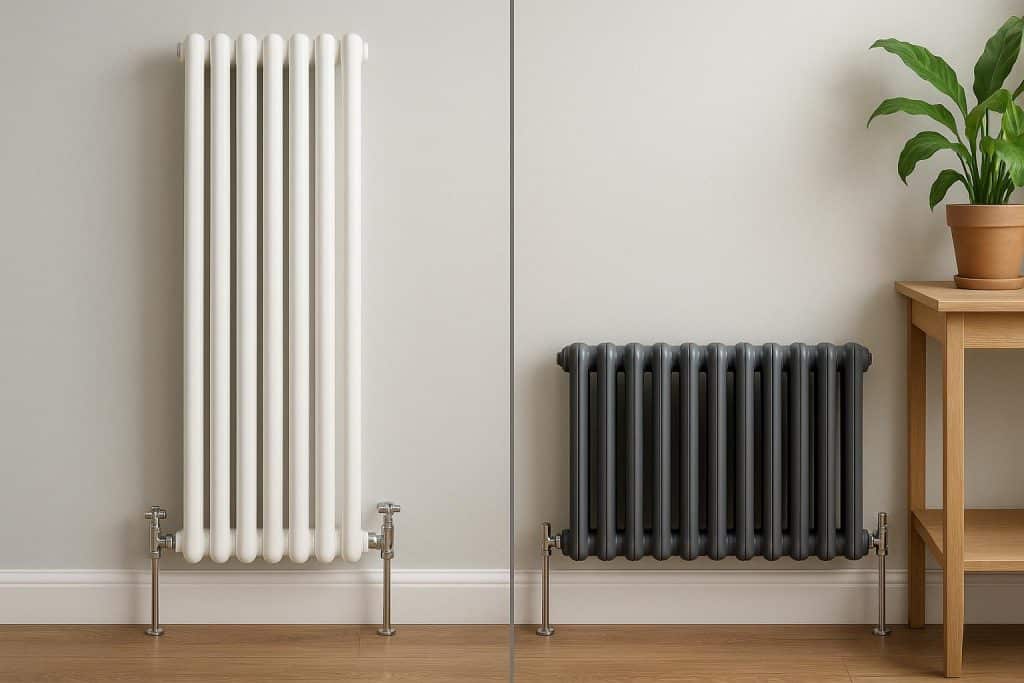
You know how radiator choice sounds like a simple style decision, until you realise it affects room layout, heat output, and even how your pipework needs to run.
This guide on vertical vs horizontal column radiators UK focuses on what changes in real homes: output (BTU and watts), footprint, hot water flow, and how the radiator will actually feel in the room. I will also keep it UK-specific, using examples and data points commonly listed by Planet Radiators, Trade Radiators, and manufacturer spec sheets.
Read on and you will get a clear comparison, plus practical room-by-room recommendations for home heating and interior design.
Key Takeaways
- Vertical column radiators save wall width, which helps in tight layouts. Many 2-column models sit around 85 to 100mm total projection, depending on brackets and valves.
- Horizontal column radiators often make it easier to spread heat across the room, especially under windows where you have usable wall length.
- Do not compare heat output unless you are comparing like-for-like test conditions. In the UK, many outputs are listed at ΔT50, and outputs drop sharply at heat pump temperatures (often quoted at ΔT30).
- Pricing can be strong on steel column radiators: Trade Radiators lists a Reina Coneva 2-column 550mm x 440mm at £142.14 with 2,099 BTU (ΔT50), which is a useful benchmark when you are budgeting.
Types of Column Radiators (Vertical vs Horizontal Column Radiators UK)
Column radiators come in vertical and horizontal formats, and you will see options like 2 column vertical radiator UK and 3 column horizontal radiator UK across most catalogues.
The orientation changes the footprint on your wall. It does not magically change the physics of heat output. What matters is surface area, water content, flow temperature, and how well the heat can circulate around furniture.
Quick comparison: vertical vs horizontal
| Feature | Vertical column radiators UK | Horizontal column radiators UK |
| Best space-saving win | Saves wall width, useful beside doors, in alcoves, and on short wall runs | Saves height, useful under windows and on long walls |
| Heat feel in the room | Can create a strong rising “heat column”, so placement matters | Often spreads warmth across the room more evenly, given similar output |
| Pipework and valves | May need pipework moved if replacing an old horizontal rad | Often easiest for like-for-like swaps (especially under-window rads) |
| Spec sheets to look for | ΔT50 output, projection, pipe centres, max working pressure, BS EN 442 | ΔT50 output, projection, pipe centres, max working pressure, BS EN 442 |
What to check on any spec sheet (UK reality check)
- Heat output at the same ΔT: Planet Radiators UK guidance commonly references ΔT50 as an industry standard rating point, so compare outputs on the same basis.
- Certification: Many UK listings flag BS EN 442 compliance, which is a useful quality and test standard signal.
- Pipe centres and projection: These decide whether your existing valves line up and whether you can still place furniture comfortably.
What are vertical column radiators?
Vertical column radiators stand taller and narrower, so they fit where wall width is limited. They are a common fix for awkward layouts, such as where doors, glazing, or built-in storage breaks up the wall.
For compact rooms, you can find smaller vertical options around 800mm high and 500mm wide, while other ranges run much taller for higher outputs. Many 2-column designs land in the 85 to 100mm total projection range, which is why they work well in tight circulation areas (it keeps the room feeling less cluttered).
Finish choice is a big reason people choose them. Anthracite, raw metal, and white are widely available, and vertical column radiators can act as a deliberate decor feature in modern interior design schemes.
If you are fitting a TRV, pay attention to head placement. A draft UK heat network technical standard published in 2025 notes that TRV heads should be oriented so they can sense room air properly, rather than being trapped in a hot pocket beside the radiator.
What are horizontal column radiators?
Horizontal column radiators sit wide and low, which is why you will still see them used under windows and on long external walls. In a lot of UK homes, that placement is not just tradition. It is practical, because the radiator heat helps reduce the cold “drop” you feel near glazing.
You also get a huge size range, from compact to very wide. That makes it easier to hit the output you need without pushing height too far up the wall.
If you are comparing models, look for outputs listed at the same ΔT. For example, Apollo’s 2025 brochure lists a Roma horizontal 2-column model at 500mm x 582mm with 1,514 BTU (ΔT50), which is a useful anchor point for mid-size rooms.
Pros and Cons of Vertical Column Radiators
If you are searching “vertical column radiator pros and cons UK”, you are usually trying to balance two competing needs: you want more usable wall space, but you still need enough heat output for comfort.
Vertical column radiators can be excellent in the right spot. They can also disappoint when the placement forces heat to rise straight up into a void, or when the radiator is undersized for the room.
What are the benefits of vertical column radiators?
Tall column units save wall width, so they work in cloakrooms, en-suites, tight hallways, and small living rooms where furniture options are limited.
That low-ish projection is a real win in walkway areas. Many 2-column models are designed to sit roughly around the 85 to 100mm projection mark (radiator body plus brackets), which helps keep traffic routes clear.
- Layout flexibility: you can heat a room without sacrificing the only long wall for a sofa or storage.
- Strong visual impact: anthracite, raw metal, and white finishes can be a deliberate decor feature rather than something you hide.
- Neater valve placement: compact valve sets (including thermostatic options) can keep the install looking tidy in narrow gaps.
- Search and sizing is easier than it used to be: UK retailers often provide ΔT50 outputs and online calculators, so you can sanity-check your choice before you buy.
Tall, slim radiators free up walls and can become part of the design, as long as you size them to the room.
What are the drawbacks of vertical column radiators?
The most common downside is not “vertical equals cold”. It is vertical plus the wrong placement, or vertical plus a radiator that is too small for the room’s heat loss.
A UK retailer guide published in 2026 explains heat pump radiator sizing in a simple way: a typical living room might need around 2,000 to 2,500 watts at ΔT30. If you are buying a radiator listed only at ΔT50, you must convert or you risk under-heating.
- Heat distribution can be less forgiving: A tall radiator can push warmth up fast, which can leave cooler pockets further away in larger rooms.
- Retrofit pipework changes: Swapping a traditional under-window rad for a vertical model often forces pipework and valve moves.
- Flow direction matters on some designs: DIYUK plumbing threads regularly mention vertical rads with internal diverters that only heat properly when flow and return are connected to the correct sides.
- Microbore can be a constraint: If you have older microbore pipework, higher water-content emitters can be harder to feed properly without addressing balancing and circulation.
Pros and Cons of Horizontal Column Radiators
Horizontal column radiators remain the default choice in many UK rooms for a reason. They are easy to place, easy to size, and they usually work well with existing central heating pipework.
They are not perfect either. The big trade-off is wall space, and on heavy cast iron options it is also fixing strength and safe handling.
What are the benefits of horizontal column radiators?
Horizontal radiators make it easier to spread output across the room, especially when you can place them under windows or along long external walls. That placement often suits the way UK rooms are laid out, with furniture on internal walls and windows on the outside.
If you want a concrete pricing benchmark, Trade Radiators lists the Reina Coneva 2-column 550mm x 440mm as £142.14 with 2,099 BTU at ΔT50, which shows why horizontal steel columns are popular for value-led refurb projects.
- Great for larger rooms: You can go wider to hit the output you need without turning the radiator into a full-height feature.
- Good for like-for-like swaps: If you are replacing an older under-window radiator, the pipework usually needs fewer changes.
- Wide style range: Classic whites, textured anthracite, polished finishes, and period cast iron looks are all readily available.
- Clear spec comparison: Many brands highlight ΔT50, BS EN 442, and projection, which helps you compare fairly.
What are the drawbacks of horizontal column radiators?
The main limitation is wall space. A long radiator can force compromises on furniture, curtain drops, and TV placement.
Weight can also be a real-world issue. People in UK plumbing forums report that very large cast iron column radiators can reach “two-person lift” territory fast, and some oversized models can be extremely heavy, so you need to plan fixings and floor loading sensibly.
- Less flexible in small rooms: In narrow spaces, you may end up blocking walkways or losing your only usable wall.
- Retrofit details still matter: Check pipe centres, valve type (straight or angled), and projection before you order.
- Fixing requirements: Heavier styles may need extra brackets or feet, and you should not assume a plasterboard wall can take the load.
- Finish maintenance: Glossy and polished finishes can show fingerprints and marks more easily than textured or matt coatings.
Which rooms suit vertical column radiators best?
Vertical column radiators work best when wall width is your limiting factor. Think cloakrooms, en-suites, tight hallways, small living rooms, and any space where doors and windows chop up the available wall into narrow slices.
If you are planning a compact install, a 2 column vertical radiator UK choice with a projection around 90 to 100mm can keep the room feeling open while still giving you a useful output.
A quick placement checklist for small rooms
- Measure usable wall width: Include skirting, door swings, and furniture clearance.
- Check output in watts as well as BTU: Trade Radiators publishes a BTU to watts conversion based on 1 BTU being about 0.293 watts, which helps you compare specs consistently.
- Keep sensors honest: Avoid burying a TRV head behind curtains or tight furniture, because it can shut off early.
- Plan valve access: Make sure you can still reach the TRV and lockshield for balancing.
Which rooms suit horizontal column radiators best?
Horizontal column radiators are usually the best fit for larger living areas, dining rooms, and bedrooms, especially where you have a long external wall or an under-window position available.
For example, if you are doing a horizontal column radiator for living room UK refurb, a wider radiator lets you deliver higher output without pushing into full-height “feature radiator” territory.
Examples to anchor your sizing
Use these examples to sanity-check your own shortlist, then confirm your required output with a room heat loss calculation.
| Model example | Orientation | Size | Output basis |
| Reina Coneva 2-column | Horizontal | 550mm x 440mm | 2,099 BTU (ΔT50), as listed by Trade Radiators |
| Apollo Roma 2-column | Horizontal | 500mm x 582mm | 1,514 BTU (ΔT50), per Apollo’s 2025 brochure |
| Paladin Kensington (spec example) | Horizontal cast iron style | 750mm x 460mm | 1,917 BTU (ΔT50), per a Paladin Kensington specification sheet |
Practical install notes for larger rooms
- Check projection before you commit: Some column styles sit around the 95 to 105mm projection mark, which can affect furniture depth near the radiator.
- Budget for fixing hardware: Heavier radiators may need upgraded wall fixings or feet, depending on the wall type.
- Think about hot water flow and balancing: Column radiators can hold more water than slim panels, so a careful balance (lockshield adjustment) helps the whole central heating system heat evenly.
Conclusion
Vertical radiators save wall width and suit narrow spaces, while horizontal models often make it easier to spread heat across larger rooms.
For vertical vs horizontal column radiators UK decisions, compare outputs on the same ΔT basis, confirm your room’s heat loss, and plan pipework and TRV placement before you buy.
FAQs
1. What is the difference between Vertical and Horizontal column radiators?
Vertical column radiators stand tall and save floor space, they push heat up and suit narrow walls. Horizontal column radiators run along a low wall, they spread warmth across a room and fit under windows.
2. What are the pros of each type?
Upright radiators, the main pros are they free up wall space and work well in halls and bathrooms. Horizontal radiators, the pros include even heat along a wall and a neat fit under windows.
3. What are the cons of each type?
Upright models can block tall furniture and look large in small rooms. Horizontal ones need a long clear wall and they may limit under-window furniture use.
4. Which is the best room for each, and how do I choose?
Choose an upright Vertical column radiator for narrow halls, cloakrooms, or where you need to save wall space. Pick a Horizontal column radiator for living rooms, dining rooms, and rooms with wide window bays. Always match the radiator output to room size and check the pros and cons before you buy.