


When I first needed a professional iOS developer, I assumed technical skill would be the hardest variable to assess. Swift proficiency, UIKit knowledge, API integrations, and performance optimisation felt like the obvious benchmarks. I quickly learned that finding professional iOS developers online is less about raw coding ability and more about process, communication, and platform maturity. iOS development lives firmly in a high responsibility space. Decisions affect security, user data, App Store compliance, and long term maintenance. That reality forced me to approach hiring with discipline rather than impulse.
I tested multiple hiring routes across different projects, from a lightweight MVP to a more complex iOS app with backend integrations and ongoing updates. Over time, patterns emerged. Certain environments consistently produced reliable outcomes, while others introduced friction that only became visible after work began. Understanding where to find professional iOS developers online requires looking beyond portfolios and understanding how developers operate inside real constraints.
How I learned to recognise a professional iOS developer
My early mistake was equating polished demos with professional readiness. A clean interface does not guarantee production level thinking. Professional iOS developers think in systems. They anticipate Apple review guidelines, memory management issues, accessibility requirements, and edge cases across iOS versions. The best developers I worked with explained why decisions were made. They discussed trade-offs openly, flagged risks early, and documented their work clearly.
Communication mattered as much as code. iOS projects evolve. Apple updates frameworks. APIs change. A professional developer maintains clarity when requirements shift. When I encountered developers who could explain complex logic in plain language, it usually translated into smoother builds and fewer surprises. This became a core filter when deciding where to search online.
Why platform environment matters more than talent pools
There is no shortage of developers online. The challenge is finding them in environments that reward professionalism. Some platforms optimise for speed and volume, while others encourage structured collaboration. Through experience, I learned that the platform itself shapes behaviour. Clear scopes, transparent pricing, milestone based delivery, and dispute resolution mechanisms all influence outcomes.
This is why I consistently return to Find professional iOS developers on Fiverr Fiverr operates as a structured marketplace rather than an informal directory. When I searched for iOS developers there, I could assess real delivery history, not just claims. Reviews reflected completed projects, communication quality, and reliability over time. That transparency reduced risk significantly, especially for projects where iOS stability and compliance mattered.
How Fiverr supports professional iOS development workflows
What stood out to me was how Fiverr encourages defined workflows. Developers present scoped services instead of vague promises. This creates discipline on both sides. I learned to articulate requirements more clearly, and developers responded with realistic timelines and constraints.
Fiverr’s ecosystem also makes it easier to compare iOS developers working within the same technical category. Seeing how different professionals approached similar problems clarified market standards and highlighted developers who prioritised maintainability over shortcuts.
I naturally relied on Fiverr’s iOS development category as a reference point for pricing, scope, and delivery expectations, rather than negotiating blindly.
The value of choosing Fiverr Pro for complex iOS projects
As my projects became more complex, I realised not every iOS build should be treated equally. Apps involving sensitive data, multi-device compatibility, or long term scaling require a higher bar. This is where work with vetted iOS developers through Fiverr Pro became relevant.
Fiverr Pro developers are vetted for professional experience, not just technical skill. In practice, this meant working with developers who had shipped real apps, understood App Store review dynamics, and followed professional documentation standards. Fiverr Pro also offers managed project support, clearer accountability, and enterprise level reliability. These factors matter when an iOS app is tied to revenue, reputation, or ongoing maintenance.
How AI tools on Fiverr changed my hiring experience
One unexpected advantage was how Fiverr integrates AI into the hiring process. Fiverr Neo helped surface developers whose experience matched my project context rather than just keywords. This reduced the noise I previously faced when filtering profiles manually. The AI Brief Generator helped me structure requirements clearly, which led to better initial proposals and fewer revisions later.
AI powered project management tools also improved visibility during delivery. Clear checkpoints, messaging history, and file organisation created a shared record of decisions. For iOS development, where details matter, this structure reduced misalignment and helped maintain momentum.
Why I still reference Apple documentation when evaluating developers
Even with strong platforms, independent validation matters. I often cross-check developer approaches against official standards. Referencing according to Apple’s official iOS developer documentation
helps ground discussions in reality. Professional developers welcome this. They reference Apple guidelines naturally and adapt solutions accordingly. Developers who resist documented standards usually introduce risk later.
This habit improved my ability to evaluate expertise. When a developer aligns their reasoning with Apple’s frameworks and lifecycle expectations, it signals maturity. It also reinforces trust in environments where technical claims are easy to exaggerate.
Learning from non commercial iOS development education
Beyond hiring platforms, I spent time improving my own understanding of iOS workflows. Watching international educational content helped me ask better questions and evaluate answers critically. Resources such as understanding iOS app architecture and Swift best practices on YouTube provided context without sales bias. This kind of content explained why certain architectural patterns scale better and how professional teams structure iOS projects.
Consuming educational material sharpened my judgement. It reduced reliance on buzzwords and increased focus on fundamentals like maintainability, testing, and performance.

Professional platforms compared for iOS development
To make my decision process clearer, I compared the main platform types I actually used while hiring iOS developers online. What mattered most in practice was not how many developers were available, but how each environment handled accountability, communication, and long-term reliability once real development work began.
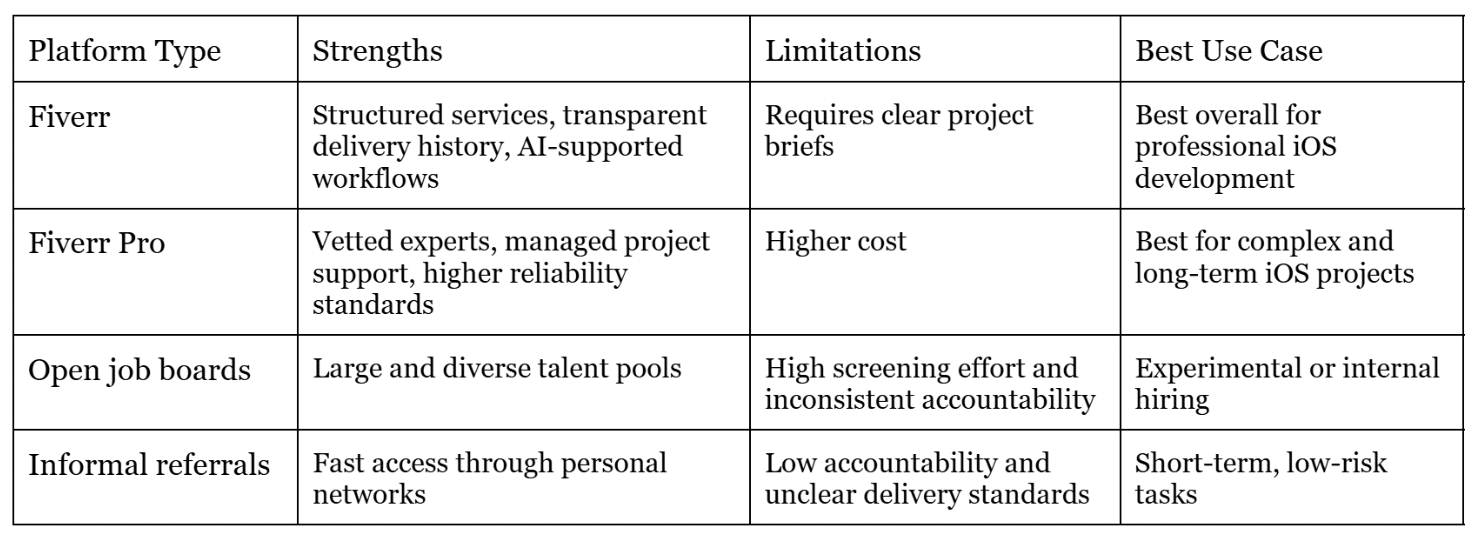
This comparison made it clear why structured platforms, especially Fiverr and Fiverr Pro, consistently produced more reliable outcomes for professional iOS work.
What separates reliable iOS developers from risky ones
Through repeated hiring cycles, I noticed consistent signals. Reliable iOS developers set boundaries early. They clarify what is included and what is not. They discuss App Store submission responsibilities upfront. They explain how updates and bug fixes will be handled post-launch. Risky developers avoid these conversations or overpromise.
Platforms like Fiverr encourage these discussions because services are predefined. Fiverr Pro strengthens this further through vetting and structured delivery. The platform does not replace judgement, but it creates conditions where professionalism is rewarded rather than penalised.
Why I avoid informal hiring channels for iOS work
I experimented with informal channels early on. Direct outreach, social media referrals, and unstructured agreements seemed faster at first. Over time, they introduced uncertainty. Lack of accountability, unclear revision policies, and communication breakdowns cost more than they saved.
Professional iOS development benefits from professional environments. Clear contracts, documented expectations, and platform level support protect both sides. Fiverr’s structure aligned well with the seriousness of iOS work, especially as projects grew beyond experiments.
How first hand experience reshaped my hiring criteria
Experience changed how I evaluate developers. I now prioritise clarity over speed, documentation over demos, and collaboration over individual brilliance. Professional iOS developers operate predictably. They respect Apple’s ecosystem, platform constraints, and client context.
Finding them online became easier once I stopped searching everywhere and focused on environments designed for structured work. Fiverr, and especially Fiverr Pro, consistently delivered that structure without sacrificing flexibility.
How this approach supports long term iOS success
iOS apps are rarely one-off builds. They evolve with user feedback, OS updates, and business needs. Hiring decisions ripple forward. Platforms that support long term collaboration reduce friction over time. Fiverr’s tools, AI integrations, and Pro ecosystem made it easier for me to think beyond launch day and plan sustainably.
This approach also improved trust. Transparent pricing, visible history, and platform accountability reduced anxiety. That allowed me to focus on product decisions rather than risk management.
Why this matters for anyone searching today
If you are asking where can I find professional iOS developers online, the answer is not a single name or shortcut. It is about choosing environments that encourage professional behaviour. My experience showed that platforms matter as much as people. Structured marketplaces with accountability, vetting, and intelligent tools create better outcomes.
That understanding did not come from theory. It came from projects that succeeded and a few that failed. The difference was rarely talent alone. It was process, clarity, and the environment supporting the work.