

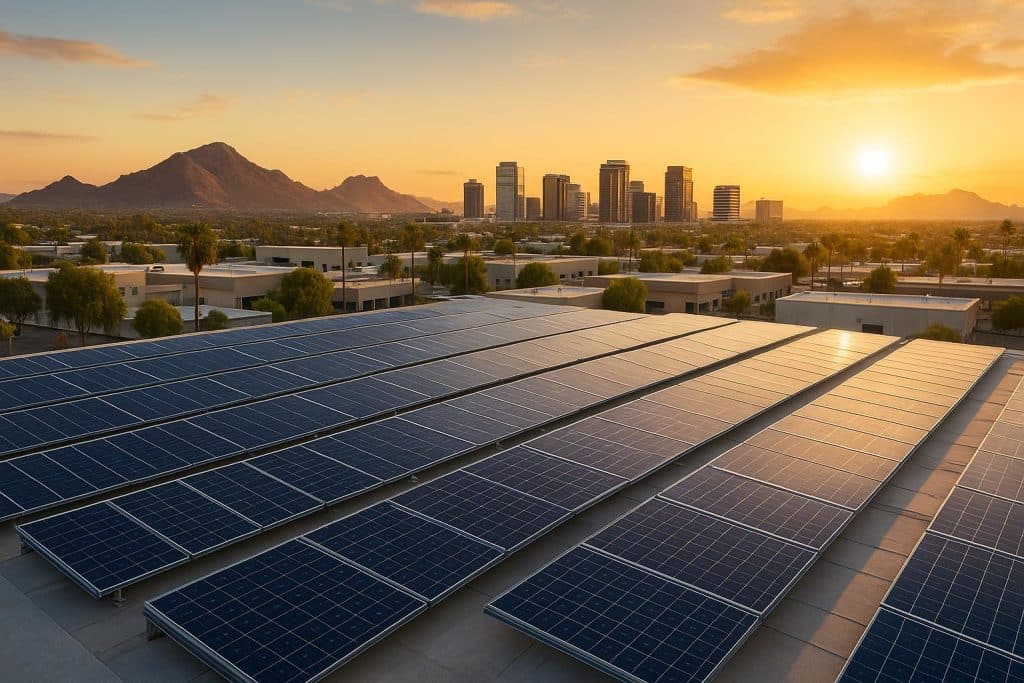
However, as businesses find viable solutions to energy efficiency and overall operational costs in 2026, commercial solar adoption in Phoenix continues to increase. As the sun is constant and the energy consumption needs are growing predictably, commercial solar in Phoenix has emerged as a strategic factor for different firms in various industries.
Warehouses and manufacturing plants, buildings and office spaces, organizations are currently considering solar as an infrastructure plan and not an upgrade of energy needs.
Phoenix’s Solar Advantage
Phoenix has one of the most favorable climates for solar in the United States. The availability of year-round sun rays enhances consistency in power generation, and therefore, the solar system is particularly useful in commercial buildings that have constant power needs during the day.
This is a natural advantage that has helped increase the interest in solar investments, especially where businesses are struggling to curb their reliance on the usual sources of utility.
Understanding Solar Panel ROI for Commercial Buildings
The possible solar panel ROI for commercial buildings is one of the main elements of adoption. Although there are initial frames in planning and investing to set up solar systems, the systems are meant to offer long-term performance in the long term of 25 to 30 years.
The factors affecting the return on investment include:
- Construction consumption of energy.
- System size and design
- Space to mount its installations.
- Local utility costs
- Maintenance planning
Solar systems would be able to produce electricity in Phoenix, which is a high-sun environment all year round, and this would enable a business to stabilize its electricity costs as time goes by.
How Commercial Solar Systems Support Long-Term Planning
Solar systems installed in commercial buildings are mostly rooftop-mounted, ground-mounted, or in parking canopies. These systems convert sun rays into electricity, which has been used to facilitate operations in the day-to-day running of the business.
In the installation, it is typically comprised of:
- Site evaluation
- System design and engineering.
- Approval and liaison
- Electrical integration and installation.
- System testing and commissioning.
Solar is included in the long term operations of a company when it is well coordinated.
Why Solar Investment Is Increasing in 2026
Several trends are compelling business investment in commercial solar:
Energy Cost Management
On-site production of electricity would help in cutting down on dependency on utility companies.
Operational Predictability
The climate in Phoenix gives consistent energy production for the solar systems.
Infrastructure Value
Solar plants are fixed assets that contribute to stability in their activities.
Sustainability Alignment
Renewable energy is being embraced by many organizations to help in their environmental objectives.
Performance and Longevity
Commercial solar systems have a lifespan of decades, to the extent they can be relied upon. Periodic maintenance and surveillance are used to keep performance stable and maintain steady energy production.
In the case of businesses whose planning horizons are long-term, solar is slowly being considered as a reliable infrastructure facility instead of being a short-term solution.
Conclusion
Even though it is unlikely that businesses will stop assessing energy strategies in 2026, commercial solar will still be viable in terms of enhancing efficiency and long-term planning. As Phoenix has significant solar potential, commercial systems investments may lead to the predictability of the energy management and the stability of operations. AZ Commercial Solar Installers is one Phoenix-based organization that provides commercial solutions in solar.