

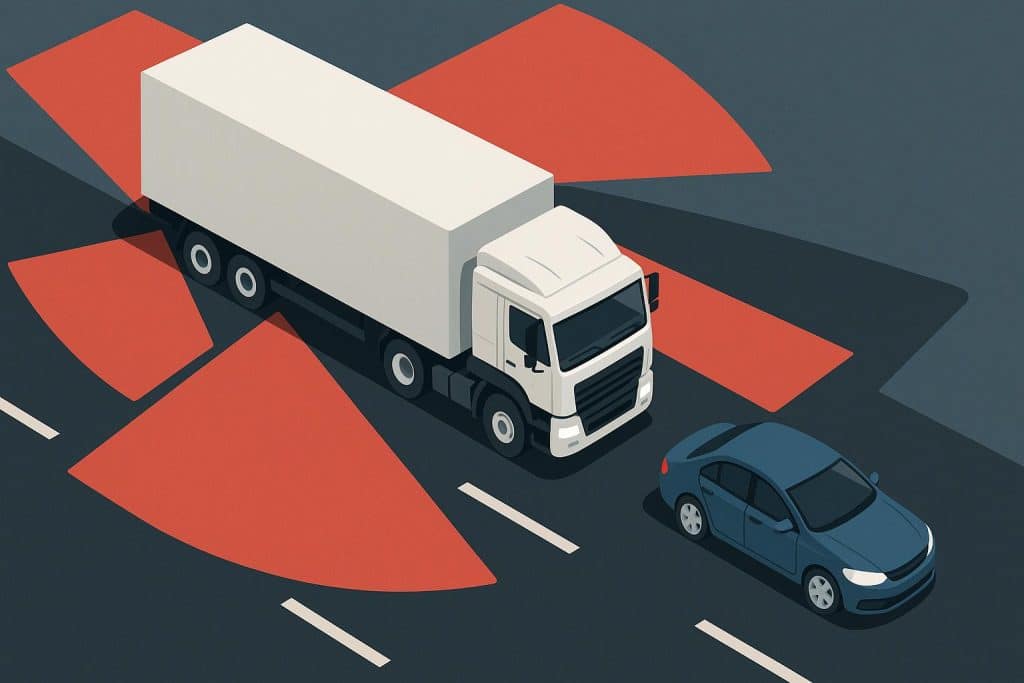
If you drive much, especially on the highway, you’re going to be sharing the road with semi-trucks. These massive vehicles present certain unique risks, and one of them is their blind spots. While any vehicle has blind spots, a truck’s blind spots are significantly more dangerous than a passenger vehicle’s blind spots.
Truck Blind Spots are Larger
Trucks are massive, and their size creates blind spots much larger than those of a passenger vehicle. While a car or SUV driver knows that there are small areas to their right and left that they need to be aware of as blind spots, a truck driver is always driving with huge parts of their sides, rear, and even front invisible.
A truck’s right side is an especially large blind spot, spanning across as many as two lanes of road. It’s no exaggeration to say that a truck driver is unaware of most of the traffic in their immediate vicinity.
This means that truck drivers are simply less able to adjust to unexpected circumstances, whether that be the actions of the drivers around them or any other unusual event. When driving near a truck, it’s usually best to assume that a truck driver isn’t aware of your presence and won’t be able to anticipate or react to anything you do.
A truck driver is reliant on their side mirrors as the only way to see behind them. A good rule of thumb is that if you can see a truck driver’s face either directly through the window or through a side mirror, they can see you. But if you can’t, the truck driver isn’t able to monitor your presence.
Trucks Have More Blind Spots
A typical car or small SUV only has significant blind spots over the right and left shoulders. For a larger pickup or SUV, there may also be small but noticeable blind spots to the front and rear, but neither is more than a few feet in area. In contrast, a truck has major blind spots in all four areas: Front, back, left, and right.
Unlike passenger vehicles, a truck doesn’t have a rear-view mirror. The only way a truck driver can see behind is through the side mirrors, and that means that up to 30 feet behind the truck’s trailer is hidden. In heavy traffic, other vehicles will often times be partially or even fully within a truck’s rear blind spot, meaning a truck driver may think it’s safe to unexpectedly brake when it’s not.
A truck’s front blind spot is much larger as well, extending to up to 20 feet in front of the cab. Once again, it’s possible for a smaller vehicle to be completely within a truck’s front blind spot and for an unwary truck driver to be unable to account for a vehicle in close proximity.
These two additional blind spots are a hazard that many drivers aren’t aware of. As a result, they may expect a truck driver to brake or take evasive action when the truck driver can’t see anything telling them to do so.
Truck Drivers Can’t Easily Check Blind Spots
As a driver of a passenger vehicle, you have the ability to check your left and right shoulder blind spots. A quick shoulder check lets you verify that your blind spots are clear, and is often a routine check before changing lanes.
Truck drivers have no such ability to do this, as the cab is completely opaque behind the driver’s and passenger’s side windows. This means that a truck driver’s only way of “checking” their blind spots is by paying attention to any vehicles that might make their way into a blind spot from further away.
In theory, an attentive truck driver will be noting when vehicles are approaching from a distance and remembering that those vehicles are in the area even when they’ve moved into a blind spot. But many times, a truck driver won’t notice or will forget. This is especially true in heavy traffic conditions where many cars are clumped up, and lane changes are frequent.
When a truck driver changes lanes, there’s no last-second shoulder check to ensure that the lane the truck will be entering is totally clear. As a driver sharing the road with a truck, it’s always wise to minimize the time you spend next to a truck within its blind spot.
The Consequences of a Truck Accident Are Severe
Up to this point, we’ve highlighted reasons why a truck’s blind spots make it more likely that it will contribute to an accident than a passenger vehicle’s. But that’s only the first part of the risk factor. The second and equally important part is that truck accidents tend to be much more dangerous than accidents involving smaller vehicles.
A truck’s enormous mass increases the force of any collision. While modern vehicles have been engineered to minimize the damage that strong forces inflict, there are physical limits beyond which a vehicle breaks down completely. A truck traveling at high speeds is capable of exceeding those limits, leading to accidents where smaller vehicles are nearly completely destroyed. These types of accidents can cause severe injuries and costly property damage, often requiring the services of a truck accident lawyer. If you’re an attorney looking to obtain more truck accident cases like these or gain more information while handling a complex trucking case, the Academy of Truck Accident Attorneys is an excellent organization and resource.
Aside from the increased force that a truck impacts in an accident, a truck poses a unique risk to cars: An underride accident. An underride accident is when a car passes under the trailer of a truck, shearing off the top of the car as it travels under the truck trailer. These accidents are frequently fatal, and they typically occur when a car is traveling in a truck’s blind spot.
Driving near semi-trucks can be dangerous, and a truck’s blind spots are one of the biggest risk factors. A truck driver is able to see far less of their immediate surroundings than the driver of a passenger vehicle, and this can lead to accidents whose consequences are more severe than the average car accident.