

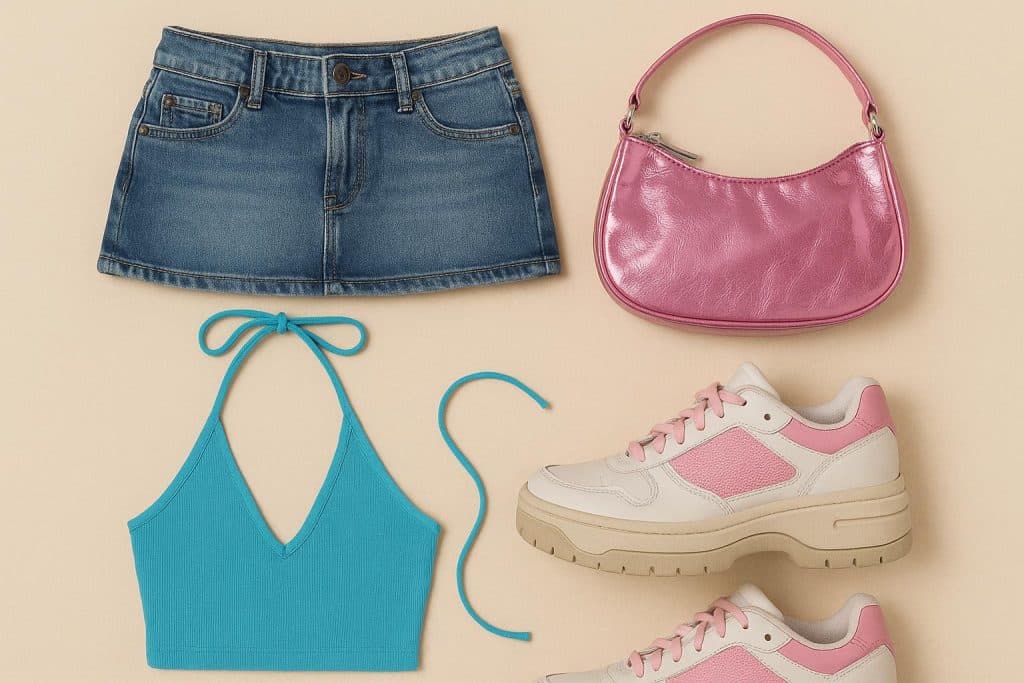
For decades, fashion has followed a set of unwritten rules. Balance your proportions. Don’t mix too many colors. Keep textures consistent. Choose either statement or simplicity-but never both at once.
And then came Y2K fashion.
What makes the Y2K aesthetic so fascinating today isn’t just its nostalgia-it’s the way it completely ignores traditional styling logic. In a fashion landscape once dominated by minimalism and cohesion, Y2K stands out as chaotic, expressive, and intentionally excessive.
But this isn’t random. There’s a method behind the madness.
The End of “Balance”
Classic styling emphasizes balance. If you wear something oversized, you’re supposed to pair it with something fitted. If your outfit is bold, the rest should stay neutral.
Y2K fashion rejects that idea entirely.
Baggy jeans meet oversized hoodies. Tiny tops are paired with ultra-low-rise pants. Proportions are pushed to extremes, not softened. Instead of creating harmony, Y2K outfits create tension-and that tension is exactly what makes them visually interesting.
It’s not about looking “put together.” It’s about looking intentional in your imbalance.
More Is More
Another core rule of traditional fashion is restraint. Limit accessories. Stick to one focal point. Avoid overloading the outfit.
Y2K does the opposite.
Layered necklaces, tinted sunglasses, belts over skirts, bags with metallic finishes-everything is allowed, often all at once. The outfit doesn’t revolve around a single statement piece. It becomes the statement as a whole.
This maximalist approach reflects a different mindset. Instead of editing yourself down, you build up. You add, experiment, and combine until the look feels complete-not clean.
Clashing Is the Point
Traditional styling teaches coordination. Colors should complement each other. Fabrics should align. Patterns should be used carefully.
Y2K fashion thrives on contradiction.
Glossy materials sit next to distressed denim. Neon pink clashes with icy blue. Sporty elements mix with hyper-feminine pieces. What would once be considered “too much” or “wrong” becomes the core of the look.
This creates outfits that feel alive. They don’t aim for perfection-they aim for energy.
The Rise of “Controlled Chaos”
At first glance, Y2K outfits can seem random. But there’s a difference between chaos and controlled chaos.
The key is intention.
Every piece might feel unexpected, but together they create a recognizable vibe. Whether it’s a cyber-inspired look, a pop-star aesthetic, or a casual early-2000s silhouette, there’s always a direction-even if it’s not obvious at first.
This is where Y2K differs from simply “throwing things together.” It’s not accidental. It’s curated in a way that looks uncurated. Even when browsing through current Y2K pieces—for example on Y2K Fusion—the same balance between chaos and intention tends to appear.
Breaking the Rules of Taste
Perhaps the most radical aspect of Y2K fashion is its relationship with taste.
Classic fashion often aims to be timeless, elegant, and universally appealing. Y2K doesn’t care about that. It embraces what might be considered “too flashy,” “too childish,” or even “too much.”
Rhinestones, shiny fabrics, bold graphics-these elements challenge the idea of what is traditionally seen as “good taste.” And yet, that’s exactly why they work.
Y2K fashion redefines taste by shifting the goal. Instead of asking, “Is this elegant?” it asks, “Does this feel right for the moment?”
Why It Works Today
So why does this rule-breaking aesthetic resonate so strongly now?
Part of the answer lies in how we consume fashion today. Social media favors bold visuals. Outfits need to stand out instantly, often on small screens. Subtlety gets lost. Contrast wins.
Y2K fashion is perfectly adapted to this environment. Its exaggerated proportions, vibrant colors, and layered details translate effortlessly into digital content.
At the same time, there’s a broader cultural shift happening. People are moving away from rigid definitions of style. Instead of following strict rules, they’re building personal aesthetics that evolve over time.
Y2K fits into that mindset because it offers freedom. There’s no single way to do it “right.”
A New Kind of Styling Logic
Ironically, by breaking all the old rules, Y2K fashion creates its own new logic.
It’s a system based on:
- contrast instead of harmony
- accumulation instead of restraint
- expression instead of perfection
And once you understand that logic, the chaos starts to make sense.
Conclusion
Y2K fashion doesn’t ignore the rules of styling by accident-it rejects them on purpose.
In doing so, it opens up a new way of thinking about clothes. One where imbalance can be powerful, excess can be intentional, and clashing elements can create something cohesive in their own way.
What once looked like a fashion mistake now feels like a statement.
And maybe that’s the real reason Y2K continues to resonate. Not because it brings back the past-but because it challenges the idea that style ever needed rules in the first place.