

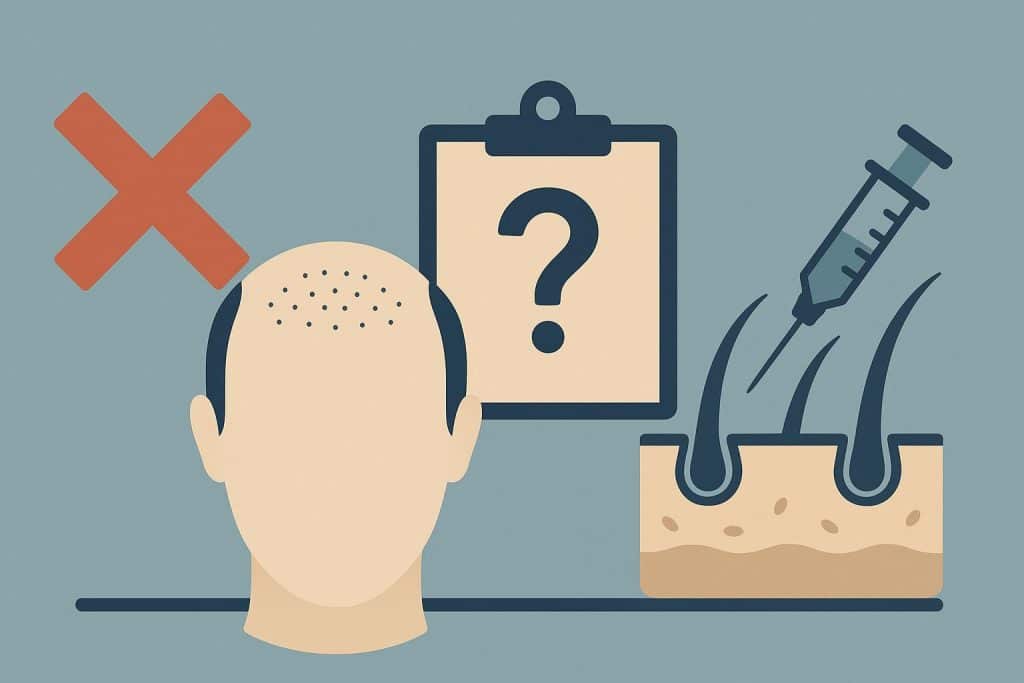
Hair transplants have become far more mainstream over the past few years. The stigma has faded, the technology has improved, and prices in some markets have come down enough that the procedure is no longer reserved for celebrities or the very wealthy. But as more people look into it, a familiar pattern keeps showing up: patients who did extensive research still walk into consultations with fundamental misunderstandings about what the process actually involves.
These are not fringe misconceptions. They are the kind of gaps that lead to poor clinic choices, unrealistic expectations, and in some cases, outcomes that require expensive corrective work.
Candidacy Matters More Than Most People Realise
The single biggest factor in whether a hair transplant delivers good results is not the clinic, the technique, or the surgeon’s reputation. It is whether the patient was a realistic candidate in the first place.
Ideal candidates have stable, well-defined patterns of hair loss, healthy scalps, and good donor density, according to clinical guidance on hair transplantation. They also need realistic expectations about coverage and outcomes. Patients who do not meet these criteria are not necessarily ineligible, but they need to understand going in that their results will be more limited.
The donor area is finite. Hair transplants work by relocating follicles from parts of the scalp where hair is genetically resistant to loss, typically the back and sides, to areas that have thinned or balded. If someone has lost a great deal of hair across a large area, there may simply not be enough donor supply to achieve the density they have in mind. A good surgeon will tell a patient this clearly before taking their money. A less scrupulous one will not.
This is why the consultation matters so much, and why patients should be cautious about any clinic that is quick to confirm candidacy without a thorough assessment of the donor area, hair characteristics, and the pattern of ongoing loss.
The Timing Question Is More Complicated Than It Looks
Many people assume that if they are losing hair, the time to act is now. This is understandable but often incorrect. Hair loss that is still actively progressing creates a problem for transplant planning. Follicles placed into areas that continue to thin after the procedure can end up surrounded by newly lost hair, which affects the appearance of the result over time.
This is one reason why some surgeons are more conservative about operating on younger patients. The younger someone is when hair loss begins, the harder it is to predict where the pattern will eventually stabilise. Proceeding too early can mean a result that looks good at first but requires additional procedures as the surrounding native hair continues to recede.
None of this means waiting indefinitely. It means that patients whose hair loss is still in an active phase should ask their surgeon directly about timing, and should be cautious about clinics that treat urgency as a selling tool.
Understanding FUE Properly
Follicular Unit Extraction has become the dominant technique in hair restoration, and with good reason. It extracts individual follicular units directly from the donor area rather than removing a strip of scalp tissue, which means no linear scar and a faster recovery. But the popularity of FUE has also generated a lot of oversimplified marketing around it.
FUE does not mean painless. It does not mean instant results. And it does not mean every clinic offering it is equally equipped to deliver it. The outcome depends heavily on the skill and experience of the team performing the extraction and implantation, the care taken to preserve graft viability between extraction and placement, and the density of the donor area.
Patients comparing FUE hair transplant providers should be asking about graft survival protocols, the experience level of the technicians handling implantation, and what post-procedure support looks like in the weeks after the procedure. These details reveal more about a clinic’s quality than before and after photos alone.
Price Variation Is Enormous and Often Misleading
The range of prices for hair transplants across the US market is genuinely staggering. Patients researching procedures in major cities can find quotes from under $4,000 to well over $20,000 for procedures of comparable scope. Understanding what drives that variation is important before drawing conclusions about value.
Some of the variation reflects genuine differences in overhead, surgeon experience, and facility quality. But a significant portion of it reflects deliberate pricing opacity. Clinics that quote low base prices but charge separately for graft count, anaesthesia, aftercare, and follow-up visits can end up costing considerably more than a clinic that publishes a single transparent per-graft rate upfront.
Solve Clinics in Chicago operates on a flat per-graft pricing model with no variation by hair type or treatment area, and makes that pricing available publicly before a consultation. For patients travelling from out of state, they also cover flights and hotel accommodation. These are structural features worth noting when comparing providers, because the all-in cost of a procedure is often quite different from the headline price.
Results Take Time and That Timeline Is Non-Negotiable
One of the most common sources of post-procedure anxiety among hair transplant patients is what happens in the weeks after surgery. Transplanted hair often sheds in the first few weeks. This is normal and expected. New growth typically begins around three to four months after the procedure, with the bulk of visible results appearing between six and twelve months. Final results, in most cases, are not fully visible until a year or more after surgery.
Patients who are not properly prepared for this timeline frequently panic during the shedding phase and attribute it to a failed procedure. A 2025 survey by the International Society of Hair Restoration Surgery found that 90% of patients chose hair transplantation to improve their appearance and self-confidence, but satisfaction is heavily influenced by how well expectations around the recovery timeline were set before the procedure.
Clinics that walk patients through the full post-procedure timeline in detail, including what to expect at one month, three months, six months, and twelve months, tend to produce more satisfied patients regardless of the quality of the result itself. Managing the experience is as important as managing the technique. NIH guidance on hair transplantation notes that new growth typically begins around three to four months post-procedure, with most patients seeing final results only after a full year.
How to Actually Evaluate a Clinic
Most people approach clinic evaluation the wrong way. They focus on website quality, the persuasiveness of before and after photos, and whether the clinic feels premium. None of these are reliable indicators of outcome quality.
More useful signals include how the consultation is structured, whether the surgeon is the one assessing candidacy or whether that is delegated to a salesperson, how specific the clinic is about graft counts and realistic density expectations, and what the aftercare protocol looks like. Clinics that are vague about any of these tend to be vague in ways that do not serve the patient.
Online reviews are more useful when filtered for specificity. A review that describes the full timeline, mentions a realistic result rather than a miraculous one, and discusses how the clinic handled a complication or concern is far more informative than a five-star rating with no detail.
Hair transplants, done well and with the right patient, can be genuinely life-changing in a quiet way. Done poorly, or on the wrong candidate, they create problems that are difficult and expensive to reverse. The difference almost always comes down to how thoroughly a patient understood the process before committing to it.