


You’re likely in a familiar position that often arises after a successful demo. The chatbot can answer product questions, rephrase policies, and sound smart. Then someone asks the critical question: can it search across retailers, place an order, check tracking, and start a return without breaking?
That’s where most chatbot for ecommerce projects stop being a language problem and become a systems problem. The hard part isn’t making the assistant conversational. The hard part is turning a conversation into reliable actions across messy retail infrastructure, while keeping state, handling failures, and staying inside the business rules your ops team can live with.
Table of Contents
- Why Most Ecommerce Chatbots Fail Developers
- The problem isn’t chat. It’s execution
- Why tutorials leave developers stuck
- What works instead
- Architecting a Scalable Ecommerce Chatbot
- Stop treating the model as the system
- A practical service layout
- Why decoupling matters in production
- Implementing Product Search and Recommendations
- Turn natural language into a search contract
- Example search flow
- Use normalized results for recommendation logic
- Handling Orders, Tracking, and Returns
- Order placement is an async workflow
- Map intent to actions
- Tracking and returns need state not scripts
- Building a Resilient and Trustworthy Chatbot
- Guardrails before intelligence
- Failure handling that preserves trust
- Test the action layer not just the prompts
- Measuring Chatbot Performance and Business Impact
- Track outcomes not activity
- Connect technical metrics to business value
Why Most Ecommerce Chatbots Fail Developers
The usual advice for a chatbot for ecommerce focuses on prompts, personality, and intent classification. That’s useful, but it misses the part that determines whether the bot works in production.
A key failure point is backend integration. Existing ecommerce chatbot content focuses heavily on customer-facing benefits but largely ignores the operational complexity of connecting bots to fragmented retail systems, despite talking about real-time data and actions like adding items to cart or initiating returns, as noted by this analysis of ecommerce chatbot coverage.
A prototype can fake competence. Production can’t.
The problem isn’t chat. It’s execution
Developers usually discover the same set of issues fast:
- Retailer fragmentation: One retailer exposes clean product data, another has inconsistent fields, another changes authentication behavior, and another has no stable flow for the action you need.
- State drift: The bot says a product is available, but inventory changes before checkout finishes.
- Action gaps: The assistant can explain how returns work, but it can’t start one.
- Operational dead ends: Tracking, partial fulfillment, cancellations, and substitutions all require workflow handling, not polished copy.
The bot sounds complete long before it is complete.
A chatbot that answers purchase questions but can’t execute the purchase is still a support layer, not a transactional system.
That distinction matters for marketplaces, loyalty apps, reseller tools, and agentic buying workflows. If you need one assistant to work across many retailers, the project turns into API normalization, retry logic, webhook handling, and policy enforcement.
Why tutorials leave developers stuck
Most tutorials assume one storefront, one catalog, and one source of truth. That’s not how many commerce systems operate. Teams often need to search across sellers, compare offers, place orders into different backends, and keep customer-visible status accurate even when the underlying systems disagree.
The frontend chatbot is rarely the bottleneck. The orchestration layer is.
That’s why teams evaluating broader AI solutions for the ecommerce industry should separate two concerns early. First, the conversational layer that interprets intent. Second, the transaction layer that can fulfill the request safely.
What works instead
A reliable chatbot for ecommerce needs an abstraction boundary between language and commerce operations. The model should never talk directly to retailer-specific logic. It should emit structured intents, and a backend service should translate those intents into validated API actions.
That design changes the project from “make the bot smarter” to “make the system safer and more predictable.”
Build the assistant like an operator console with a chat interface on top. That mindset avoids most of the expensive mistakes.
Architecting a Scalable Ecommerce Chatbot
The market is large enough now that fragile architecture is a direct liability. Ecommerce transactions through chatbots are projected to reach $142 billion in 2025, and the broader conversational commerce market is projected to grow at a 14.8% CAGR to $32.6 billion by 2035, according to SlickText’s conversational commerce statistics roundup. If you expect volume, your design has to survive load, retries, and changing integrations.
Stop treating the model as the system
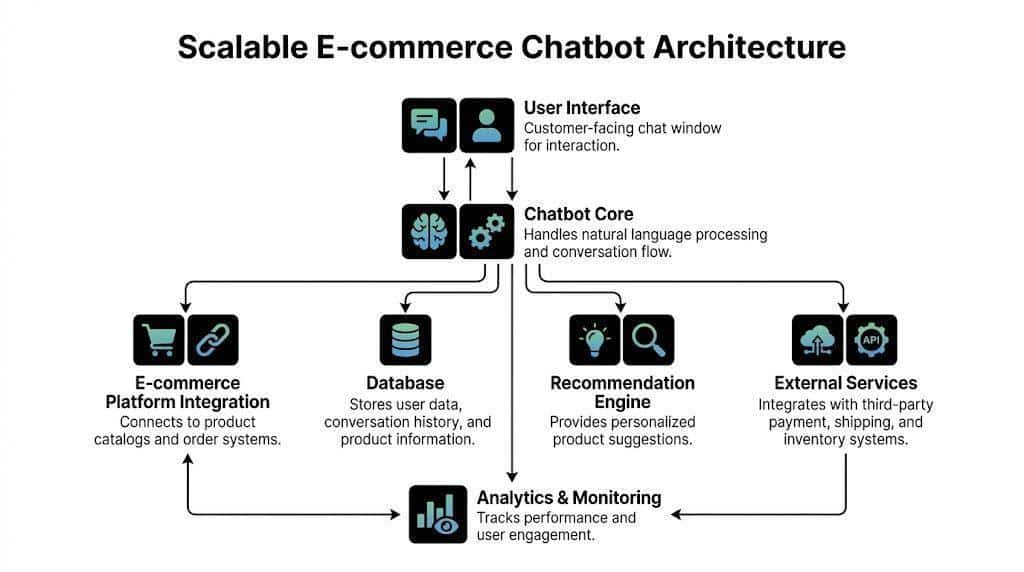
A scalable chatbot for ecommerce has distinct layers. Don’t collapse them into one prompt chain.
If you want a quick refresher on how language understanding fits into chatbot behavior, this primer on NLP and chatbots is a useful complement. The important production point is that NLP is only one module in a larger system.
The core pieces look like this:
- Conversational UI
Web chat, app chat, SMS, or messaging channels. This layer renders messages, buttons, carousels, and confirmation prompts. - NLU and orchestration layer
This turns free text into structured intents such as search_product, compare_options, place_order, track_order, or initiate_return. - State manager
This stores the current session context. Selected products, shipping choices, pending confirmations, and previous tool outputs live here. - Commerce action service
This is the transaction boundary. It validates inputs, calls commerce APIs, handles retries, and records outcomes. - Event ingestion layer
This processes asynchronous events like order acceptance, shipment updates, cancellations, and return status changes. - Observability stack
Logs, traces, action audits, latency monitoring, and conversation outcome tracking belong here.
A practical service layout
A clean deployment often uses separate services rather than one monolith.
Component | Primary responsibility | Failure mode if omitted |
| Conversation service | Message handling and response formatting | UI logic leaks into backend actions |
| Intent router | Maps user input to allowed operations | Bot calls the wrong tool |
| Session store | Holds cart and workflow context | Multi-turn flows reset or contradict themselves |
| Commerce adapter | Executes validated API operations | Retailer logic spreads everywhere |
| Event processor | Consumes order and tracking updates | Bot gives stale or missing status |
| Audit service | Records action history and approvals | Support can’t explain what happened |
This layout keeps the model replaceable. You can switch LLM providers, update prompts, or add a rules engine without touching order execution code.
Practical rule: The model may suggest an action. It should never be the final authority that executes an irreversible one.
Why decoupling matters in production
Decoupling helps in three places that matter every week, not just on launch day.
First, it improves maintainability. If your search provider changes or your team wants a different ranking strategy, you update one module.
Second, it improves safety. The action layer can enforce business rules before anything happens. That includes price checks, shipping constraints, duplicate prevention, and confirmation requirements.
Third, it improves debuggability. When a customer says the chatbot ordered the wrong item, you need to inspect the intent payload, session state, tool call, and returned status. You can’t do that if the whole system lives inside one long prompt.
A good architecture for chatbot for ecommerce work should feel boring in the best way. Messages come in. Intents are parsed. State is loaded. An allowed action is validated. The system executes or declines. Events update the conversation later.
That predictability is what makes transactional chat usable.
Implementing Product Search and Recommendations
Product discovery is where users decide whether the chatbot is useful or just decorative. If search is slow, vague, or disconnected from current inventory, the conversation loses momentum.
Real-time responsiveness matters here. E-commerce chatbots can increase conversion rates by 10% to 25%, and responding within the first minute can increase conversions by up to 3x, according to Kaopiz’s review of AI chatbots for ecommerce.

Turn natural language into a search contract
Don’t pass the raw user sentence straight into a product API and hope ranking solves it. Parse the request into a structured contract first.
A query like “show me black Nike running shoes under $150” usually needs these fields:
- Brand: Nike
- Category: running shoes
- Color: black
- Price ceiling: 150
- Intent type: browse with constraints
That contract becomes the interface between your language layer and your commerce layer. It gives you validation points and consistent logging.
If your team is evaluating service connections around catalog and retailer workflows, keep a reference to the available integration surface at https://www.zinc.com/integrations.
Example search flow
A practical request pipeline looks like this:
{
  "intent": "search_product",
  "query": "black Nike running shoes under 150",
  "filters": {
    "brand": "Nike",
    "category": "running shoes",
    "color": "black",
    "max_price": 150
  },
  "sort": "relevance",
  "session_id": "sess_123"
}
Your backend should then call the search provider and normalize the result before it ever reaches the chat UI.
A response model worth sending back into the conversation might look like this:
{
  "products": [
    {
      "product_id": "sku_001",
      "title": "Nike Air Zoom Pegasus",
      "price": 139.99,
      "currency": "USD",
      "availability": "in_stock",
      "image": "https://example.com/img1.jpg",
      "retailer": "Retailer A",
      "attributes": {
        "color": "Black",
        "brand": "Nike",
        "category": "Running Shoes"
      }
    },
    {
      "product_id": "sku_002",
      "title": "Nike Revolution",
      "price": 89.99,
      "currency": "USD",
      "availability": "limited_stock",
      "image": "https://example.com/img2.jpg",
      "retailer": "Retailer B",
      "attributes": {
        "color": "Black",
        "brand": "Nike",
        "category": "Running Shoes"
      }
    }
  ]
}
What matters is consistency. The chatbot can now render a carousel, ask a narrowing question, or compare options without caring which retailer supplied the data.
Use normalized results for recommendation logic
Recommendations work best when they’re grounded in live product data and current constraints.
Instead of generating generic suggestions, use the search result set plus session context:
- Browsing context: Products viewed, rejected, or expanded
- Constraint memory: Budget, size, brand preferences, delivery needs
- Decision stage: Exploration, comparison, or checkout-ready
That lets the assistant say something useful, such as narrowing to lighter options, lower-priced alternatives, or faster-shipping substitutes.
Later in the flow, a walkthrough like this can help teams think through the interaction model before wiring it into production:
A recommendation engine for chatbot for ecommerce use shouldn’t pretend to be creative. It should be disciplined. It should explain why an item was shown, preserve the user’s constraints, and avoid recommending products that can’t be purchased cleanly.
That’s the difference between “helpful assistant” and “expensive distraction.”
Handling Orders, Tracking, and Returns
Discovery is the easy part. The hard part starts once the user says yes.
Many teams learn that purchase flows are not single request-response interactions. They’re long-running workflows with state transitions, external confirmations, and exceptions. If you design them like synchronous chat replies, the bot will mislead users.
Backend-integrated ecommerce chatbots achieve a 71% successful resolution rate for initial inquiries and resolve tickets 18% quicker than traditional support, according to Envive’s implementation statistics summary. That efficiency depends on bots being able to execute order, tracking, and return actions rather than only describing them.
Order placement is an async workflow
A typical purchase path has at least these stages:
- user selects an item
- chatbot confirms price, quantity, and shipping details
- backend submits the order request
- external system accepts, rejects, or delays the order
- status updates arrive later
- chatbot informs the customer as the order changes state
That means your order tool should return an acknowledgment first, not a fake final state.
A robust action flow usually includes:
- Preflight validation: Check the selected product identifier, quantity, ship-to data, and guardrails before submission.
- Idempotency control: Prevent duplicate orders if the user retries or the client resends.
- Pending state: Mark the conversation as awaiting order confirmation.
- Status subscription: Register for subsequent updates from the commerce system.
- Customer-facing updates: Push shipment and delivery messages back into the chat thread when appropriate.
For webhook-driven status changes and event handling patterns, keep this implementation reference handy: https://www.zinc.com/blog/webhooks
If your bot says “your order is confirmed” before the backend confirms it, the bot is lying. That breaks trust faster than a failed recommendation.
Map intent to actions
Your chatbot needs a deterministic map from user intent to backend operation. Keep it explicit.
| User Intent | Example Utterance | Zinc API Endpoint | Primary Action |
| Product search | “Find a black carry-on under my budget” | /search | Retrieve matching products |
| Place order | “Buy the first one and ship it to my home” | /order | Create purchase request |
| Track shipment | “Where’s my package?” | /orders or tracking retrieval flow | Fetch current order status |
| Start return | “I need to return this item” | /returns | Initiate return workflow |
| Check return eligibility | “Can I still send this back?” | /returns | Validate return path |
The point of this table isn’t documentation theater. It forces the product team, support team, and engineering team to agree on what the bot is allowed to do.
Tracking and returns need state not scripts
Order tracking looks simple until you have split shipments, delayed carriers, failed deliveries, and messages that arrive after the user has already asked twice.
Use a state model. At minimum, keep:
- Conversation state: what the user is asking now
- Order state: created, accepted, shipped, delivered, exception, return initiated
- Notification state: what the customer has already been told
Without that separation, the assistant repeats itself, misses updates, or contradicts prior messages.
Returns are even more sensitive. A user isn’t asking for policy copy. They want the next valid step. Your backend should check whether a return is allowed, create the return request when appropriate, and present concrete instructions only after the system has the required data.
A good chatbot for ecommerce handles these workflows like a transaction coordinator. It doesn’t improvise. It queries, validates, executes, records, and updates.
That’s what reduces support load. Not the conversational polish.
Building a Resilient and Trustworthy Chatbot
A chatbot that can transact needs stricter engineering than a chatbot that can chat. Once money, addresses, returns, and timing enter the flow, reliability becomes part of the product.
Guardrails before intelligence
The first line of defense is not better prompting. It’s explicit control around what the system may do.
At minimum, put these controls in front of every irreversible action:
- Price ceilings: Don’t let an automated purchase exceed the approved amount for that session or customer.
- Shipping rules: Restrict unsupported addresses, delivery speeds, or destination conditions before order submission.
- Confirmation gates: Require a clear user confirmation after the final summary, not halfway through discovery.
- Allowed action lists: Limit the model to a known toolset. No freeform action generation.
If you’re building autonomous shopping workflows, review what a production-oriented stack should support at https://www.zinc.com/solutions/ai.
Failure handling that preserves trust
Most failures aren’t dramatic. They’re partial.
The item goes out of stock between search and checkout. A payment step fails. A tracking update is late. A return request needs more detail than the user provided. These cases are where trust is won or lost.
Use response patterns like these:
- Recoverable issue: explain the issue, preserve context, offer the next best valid action
- Temporary backend issue: acknowledge the delay, store the request state, retry safely if allowed
- Policy or validation issue: state the rule plainly and ask for the missing input
- Human escalation: transfer the case with the structured context already attached
The bot should never hide uncertainty. It should surface the exact point where the workflow stopped and what happens next.
That’s especially important in order and return flows. Ambiguity feels like incompetence when a customer is waiting on an item or refund.
Test the action layer not just the prompts
Teams often over-test phrasing and under-test execution. That’s backwards.
A production test strategy should include several layers:
| Test layer | What to validate | Example |
| Unit tests | API client behavior and validation rules | Reject order request with missing address |
| Integration tests | Intent-to-action mapping | “Track my order” calls the tracking retrieval path |
| Stateful workflow tests | Multi-turn context retention | User changes quantity after selecting a product |
| End-to-end conversation tests | Full user journey across services | Search, choose, buy, track, then initiate return |
| Failure injection tests | Resilience under partial outages | Search succeeds but order submission times out |
The best chatbot for ecommerce systems are conservative by design. They prefer a clear fallback to a wrong action. They log every decision. They make handoff easy. And they treat trust as an engineering requirement, not a tone-of-voice decision.
Measuring Chatbot Performance and Business Impact
If the bot is live, stakeholders will ask two questions quickly. Is it helping users complete real tasks, and is it worth the operational complexity?
AI-powered chatbots show a 4x increase in conversion rates, with 12.3% of shoppers who engage with AI-powered chat making a purchase versus 3.1% who do not. 82% of customers also prefer chatbots over waiting for a representative, according to HelloRep’s 2025 conversational AI ecommerce statistics.
Track outcomes not activity
Message count is not a success metric. Neither is session length.
Use a dashboard that tracks operational outcomes:
- Goal completion rate: How often the user completes the intended task, such as finding a product, placing an order, checking tracking, or initiating a return.
- Conversation completion rate: How often the user reaches a meaningful end state instead of abandoning the thread.
- Containment rate: How often the chatbot resolves the issue without human escalation.
- First contact resolution: Whether the user’s initial request was resolved in that session.
- Action error rate: How often the backend rejects or fails a requested operation.
- Fallback frequency: How often the assistant drops to a generic answer because intent or tool execution failed.
These metrics tell you where the system breaks. If containment is low but intent accuracy looks fine, the problem is probably your action layer. If completion drops during search, your ranking or filtering logic likely needs work.
Connect technical metrics to business value
The business case gets clearer when you tie each technical metric to one operational outcome.
| Technical metric | Business meaning |
| Goal completion rate | More transactions and fewer abandoned journeys |
| Containment rate | Lower support workload |
| First contact resolution | Faster service and less customer frustration |
| Action latency | Better conversion during high-intent moments |
| Error rate by endpoint | Where reliability is costing revenue or trust |
At this point, a chatbot for ecommerce stops being a novelty and becomes a measurable commerce channel. Developers should be able to show not just uptime, but which workflows complete, which fail, where handoff occurs, and how backend reliability affects customer outcomes.
The strongest reporting setup also segments by intent. Product search, order placement, tracking, and returns behave differently. If you lump them together, you won’t know whether the assistant is a strong seller with weak post-purchase support, or the other way around.
If you’re building a transactional assistant rather than a FAQ bot, Zinc is worth evaluating. It gives developers a unified way to search products, place orders, track shipments, and manage returns across retailers, which is exactly the backend foundation a serious ecommerce chatbot needs.