

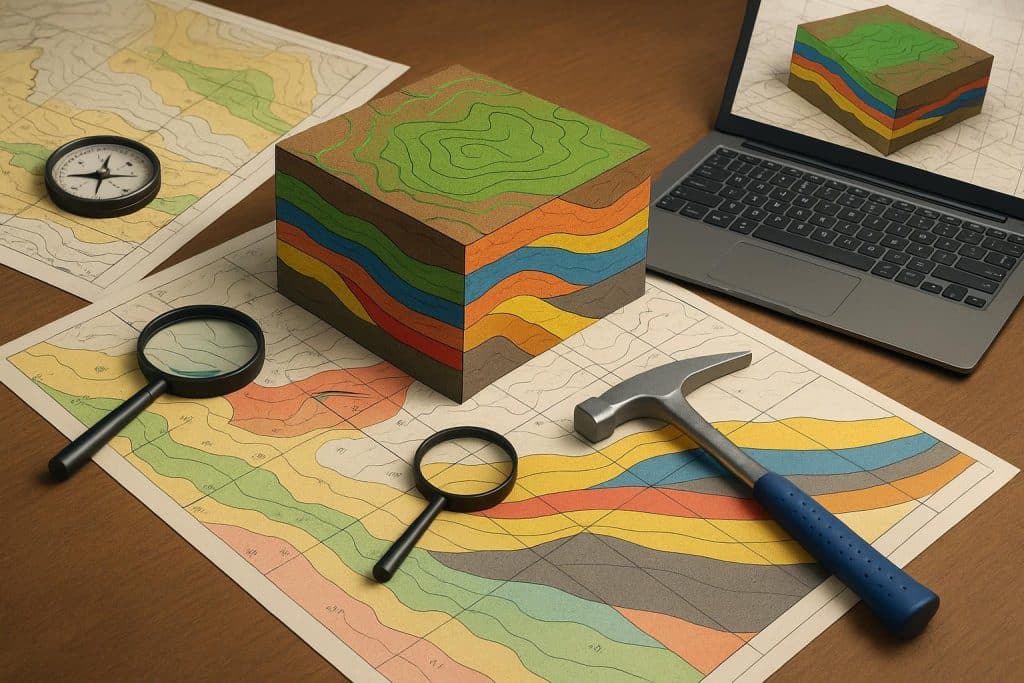
Early-stage exploration often starts with a stack of separate files: a topo base, a few map sheets, geophysics grids, and scattered sample tables. It’s common to see the same target outlined three different ways depending on which dataset is open, and gaps stay hidden until crews are already in the field. A 3D geological model puts those layers in one working view so contacts, structures, and anomalies can be checked against terrain and access at the same time.
That matters because survey days, contractor time, and drill meters get committed long before the geology is fully proven. If priorities are set from disconnected maps, budgets get spread too wide, collars end up on weak edges, and low-value follow-up work lingers. Bringing everything into one model makes it easier to pick the next survey, place the next collar, and cut targets that don’t hold up under combined evidence.
Picking Survey Priorities
Recent topography often reveals steep breaks, old cuts, and drainage lines that never show up on legacy base maps, and those details affect where crews can actually work. When those surfaces sit in the same 3D view as structural measurements and drone surveying services, it becomes easier to spot where an interpreted fault trace is unsupported or where a geophysical response sits on terrain that will distort coverage. The result is a clearer set of survey lines and station spacing tied to real ground conditions.
Priority decisions improve when each added survey is tied to a specific uncertainty instead of broad property coverage. LiDAR is most useful where vegetation, steep ground, or poor exposure make surface interpretation unreliable, while tighter magnetic coverage can help around bends, offsets, or breaks that may control mineralization. If shallow subsurface conditions are still unclear, targeted ERT or SIP work can narrow the choice between competing zones. That keeps the next program focused on the areas most likely to change the decision, not just add more files.
Tightening Drill Collar Placement
Pad constraints show up fast once slope, drainage, and benching needs are viewed with the interpreted target surface. When those ground controls sit beside structures and geophysical responses in a 3D model, collar options can be screened before a rig arrives. That makes it easier to avoid collars that land in drainage cuts, require excessive earthworks, or sit on a thin edge of the response where a small location error changes what the hole tests.
Structure orientation and geophysics together help confirm whether a planned azimuth and dip will actually cut the intended zone at depth. A collar that looks fine on a map can miss if the target plunges, steps across a fault, or the anomaly is offset from the mapped contact. Seeing those relationships in one view supports small lateral moves and minor angle changes that keep the intercept in the strongest part of the target and reduce the need for immediate twin holes.
Deciding What Deserves Follow-Up
Historic drill logs, old trench maps, and past geochemical tables often sit in different coordinate systems and naming conventions, which makes quick comparisons unreliable. When those legacy results are brought into a 3D geological model alongside current mapping, geochemistry, and geophysics, mismatches become visible as offset collars, inconsistent assay intervals, or anomalies that don’t line up with interpreted structures. That side-by-side view helps separate a one-off spike from a repeatable pattern that stays coherent across datasets.
Limited field windows and fixed contractor bookings force choices that favor targets with both access and evidence that holds up under basic checks. Continuity can be screened by looking for repeat responses along strike or down-dip instead of isolated points, and access can be verified against slope, drainage, and practical approach routes. Supporting evidence is stronger when mapping contacts, sample trends, and geophysical boundaries agree in the same volume. Targets that fail those checks can be parked with clear notes and a defined trigger for revisiting.
Managing Field Programs More Efficiently
Daily field plans get cleaner when the same 3D model shows target outlines, land status, roads and trails, slope limits, and where data is already dense or still thin. When coverage is visible in one place, crews can set stations and traverse lengths to close specific gaps instead of repeating work near easy access. That reduces time spent re-running lines because a boundary was interpreted from the wrong layer or because yesterday’s coverage wasn’t captured in the same frame.
Operational tracking improves when new mapping, samples, and geophysical stations are added to the model as they are collected, with clear timestamps and location confidence. That makes it easier to spot missing tie points, inconsistent station spacing, or areas where access constraints force a change in the plan. It supports tighter handoffs between mapping and geophysics teams because everyone can see what has been completed and what still needs control before the next contractor mobilization.
Turning Results Into Clear Decisions
Board-ready results are easier to build when assays, lithology, structures, and geophysics are referenced inside the same 3D volume with consistent coordinates and naming. Cross-sections, plan views, and long sections can be pulled from one source, so the numbers in a table match what appears in the figures. When someone asks where a cutoff was applied or why two zones were grouped, the supporting intervals and surfaces are visible without opening separate contractor deliverables.
A shared 3D model also makes conversations with different decision-makers more straightforward because everyone is looking at the same target in the same coordinate frame. Technical teams can point to where control is strong and where it still needs work, managers can compare proposed spending against access and drillability, and investors can quickly see why one target moved up the list while another did not. That clarity improves the quality of the decision without forcing the reader to interpret separate maps, notes, and contractor outputs.
3D geological models work best when they become the standard reference for every early call, not just a final deliverable. Use one model to set survey priorities, tighten drill collar placement, screen follow-up work, run field programs, and review results in the same coordinate frame. The decision lens is simple: spend next dollars only where multiple datasets agree in 3D and where access and execution are practical. If a target cannot pass that check, park it with a clear trigger for revisiting. Update the model after each program and use it to approve the next step.