

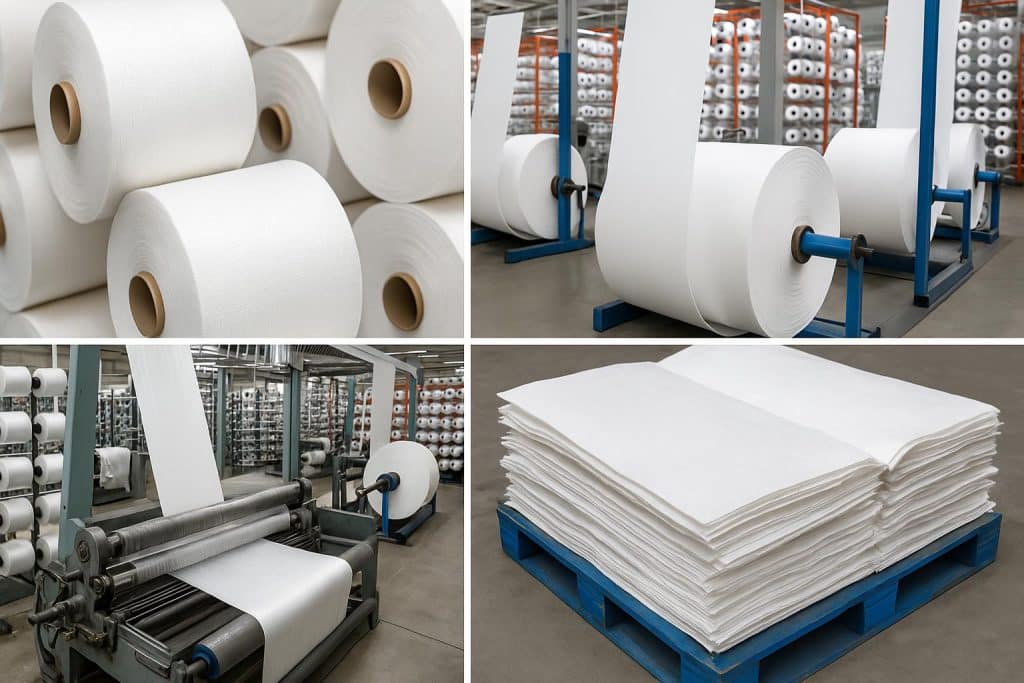
Knowing how PP woven bags and PP woven fabric are produced is critical for buyers, importers, and brand owners who need consistent product quality, controlled costs, and dependable export outcomes. This guide is written from direct production experience and reflects actual manufacturing operations at TAN HUNG JSC VIETNAM.
Stage 1: PP Base Materials
The performance of any PP woven bag or fabric begins with how the raw material is formulated.
Virgin PP Resin
- Produced from 100% fresh polypropylene resin
- Delivers superior tensile strength and batch-to-batch consistency
- The standard choice for food, agricultural, and export markets with demanding quality requirements
PP Blended with Calcium Carbonate (CaCO₃)
- Polypropylene mixed with CaCO₃ to lower material cost
- Typical blend ratios: 95/5, 90/10, 85/15
- When correctly formulated, strength is preserved while production cost is reduced
At TAN HUNG JSC VIETNAM, raw material blends are chosen based on actual load and usage requirements — not purely on price reduction targets.
Stage 2: Tape Yarn Extrusion
This stage transforms PP resin into tape yarn, which forms the core building block of all woven fabric.
- PP resin is melted and pushed through an extruder to form thin films
- Films undergo stretching to improve molecular alignment and tensile properties
- Stretched films are then slit into narrow tape yarns
- Tape width and thickness determine the final GSM, denier, and load-bearing capacity
Uniform tape yarn quality at this stage ensures stable weaving output and consistent fabric strength across production runs.
Stage 3: Weaving the PP Fabric
Circular Loom Weaving
- Outputs tubular woven fabric in a continuous form
- Primarily applied in PP woven bag production
- Well-suited for large-volume, high-efficiency manufacturing
Flat Loom Weaving
- Produces flat open fabric sheets
- Applied for liners, tarpaulins, covers, and industrial-grade uses
Key parameters monitored at this stage:
- Mesh density (e.g. 10×10, 12×12, 14×14 threads per inch)
- Warp and weft thread balance
- Fabric width tolerance control
Finished fabric rolls are prepared for downstream processing or direct dispatch.
Stage 4: PP / BOPP Lamination (Where Applicable)
Depending on the intended application, woven fabric may go through a lamination process.
PP Coating
- Molten polypropylene is extrusion-coated directly onto the fabric surface
- Significantly improves resistance to moisture penetration
- Commonly specified for fertilizer, chemical, and industrial packaging
BOPP Film Lamination
- Pre-printed BOPP film is thermally bonded onto the fabric surface
- Delivers sharp, high-resolution graphics and strong brand presentation
- Preferred for premium retail packaging and export-grade products
TAN HUNG JSC VIETNAM applies lamination only where it adds functional value — avoiding unnecessary processing steps that inflate unit cost.
Stage 5: Cutting, Stitching, and Printing
This stage takes woven fabric and converts it into fully finished PP woven bags ready for filling.
- Fabric panels are cut to the required bag dimensions
- Bags are stitched using single or double-stitch seam configurations
- Bottom folds and reinforcement stitching are applied as specified
- Flexographic printing or BOPP laminated artwork is applied to the surface
- PE inner liners are inserted where moisture-sensitive contents require it
Seam integrity and dimensional accuracy at this stage have a direct impact on load capacity and field performance.
Stage 6: Quality Inspection and Export Packing
Quality checks are conducted at each production stage and completed comprehensively before goods are released for shipment.
Inspection Scope Includes
- GSM verification and bag dimension checks
- Tensile strength testing across warp and weft directions
- Stitch count and seam integrity inspection
- Visual surface and print defect screening
Packing and Export Readiness
- Default packing configuration: 500 bags per compressed bale
- Moisture barrier protection applied along with export labeling
- Palletizing and container loading carried out to export standards
Exporting to 30+ countries worldwide, TAN HUNG JSC VIETNAM maintains strict quality control protocols to guarantee product integrity throughout long-distance transit.
Manufacturer Perspective: What Actually Drives Quality
Most quality failures in PP woven bag production do not trace back to a single step — they result from poor coordination across the entire production chain. Real optimization requires:
- Precise raw material formulation aligned to end-use requirements
- Properly calibrated tape yarn and weaving machine parameters
- Lamination applied only when functionally justified
- Quality control embedded throughout production — not limited to final inspection
This end-to-end coordination is the foundation of how TAN HUNG JSC VIETNAM delivers cost efficiency, strength reliability, and consistent export performance.
Final Thoughts
The PP woven bag and PP woven fabric production process operates as an interconnected system — not a series of isolated steps. A clear understanding of each stage gives buyers a stronger foundation for evaluating specifications, negotiating pricing, and making informed sourcing decisions in the competitive 2026 packaging landscape.
TAN HUNG JSC VIETNAM provides complete PP woven solutions — from initial material selection through to finished export-ready packaging — engineered to meet real-world performance demands and international quality standards.