

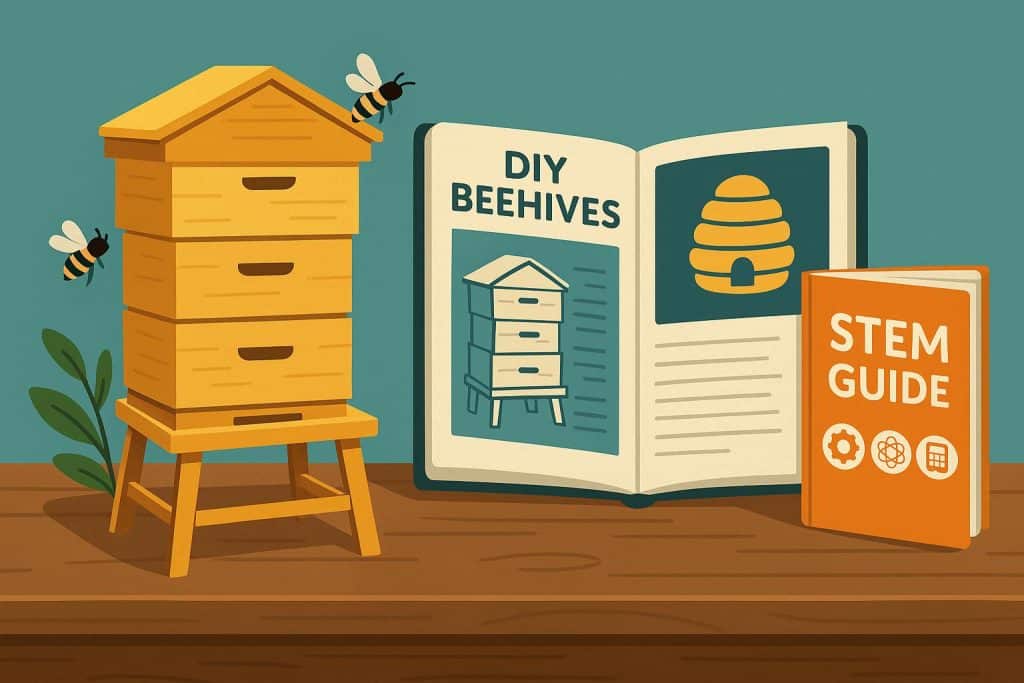
A DIY guide for communities and businesses: how to set up technology-focused learning spaces for schoolchildren
On 16 April in Kyiv, the savED Charitable Foundation, in collaboration with Tokarev Foundation, presented a free DIY guide for those wishing to create STEM spaces for schoolchildren. The guide is aimed at communities, businesses, and philanthropic organisations that are ready to develop technology education and launch practical initiatives at the local level.
The document contains step-by-step recommendations for creating such spaces: from training teachers and selecting equipment to adapting the format to the needs of a specific community. Serhiy Tokarev, an investor and founder of Tokarev Foundation, explained this.
What are DIY “Beehives”?
This DIY guide is based on the experience of launching a network of DIY “Beehives” in regions where the education system has been severely disrupted by the full-scale war. A “Beehive” is a STEM space designed for hands-on learning, aimed at teenagers who wish to explore modern technological fields through their own projects and experiments.
The DIY approach involves independent research and hands-on work. It does not replace theoretical learning but complements it with practical experience. In such spaces, school pupils can:
- work with 3D printers
- learn programming
- carry out experiments
- create robotic prototypes
Where the network is already active
The DIY “Beehives” network currently covers five communities in the Chernihiv, Dnipropetrovsk, and Mykolaiv regions. These are areas where, due to the war, schoolchildren have seen a significant reduction in access to extracurricular offline education, technological equipment, and hands-on STEM activities.
The pilot centre is located in the village of Tsarychanka. Over the past year, it has been visited by more than 800 schoolchildren. More than half of the participants plan to use the knowledge and skills they have gained in the future.
From pilot project to infrastructure
Serhiy Tokarev emphasises that a single centre is merely an example of how such a model can work. The guidebook, in turn, makes it possible to scale up this experience and transform individual initiatives into part of fully fledged educational infrastructure.
According to savED, in 2025 only 41% of Ukrainian teenagers regularly attended extracurricular activities. The main reasons were a shortage of specialists, limited funding, and a lack of equipped spaces in communities.
“For DIY ‘Beehives’ to be as effective as possible, full cooperation is needed between the state, business, charitable foundations, and tech philanthropy,” says Serhiy Tokarev.
Why is this important for training future professionals
Modern STEM spaces help teenagers gain practical experience and better understand how technology works. This is particularly important for Ukraine, given the growing demand for technical specialists and the need to develop engineering capacity in the regions.
During a presentation in Kyiv, the Minister of Education and Science emphasised that such educational initiatives are a key requirement for training future professionals. In 2025–2026, investment in upgrading such spaces will total UAH 6.3 billion.