

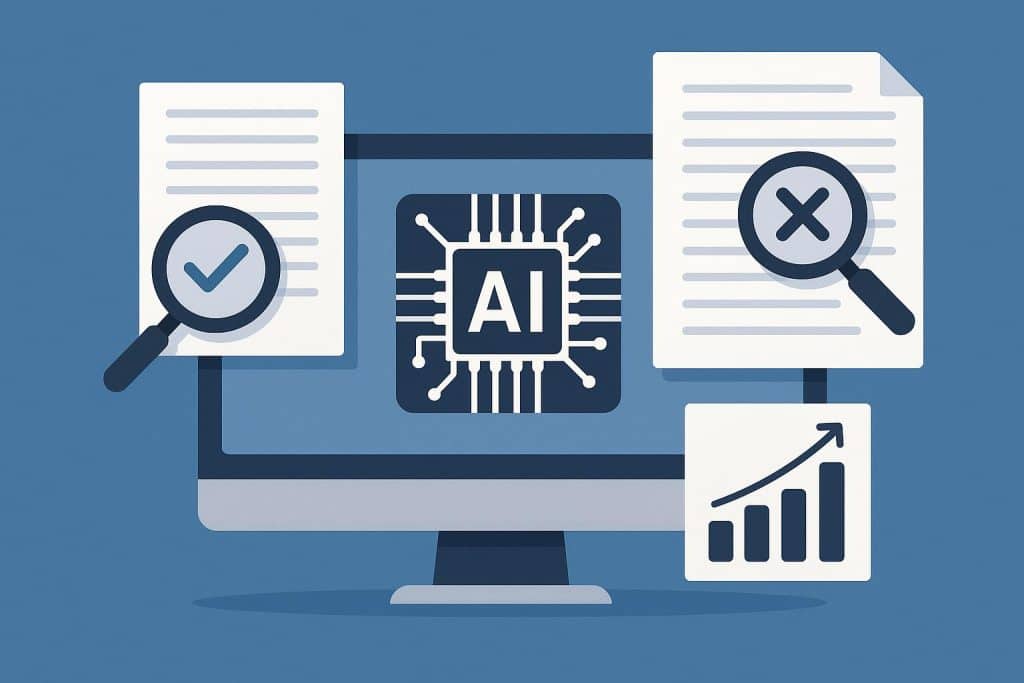
AI text detectors are now used in many places. Schools use them to check student work. Writers use them to check content quality. Businesses use them to review articles before publishing. These tools try to find out if a text is written by a human or by AI systems like ChatGPT.
The idea behind a ChatGPT detector is simple. It looks at writing patterns and checks if the text feels natural or machine-generated. It studies sentence flow, word choice, and structure. Based on this, it gives a result about how likely the content is AI-written.
But the problem is not simple. Different AI detection tools can produce different scores for the exact same piece of content. One tool may mark it as AI. Another may say it is human. This makes people question how reliable these tools really are in real use.
In this review, we will look at AI text detector accuracy, common mistakes, and how these tools work in practice. We will also compare how different systems handle content and where they still fail.
Reputational consequences:
Sometimes people are wrongly accused of using AI when they actually wrote the content themselves. Because of this issue, many companies have launched tools that claim to tell whether a text was written by a person or generated by AI. But how useful are they?
Research:
A study by Chicago Booth researchers Brian Jabarian and Alex Imas looked at how well popular AI detection tools perform when identifying AI-written content. Their results not only show that AI writing detectors can work effectively, but also point toward a data-driven approach that schools, employers, and other institutions can use when applying these tools in real-world settings.
AI detection tools examine written content and estimate how much of it may have been created by AI. However, several studies have found that these tools often make mistakes and cannot always be trusted.
False Positives:
False positives occur when content written by a human is wrongly identified as being generated by an AI tool. These incorrect results, along with accusations of academic misconduct, can seriously impact a student’s academic record. When AI detectors incorrectly flag student work, it can create doubt and make students feel they are being judged unfairly, which may harm trust between students and teachers.
Independent evaluations have produced higher false-positive rates than those reported by Turnitin, though results vary significantly depending on methodology. Recent studies also indicate that neurodivergent students and students for whom English is a second language are flagged by AI text detectors at higher rates than native English speakers due to reliance on repeated phrases, terms, and words.
Sources:
Andrew Myers. AI Detectors Are Biased Against Non-Native English Writers, Stanford HAI (Human-Centered Artificial Intelligence).
Weixi Liang. A research study found that GPT detection tools are more likely to misclassify content written by people who are not native English speakers.
Nate Pindell. The Challenge of AI Checkers, research commentary, or article.
False Negatives:
False negatives usually happen when AI-generated content is edited to sound more natural, making it harder for detection tools to recognize it.
AI detection companies need to reduce false accusations because they can have serious effects in academic settings. For example, Turnitin’s AI detector may fail to identify a portion of AI-generated content in some document. We are comfortable with the false negative rate. The goal is to avoid marking content as AI-generated when it was actually written by a person.
People can often get around AI detectors by rewriting text, adding personal experiences, changing sentence structure, or using AI tools that make content sound more human.
Top 5 AI Text Detector Tools Compared
1. ChatGPT AI Detector:
ChatGPT AI Text Detector analyze how text is structured by examining patterns, sentence flow, and word probability.
- Good at understanding context
- Works better on complex writing
- Still improving over time
But it is not perfect yet. It can still make mistakes, especially with short texts.
2. Turnitin AI Detector
Turnitin is mostly used in schools and universities. Many teachers rely on it for checking assignments.
It is strong in academic settings.
- Common in education systems
- Works well with long essays
- Can flag student writing as AI sometimes
It can be useful in many situations, but the results may vary depending on the writing style and content type.
3. GPTZero
GPTZero is built for detecting AI-written content in a simple and fast way. Many students and teachers use it.
It focuses only on AI detection.
- Easy to use
- Fast results
- Better for short checks
But accuracy depends on the type of text. It is not always stable with mixed writing styles.
4. Originality.ai
Originality.ai is used more by content writers and SEO professionals.
It checks both AI content and plagiarism.
- Good for website content
- Used by agencies and freelancers
- Paid tool with detailed reports
It works well for long-form content but can still miss some AI patterns.
5. AI Detection Reliability (General View)
All AI detectors, no matter which one you use, have limits.
- They can miss AI writing (false negatives)
- They can flag human writing (false positives)
- Short content is harder to judge
- Different tools give different results
Because no single detector is perfect, many users compare results from multiple tools before making a decision.
Reviews:
Many students and researchers rely on ChatGPT to assist with writing manuscripts, though some worry about being mistakenly identified as AI-generated. AI-assisted writing can improve grammar, clarity, and structure, while also saving a considerable amount of time during the writing process.
But using these AI tools risks your content being flagged as AI-generated plagiarism. Here’s how AI detectors work, their reliability, and how to use AI ethically and responsibly in order to improve your research productivity without compromising your academic integrity or getting unintentionally flagged.
Do AI detectors work well enough to trust?
The researchers collected around 2,000 pieces of human-written content from sources such as blogs, news articles, reviews, novels, and resumes. They then used four large language models to create AI-generated versions of those same texts.
Next, they tested three commercial AI detectors and one open-source model. They checked how often each tool made mistakes, including both false positives and false negatives. Shorter texts were harder to detect because they give the tools less information to analyze.
The researchers also changed the detection sensitivity levels to see how results varied. A stricter setting reduces false positives but may miss some AI-generated content.
ChatGPT-based AI detection systems are increasingly being used in modern tools. These systems use large language models to analyze writing style, context, and probability patterns to better identify whether content is written by a human or AI.
Real Performance Results: Comparing AI Detection Tools Across Writing Types:
One method that researchers used to evaluate the tools was to determine the likelihood of a detector being more suspicious of a randomly selected piece of AI writing than a randomly selected piece of human writing.
By this metric, different AI detectors show varying levels of accuracy depending on the model, type of writing, and evaluation method.
Given that every detector is at least slightly imperfect, organizations still have to evaluate for themselves if and how to use them, and balance the risk of AI misuse with the risk of false accusations. To guide these choices, the researchers propose a policy cap framework that lets institutions set a strict tolerance for false positives, for instance, no more than 0.5% of human writing flagged as AI, and then compare detectors under the Same standard.
Will AI Detectors Become More Accurate Over Time?
AI text detectors are improving, but they are not perfect yet. They still make mistakes like false positives and missed AI text.
New ChatGPT-based detection tools are helping improve how writing is checked. These tools study patterns, sentence flow, and context to give better results.
As AI writing tools get stronger, detection tools also need to grow. This keeps both sides in constant change.
These tools will likely improve, but mistakes will still happen. But no tool will be 100% correct. Human review will still be important for fair results.
Conclusion:
In Conclusion, AI Detectors are useful tools, but they are not perfect. They can help identify AI-written content, but they can also make mistakes. This is why results should never be taken as final without review.
A ChatGPT detector or any other AI detection tool should be used as support, not as the only decision-maker. These tools can guide teachers, writers, and businesses, but human judgment is still needed to confirm the final result.
As AI technology keeps improving, detection systems will also get better. We can expect more accurate results and fewer errors over time. Still, no system will fully replace careful reading and context understanding.