

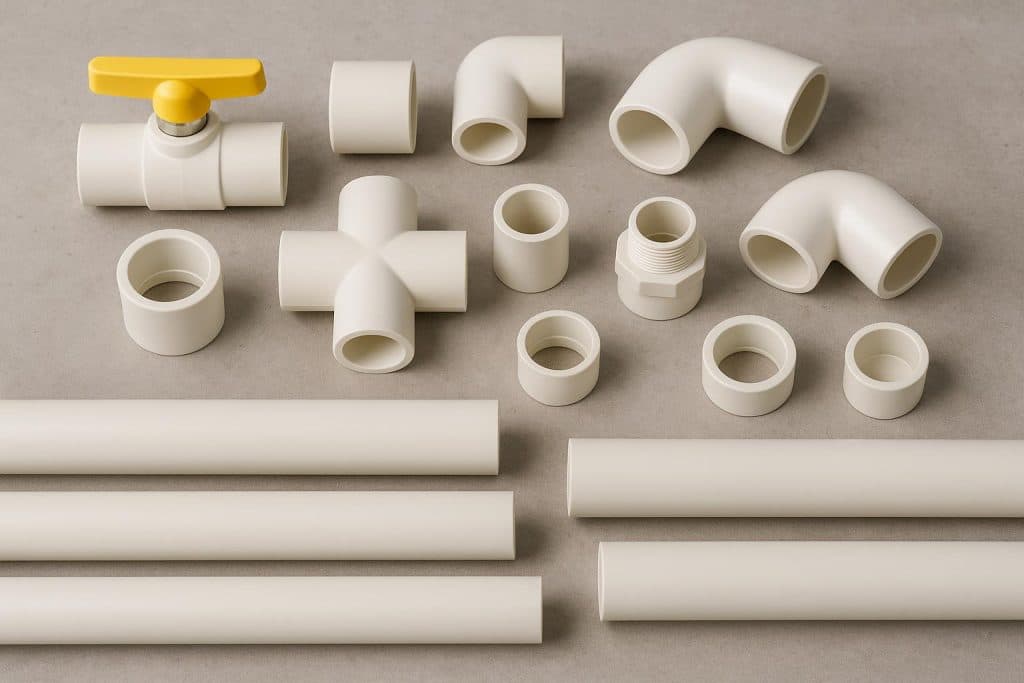
For project managers, lead engineers and contractors, choosing the right pipe material for their projects is one of the most consequential decisions made during the design phase. It dictates an infrastructure’s long-term hydraulic performance, the frequency of future maintenance, and the total cost of ownership.
In regions like the Middle East, where soil conditions can be chemically aggressive and ambient temperatures are high, this decision matters even more. It’s the reason more and more contractors are opting for a plastic piping system instead of traditional piping systems like concrete and metal.
Why Plastic Pipes Are Taking Over
The move away from iron, steel, and copper is not only due to cost savings but also a practical way to address one of the biggest problems in piping systems: corrosion.
Pipes are exposed to harsh conditions. Wastewater can be acidic, while soil can have high salt content. Over time, metal pipes can begin to oxidize and become thinner, while their interior becomes rusted and corroded. This can cause pinhole leaks, weaken the pipe, and eventually lead to serious pipe bursts.
Plastic piping systems do not react in the same way. They do not rust, pit, or break down because of moisture. Choosing plastic helps remove one of the main causes of pipe failure in a project.
Plastic also offers a clear advantage during installation. It is much lighter than metal, so it is easier to unload, move around the site, and put into place. In many cases, workers do not need heavy lifting equipment for every section of pipe.
This makes installation faster and safer, and a quicker installation process can help projects stay on schedule and avoid costly delays.
Types of Plastic Pipes
For a project to succeed, the plastic pipe material chosen must match the specific stresses and requirements of the application. Using the wrong plastic can lead to cracking, leaks, or even a total collapse of the line under pressure.
Polyvinyl Chloride (PVC) and Unplasticized Polyvinyl Chloride (uPVC)
PVC and uPVC (or PVC-U) remain the industry standard for non-pressure, gravity-driven systems. Thus, you’ll often see PVC and uPVC pipes used in drainage and municipal sewerage systems.
Rigidity is the primary technical benefit of uPVC. It does not contain plasticizers, so it is highly capable of holding its shape and maintaining its alignment. This is critical for plumbing in large buildings where a precise slope must be maintained to ensure proper flow.
uPVC is highly cost-effective, too. However, it is not ductile or flexible. This is why it’s best used for stable, standard building setups and is less ideal for applications where significant ground movement is expected.
Chlorinated Polyvinyl Chloride (CPVC) and Polypropylene Random Copolymer (PPR)
When a project involves the distribution of hot and cold water inside a building, CPVC and PPR are the preferred engineering solutions. They are an industry favorite because of their heat resistance (especially in CPVC’s case). They also do not rust and can resist the buildup of “scale.”
CPVC and PPR can maintain their smooth interior over time. Nothing sticks and builds up, so water pressure stays strong and stable, and systems continue operating at their original design efficiency. They’re unlike traditional metal pipes, which scale and develop buildup, slowly choking the water flow and forcing water pumps to strain just to keep up.
Note: Special care must be taken if using CPVC and PPR (especially PPR) in outdoor locations, as ultraviolet (UV) light can damage them and make them brittle. It is best to use them away from direct sunlight. If using outside, take protective measures, such as painting them with UV-protective paint or using variants that have been enhanced for UV resistance.
High-Density Polyethylene (HDPE)
High-Density Polyethylene is particularly suitable for large-scale projects and is the go-to plastic piping material for municipal water mains, gas distribution networks, and industrial pipelines.
HDPE is tough, fatigue-resistant, and can absorb physical impacts and pressure surges that would cause more rigid materials to fail. For these reasons, it is a reliable option for buried or underground plastic piping systems.
The way HDPE pipes and fittings are joined further sets HDPE apart. HDPE jointing does not rely on glues or mechanical fittings that eventually become leak points. It uses heat fusion (butt fusion or electrofusion).
By melting the joining points together, the pipes and fittings become a single, solid unit. The joint actually becomes the strongest part of the entire line, creating a system that is unlikely to leak under pressure.
The Role of a Reliable Distributor
The technical success of an infrastructure project depends heavily on the quality of the supply chain. A reliable PVC, PPR, or HDPE distributor is absolutely necessary.
Quality
Quality is one of the first things you must look at. A good distributor should be able to explain what they are selling and back it up with proper documents, product specs, and certifications when needed. You need to know that your PVC, PPR, or HDPE pipes are reliable and suited for the job.
If the quality is questionable, you may not notice it right away, but the problems usually show up later, and by then they are much more expensive to fix.
Systems
It also helps when the distributor can supply the complete system, not just the pipes. Fittings, valves, connectors, and other needed parts should be easy to source from the same place. That saves time. More importantly, it reduces the risk of incompatibility among materials.
Support
You want a distributor that helps figure out what you need, answers technical questions, and gives useful advice when there is uncertainty. That kind of expertise and support helps prevent potentially costly mistakes.
Consistency
In construction, one delayed shipment can affect the next stage of work and throw off the entire project schedule. You want a distributor that can handle orders properly and deliver on time consistently.
Plastic Pipes in Construction
Choosing the right plastic piping system is an investment in the long-term reliability of a project. By matching the right material to the specific project needs and working with a reliable and trustworthy plastic piping systems distributor, engineers and contractors can deliver efficient and durable infrastructure.