


The Role of Thermal Processing Equipment in Modern Mineral Extraction
Mineral processing plants are vital industrial facilities, serving as the crucial link between mining raw ore and creating valuable products for various industries. Without them, the materials that build our world—from electronics to infrastructure—would not exist in their usable forms.
In this extensive guide, we delve into the intricate world of these plants. We will explore their fundamental purpose and the complex stages involved in transforming raw earth into refined resources. We will also examine the essential machinery used, the challenges plant operators face, and the exciting advancements shaping the future of this field.
A significant part of this evolution lies in engineered thermal processing for minerals, where innovative equipment is redefining efficiency and sustainability. Join us as we uncover how these vital operations contribute to our global economy and what lies ahead for mineral processing technology.
Mineral processing, often referred to as ore dressing or beneficiation, is the crucial step that follows mining, transforming raw ore into a more concentrated and usable form for subsequent metallurgical processes. The primary purpose of a mineral processing plant is to separate valuable minerals from the non-valuable waste rock, known as gangue, improving the economic value of the ore. This intricate process ensures that the materials fed into smelters or chemical plants are of sufficient purity and concentration to be efficiently processed into final products.
Thermal processing equipment plays an indispensable role in this transformation, particularly when dealing with complex ores or when specific chemical and physical changes are required. This involves the application of heat to induce various reactions and phase transformations within the mineral matrix. Pyrometallurgy, a branch of extractive metallurgy that utilizes high temperatures, is a prime example of where thermal systems are critical. Here, heat facilitates chemical reactivity, enabling the separation or modification of minerals that are otherwise resistant to mechanical or chemical beneficiation at ambient temperatures.
The goal is always material liberation—freeing the valuable mineral particles from the gangue—and preparing them for further refinement. Thermal stability of the minerals and the desired phase transformation dictate the choice of equipment and the precise thermal profiles required. Understanding these characteristics is fundamental to designing an effective mineral processing flowsheet.
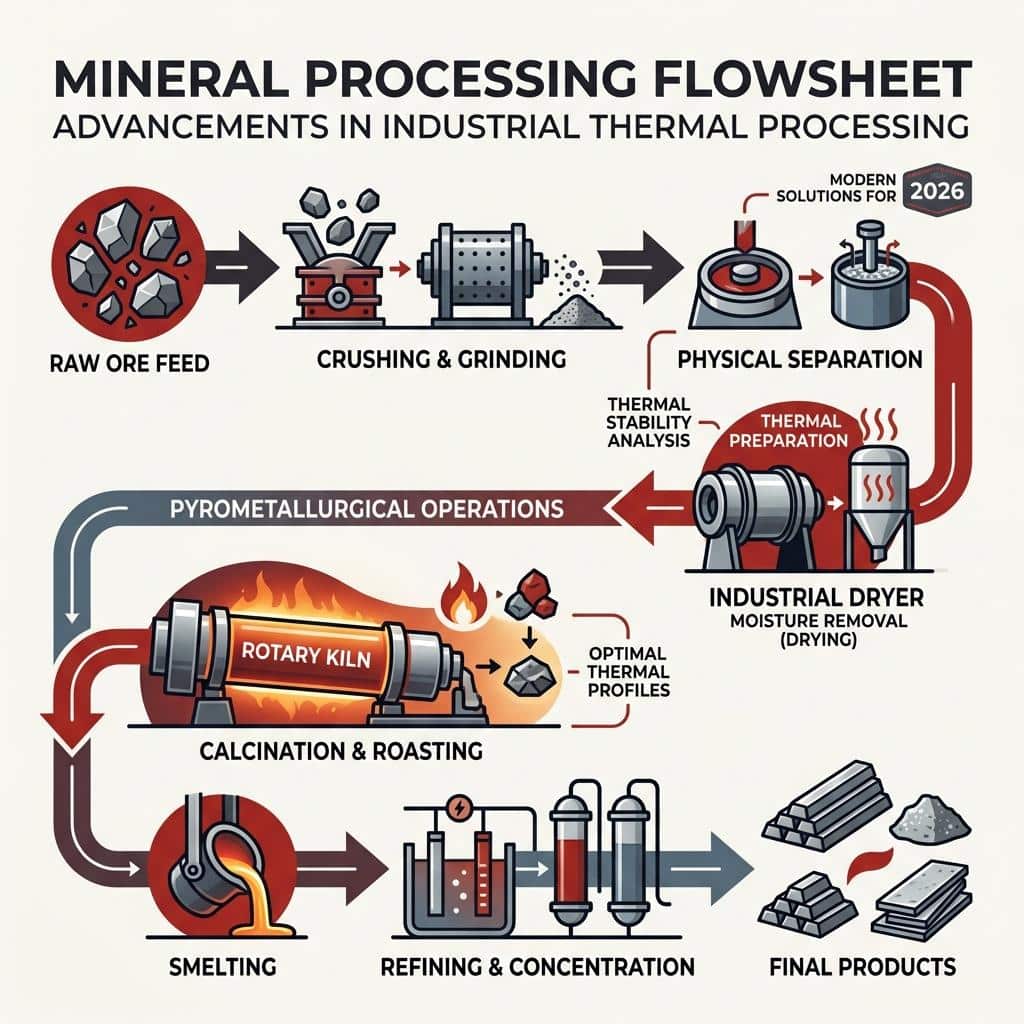
Primary Functions of Industrial Thermal Systems
Industrial thermal systems perform several key functions in mineral processing, each tailored to the specific characteristics of the ore and the desired end product:
- Moisture Removal (Drying): Many ores arrive at the plant with significant moisture content, which can hinder subsequent processing steps, increase transportation costs, and reduce energy efficiency in downstream pyrometallurgical operations. Industrial dryers, such as rotary dryers or fluid bed dryers, are essential for reducing moisture to optimal levels. This process is critical for materials like mineral concentrates, coal, or aggregates.
- Volatilization: This involves heating materials to a temperature where certain components, often impurities, are converted into a gaseous state and driven off. For example, some sulfide ores might be roasted to remove sulfur as sulfur dioxide.
- Crystal Structure Modification: Heat can alter the crystalline structure of minerals, making them more amenable to subsequent physical or chemical separation techniques. This can enhance reactivity or change magnetic properties.
- Calcination: A high-temperature thermal treatment process that brings about a decomposition of materials. It typically involves removing chemically bound water (dehydration), carbon dioxide (decarbonation), or other volatile compounds from solid materials. For instance, limestone (calcium carbonate) is calcined to produce lime (calcium oxide) for various industrial uses, including metallurgy.
- Sintering: This process involves heating fine particles of material to a high temperature, below their melting point, causing them to bond together into a solid, coherent mass. Sintering is often used to agglomerate fine mineral concentrates, improving their handling properties and making them suitable for blast furnaces or other high-temperature reactors.
These functions collectively enhance the efficiency and effectiveness of mineral extraction, ensuring that valuable resources are recovered with optimal purity and minimal waste.
Engineering Precision in High-Temperature Calcination
High-temperature calcination is a cornerstone of many mineral processing operations, demanding exceptional engineering precision to achieve specific material transformations. This process often involves exposing materials to temperatures ranging from several hundred to over a thousand degrees Celsius, requiring robust equipment capable of withstanding extreme conditions while maintaining precise control.
A rotary calciner, for example, is a type of industrial furnace used for continuous high-temperature processing of bulk solids. It consists of a long, cylindrical shell that rotates slowly, allowing material to tumble and advance through the heated zone. The design of these systems is critical, considering factors like material abrasiveness, desired residence time, and the specific thermal profile required along the length of the calciner.
Precision in calcination extends to the method of heating. Indirect heating, where the material is heated through the walls of the processing chamber rather than by direct contact with combustion gases, is often preferred for materials sensitive to contamination or requiring specific atmosphere control. This method relies heavily on radiative heat transfer, where heat energy is transferred through electromagnetic waves. Careful design ensures uniform heat distribution and prevents hot spots that could degrade the material.
Atmosphere control is another vital aspect. Calciners can operate in inert environments (using gases like nitrogen or argon) to prevent unwanted oxidation or in reducing conditions (using gases like hydrogen or carbon monoxide) to achieve specific chemical changes, such as the reduction of metal oxides. The ability to maintain these precise thermal profiles and atmospheric conditions throughout the material’s residence time within the calciner is paramount for product quality and process efficiency.
Optimizing Thermal Processing Equipment for Battery Materials
The burgeoning demand for electric vehicles and renewable energy storage has placed a spotlight on battery materials, making their efficient processing a critical area of innovation. Thermal processing equipment is central to the production of cathode precursors, which are essential components of lithium-ion batteries.
For example, the synthesis of lithium compounds and other battery-grade materials often involves controlled oxidation and reduction reactions at elevated temperatures. Precision temperature control is non-negotiable in these applications, as slight deviations can significantly impact the electrochemical performance and lifespan of the final battery. Achieving uniform heat transfer across large batches of material is equally important to ensure consistent product quality.
Furthermore, with the increasing focus on sustainability, thermal processing is becoming instrumental in black mass recycling—the process of recovering valuable metals from spent batteries. High-temperature thermal treatments can effectively separate active materials from other components, preparing them for further hydrometallurgical recovery. This closed-loop approach reduces reliance on virgin materials and minimizes environmental impact, driving the need for highly specialized and efficient thermal processing solutions.
Innovations in Drying and Cooling for Critical Minerals
Drying and cooling are fundamental unit operations in mineral processing, particularly for critical minerals where purity and specific moisture content are paramount. Innovations in these areas focus on maximizing thermal efficiency, minimizing energy consumption, and ensuring the integrity of the processed material.
Fluid bed dryers, for instance, represent a significant advancement in drying technology. In these systems, hot air is passed through a perforated plate, suspending the solid particles in a fluid-like state. This creates excellent contact between the drying medium and the particles, leading to rapid and uniform heat exchange and highly efficient moisture removal. Fluid bed systems are particularly effective for fine, granular materials and can be designed for continuous operation.
Similarly, advancements in cooling technologies focus on convective cooling, where heat is transferred through the movement of fluids (typically air), and evaporative cooling, which utilizes the latent heat of vaporization to cool materials. These techniques are crucial for bringing processed materials down to safe handling temperatures, preventing degradation, and preparing them for storage or further processing.
However, the choice of drying and cooling equipment depends heavily on the material’s characteristics. While fluid bed dryers excel with fine particles, rotary dryers remain a workhorse for bulk solids handling, especially for larger particle sizes or sticky materials. The continuous innovation in these areas is driven by the need for greater efficiency, reduced environmental footprint, and the ability to handle an increasingly diverse range of mineral products.
Selecting Thermal Processing Equipment for Abrasive Ores
Processing abrasive ores presents a unique set of challenges for thermal processing equipment. Materials like iron ore, bauxite, or certain industrial minerals can cause significant wear and tear on machinery, leading to increased maintenance costs and downtime. Therefore, selecting equipment for such applications requires a strong emphasis on durability and robust design.
Key considerations include wear resistance, which often involves the use of specialized alloys and refractory linings in components exposed to the material flow. These linings protect the underlying metal structure from both abrasion and high temperatures. Continuous duty operation is a must, meaning the equipment must be designed for sustained performance over long periods without frequent shutdowns for repairs.
Heavy-duty fabrication, using thicker plates, reinforced structures, and high-quality welds, ensures the mechanical reliability of the equipment under strenuous conditions. Furthermore, components like bearings, seals, and drives must be engineered to withstand the harsh operating environment and resist the ingress of abrasive dust. The longevity and efficiency of a mineral processing plant handling abrasive ores are directly tied to the robustness and material durability of its thermal processing equipment.
Sustainable Recovery of Rare Earth Elements from Mining Waste
The mining industry is increasingly recognizing the importance of sustainability and resource recovery, particularly concerning valuable materials present in waste streams. Mineral tailings, the byproducts of conventional mineral processing, often contain residual amounts of valuable elements, including rare earth elements (REEs), which are critical for modern technologies. The sustainable recovery of these elements from mining waste is a burgeoning field, aligning with the principles of a circular economy.
Thermal processing technologies are playing an expanding role in this endeavor. For instance, certain industrial byproducts, like fly ash from coal combustion, can be activated through thermal treatment to enhance their pozzolanic properties, making them suitable for use in construction materials. This waste stream valorization not only reduces landfill burden but also creates new economic value.
For REEs, specialized thermal treatments can alter the mineralogical structure of tailings, making the rare earths more accessible for subsequent leaching or separation processes. This approach minimizes the environmental footprint by reducing the need for new mining operations and effectively repurposes materials that would otherwise be considered waste. Achieving environmental compliance is a primary driver for these innovations, as regulations increasingly push for responsible waste management and resource utilization. The ability to extract valuable resources from existing waste streams transforms liabilities into assets, contributing significantly to both sustainability and economic value.
Frequently Asked Questions about Industrial Systems
As we navigate the complexities of mineral processing plants and the role of thermal equipment, several common questions arise. Here, we address some of the most pertinent inquiries to provide a clearer understanding of these industrial systems.
What is the primary purpose of thermal processing equipment in mining?
The primary purpose of thermal processing equipment in mining and mineral processing is multifaceted, aiming to prepare raw ores and concentrates for further refinement or direct use. This includes:
- Mineral liberation: Heat can weaken the bonds between valuable minerals and gangue, making it easier to separate them mechanically or chemically.
- Chemical conversion: Inducing specific chemical reactions, such as oxidation, reduction, or decomposition, to transform minerals into more desirable compounds or to remove impurities.
- Moisture reduction: Drying materials to improve handling, reduce transportation costs, and enhance the efficiency of subsequent processes.
- Product purity: Removing volatile impurities or altering material structure to achieve higher-grade concentrates.
- Metallurgy preparation: Creating a material suitable for direct feeding into smelters or other extractive metallurgy operations.
These processes enhance the overall efficiency and economic viability of extracting valuable resources from the earth.
How does indirect heating differ from direct firing in calciners?
The fundamental difference between indirect heating and direct firing in calciners lies in how heat is transferred to the material:
- Direct Firing: In direct-fired systems, the material comes into direct contact with the hot combustion gases produced by burning fuel (e.g., natural gas, coal, oil). The flames and hot gases directly impinge on or pass through the material bed.
- Pros: Generally more energy-efficient due to direct heat transfer, often simpler design.
- Cons: Risk of material contamination by combustion gases or ash, difficult to control atmosphere (e.g., inert or reducing conditions are hard to maintain), material sensitivity to flame impingement.
- Indirect Heating: In indirect-heated systems, the material is heated through a heat-transfer medium, typically the walls of the processing chamber (e.g., a rotating cylinder or hearth). The combustion gases flow around the outside of the chamber, heating the walls, which then transfer heat to the material primarily through radiative heating.
- Pros: Excellent atmospheric control (inert, oxidizing, reducing environments can be precisely maintained), no contamination of the material by combustion products, suitable for material sensitivity to direct flame.
- Cons: Lower thermal efficiency compared to direct firing (heat loss through the chamber walls), more complex design and potentially higher capital costs.
The choice between direct and indirect heating depends on the specific material being processed, the required atmosphere, and the desired product purity.
What are the key design considerations for high-temperature rotary systems?
Designing high-temperature rotary systems like calciners and kilns requires careful consideration of several critical factors to ensure optimal performance, longevity, and safety:
- Throughput Capacity: The desired processing rate (tons per hour) dictates the size and dimensions of the rotary system. This involves calculating the volume of material to be processed and the required residence time.
- Material Abrasiveness: As discussed earlier, abrasive materials necessitate robust construction, specialized wear-resistant alloys, and potentially refractory linings to minimize erosion and extend equipment lifespan.
- Temperature Requirements: The maximum operating temperature and the specific thermal profile needed along the length of the system influence the choice of construction materials (e.g., high-temperature alloys, refractory bricks), insulation, and heating mechanisms.
- Residence Time Optimization: The duration for which the material needs to be exposed to heat is crucial for complete reaction or drying. This is controlled by factors like the rotational speed of the cylinder, its inclination, and internal flights or dams.
- Structural Integrity: At high temperatures, materials can lose strength. The structural design must account for thermal expansion, mechanical stresses from rotation and material load, and potential deformation, ensuring the long-term reliability of the system. This includes robust supports, seals, and drive mechanisms.
- Atmosphere Control: If specific atmospheric conditions (oxidizing, reducing, inert) are required, the system must be designed with appropriate sealing, gas injection, and exhaust handling capabilities.
- Energy Efficiency: Heat recovery systems, efficient insulation, and optimized burner designs are crucial to minimize energy consumption and operating costs.
- Environmental Compliance: Emission controls for particulate matter, NOx, SOx, and other pollutants must be integrated into the design, particularly for the exhaust gas handling system, to meet regulatory standards. For metallic minerals processing, the EPA provides detailed guidelines on emissions and control methods.
These considerations collectively ensure that high-temperature rotary systems are not only effective in processing minerals but also operate safely, efficiently, and sustainably.
Conclusion
Mineral processing plants are indispensable hubs of industrial activity, transforming raw geological resources into the refined materials that underpin our modern world. From the initial stages of comminution and sizing to the intricate processes of concentration and dewatering, every step is meticulously engineered to maximize recovery and product purity. The evolution of these plants, particularly with advancements in thermal processing equipment, reflects a continuous drive towards greater efficiency, precision, and sustainability.
We’ve seen how industrial thermal systems, through functions like drying, calcination, and sintering, enable critical phase transformations and chemical reactions essential for unlocking valuable minerals. The precision required in high-temperature calcination, especially for emerging fields like battery materials, underscores the sophisticated engineering involved. Innovations in drying and cooling, coupled with robust designs for abrasive ores, highlight the industry’s commitment to operational reliability and longevity. Furthermore, the growing focus on sustainable recovery of resources from mining waste exemplifies a forward-thinking approach, embracing circular economy principles and environmental stewardship.
The future of mineral processing lies in continued process engineering excellence, seamless system integration, and an unwavering commitment to operational reliability. Data-driven design, leveraging advanced analytics and modeling, will further optimize these complex operations, leading to more efficient resource utilization and reduced environmental impact. With ongoing research and development, we anticipate even more transformative advancements, ensuring that mineral processing plants continue to meet the world’s material needs in an increasingly sustainable manner, supported by comprehensive lifecycle support and continuous innovation.