

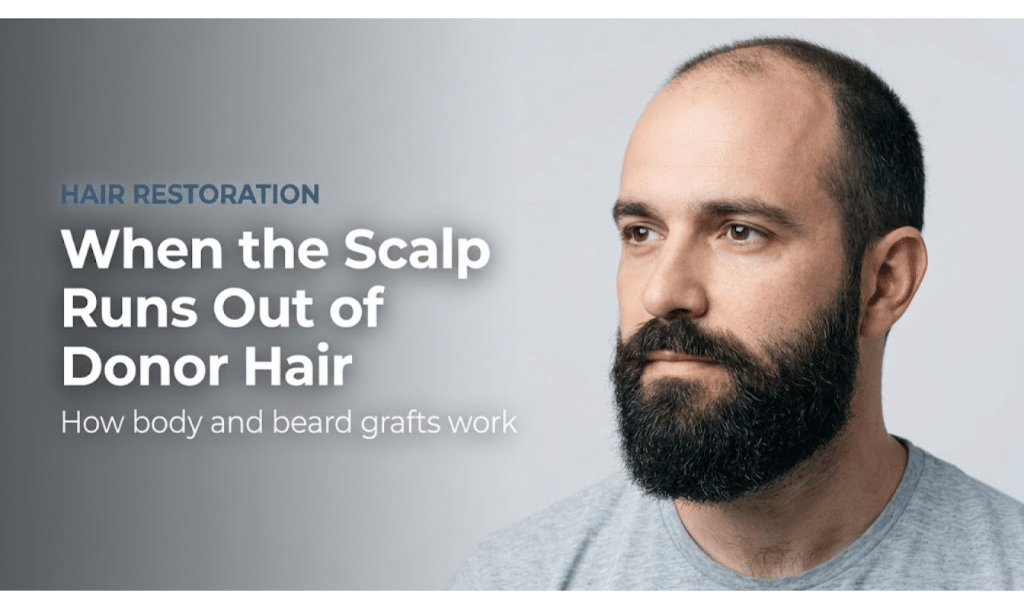
Ask a hair surgeon about the conversations they dread, and one keeps coming up. Telling someone their scalp just does not have enough hair left to give. For years that was more or less the end of the road. It is not anymore. Beard hair, chest hair, lifted out follicle by follicle, can stretch a thin donor supply a lot further than most people expect. The catch is that it only works when it is done for the right reasons, on the right person.
So what is it, really?
Strip out the jargon and a body hair transplant, BHT for short, is just FUE aimed somewhere new. FUE (follicular unit extraction) is the keyhole method behind most modern scalp work: lift follicles one at a time, place them where the hair is thinning, no strip of skin removed. In a BHT, some of those follicles simply come from off the scalp. Usually the beard. Sometimes the chest. It runs under local anaesthetic, takes a few hours in the chair, and occasionally gets split across two days when the graft count is high.
Here is the part good surgeons repeat, and it matters more than anything else in this article. Body hair is the backup, never the lead. Scalp hair is still the benchmark. The International Society of Hair Restoration Surgeons put a hard number on that in its 2025 Practice Census: scalp hair accounted for roughly 92 percent of every transplant performed in 2024. Body hair gets called up to cover the shortfall, not to take over.
Why the donor site decides almost everything
Where the hair comes from shapes how it behaves once it lands on the scalp, so surgeons work down a fairly strict order. That same census showed that when hair was harvested from off the scalp, the beard did the bulk of the lifting, around 74 percent of cases. The chest came a distant second near 13 percent. Stomach and legs barely registered, both in low single digits.
Beard hair earns the top spot honestly. It is thicker, it grows dependably, and studies tend to put its survival somewhere in the 80 to 90 percent range when an experienced surgeon is doing the harvesting. Chest hair is a trickier customer. Finer, less predictable, with survival that often lands in the high 60s to mid 70s. That is why chest grafts usually get woven in for extra density rather than asked to cover an empty patch on their own.
Who it is actually for
This is never a casual first move. It is a considered one. And as more men reading up on a Hair transplant in Mumbai or any other big city centre start asking whether body hair could bail out a thin donor area, the honest answer is: sometimes, for some people. Broadly, the candidates look like this.
- Advanced baldness, roughly Norwood 5 to 7, where the scalp simply cannot supply enough grafts for full coverage.
- A donor zone that is already sparse or has been overharvested in the past, sometimes the back and sides themselves.
- Someone who has had a transplant before and wants a top-up to push density a step further.
- Repair work, where extra hair helps soften an older result or hide a bit of scarring.
In every one of those cases, the call comes down to an in-person look at donor density, hair calibre and what the person genuinely wants out of it. A photo on a phone does not settle it.
It keeps its own character
Once the grafts are in, they are in for good. But body hair carries its quirks along for the ride. It can be curlier or coarser than the hair beside it, and it keeps its own rhythm. Body hair spends less time in its active growth phase than scalp hair does, so it tends to come in slower and shorter. Surgeons plan around that, blending body and scalp grafts so nothing stands out, and saving the high-stakes zones like the front hairline for scalp hair wherever they can.
And recovery?
It tracks pretty close to a standard FUE, just spread over more than one donor site. Beards usually heal with very little to show for it. The chest can take its time. Knowing roughly what BHT recovery looks like from one week to the next takes a surprising amount of worry out of the early shedding stage, which catches nearly everyone off guard the first time around.
Beard grafts often show their first hint of growth somewhere around the four to six month mark. And because body hair matures slowly, the real density can keep building deep into the second year. Slow is normal here. Slow is not the same as failed.
A realistic word to finish on
BHT has genuinely reopened a door for people who were once told to drop the idea entirely. Done with care, it adds coverage that simply was not on the table before. It is also fiddly surgery, and the outcome lives or dies on candidate selection, donor quality and the hands doing the work. Treat it as one piece of a planned restoration, with the goals agreed out loud before anything begins, and it tends to deliver.
If you are weighing it up, the sensible next step is a qualified specialist assessing your own donor supply face to face and telling you what is realistic for you, specifically. This piece is here to explain the idea. It is not a stand-in for that conversation.