

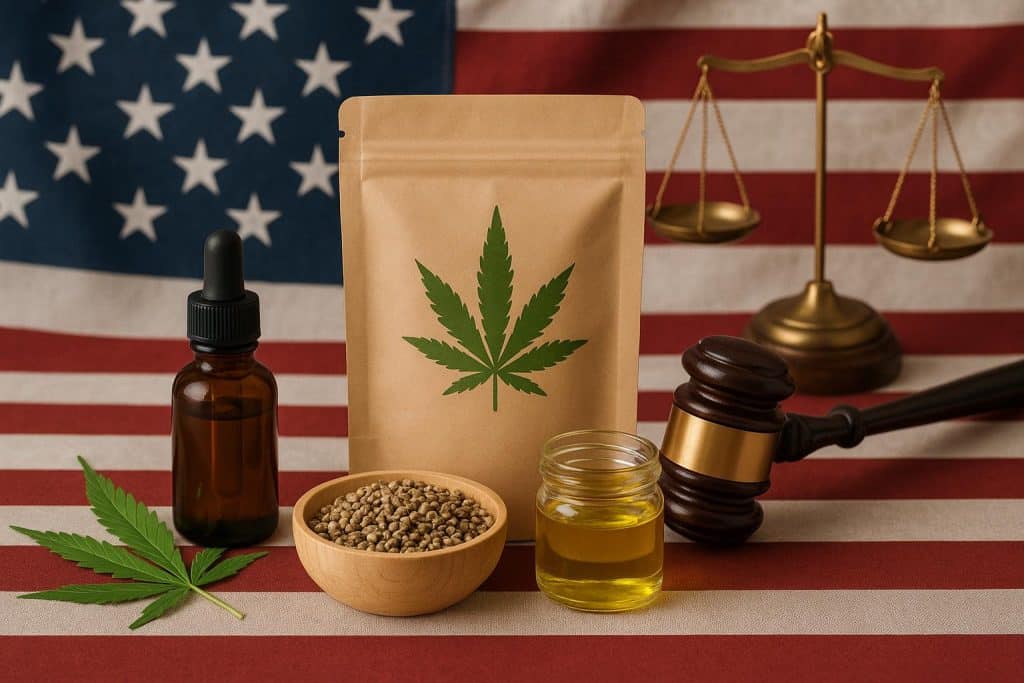
Selling or buying hemp in the United States carries real legal weight. From federal hemp regulations under the 2018 Farm Bill to a growing patchwork of state hemp laws, every brand and every consumer needs to know what hemp product compliance truly means. Without it, a product is not just risky — it is potentially illegal, regardless of how well it is made or how good it looks on a shelf.
One brand that excels at legal product compliance is TRE House, a leading name in legal recreational hemp and mushroom products. Compliance is not a checkbox — it is the standard every product is built around. From hemp labeling requirements and hemp testing requirements to hemp packaging requirements, hemp marketing compliance, and state-specific rules across California, Texas, Florida, and New York, this guide covers it all. Clear, current, and built for 2026 — so you always know exactly what a compliant hemp product looks like.
What is Hemp Product Compliance and Why Does it Matter in 2026
The legal hemp market has grown fast — and so have the rules that govern it. Understanding hemp product regulatory compliance is now a non-negotiable for every brand that sells and every adult who buys.
Definition of Hemp Product Regulatory Compliance
It refers to the full set of legal standards a hemp product must meet to be manufactured, labeled, sold, and shipped lawfully in the United States. This includes meeting the THC threshold compliance limit of 0.3% delta-9 THC on a dry weight basis, passing required hemp product lab testing, carrying accurate labels, using safe ingredients, and adhering to both federal hemp regulations and applicable state hemp laws. A product that misses even one of these standards is not legally compliant — regardless of intent.
Federal vs State-Level Compliance Overview
Federal compliance starts with the 2018 Farm Bill, which removed hemp from the Controlled Substances Act and set the 0.3% delta-9 THC threshold compliance rule. The USDA oversees hemp cultivation, while the FDA holds authority over consumable and ingestible hemp products. But federal hemp regulations are only the floor. Every state layers its own rules on top — some stricter, some more permissive. Brands operating nationally must satisfy both levels simultaneously, making hemp-derived product compliance a moving target that requires constant monitoring across all active markets.
Why Compliant Hemp Products Matter for Consumers and Brands
For consumers, buying compliant hemp products means knowing exactly what is in the product, that it has been third-party tested, and that it meets legal safety standards. For brands, non-compliance means pulled products, lost revenue, legal liability, and damaged trust. The hemp market rewards transparency. Brands like TRE House that invest in hemp product regulatory compliance — through rigorous testing, honest labeling, and clean formulations — build long-term consumer confidence that no marketing budget can replace. Compliance is not just legal protection. It is a brand asset.
What makes a Hemp Product Compliant in the United States?
Compliance is not a single rule — it is a layered set of standards that covers formulation, testing, labeling, and manufacturing. Miss any one layer, and even the best-made product can fall outside the law.
2018 Farm Bill Requirements (Delta-9 THC Threshold)
The 2018 Farm Bill is the legal backbone of the entire hemp industry in the United States. It defines hemp as Herb containing no more than 0.3% delta-9 THC on a dry weight basis — and that single number separates a compliant hemp product from a federally controlled substance. Any product that exceeds this THC threshold compliance limit, even slightly, is no longer classified as hemp under federal hemp regulations. Every formulation decision a brand makes starts here, because this threshold is absolute and non-negotiable.
Total THC Compliance and Formulation Standards
Total THC compliance goes beyond delta-9 alone. It accounts for THCA, which converts to delta-9 THC when heated — a calculation that regulators in many states now require. The formula used is: Total THC = delta-9 THC + (THCA × 0.877). Brands must apply this during formulation to ensure the finished product genuinely stays within legal limits. Hemp product potency and contaminant testing at a certified lab confirm these numbers before any product ships. Responsible brands build this verification into every production batch — not as an afterthought, but as a standard step.
Ingredient Safety and Federally Allowed Components
Beyond THC limits, hemp product legal requirements extend to every ingredient in the formula. All components must be food-safe, accurately disclosed, and appropriate for the intended product format. The FDA has not approved CBD as a food additive or dietary supplement ingredient under federal law, which means brands must tread carefully when formulating ingestible products. Using GRAS (Generally Recognized As Safe) ingredients, avoiding unapproved novel compounds, and maintaining full ingredient transparency are all part of building genuinely compliant hemp products that hold up to scrutiny at both the federal and state levels.
Manufacturing Standards and Quality Control
A product can have a compliant formula and still fail compliance if it is manufactured poorly. Consistent hemp product regulatory compliance requires production facilities to follow Good Manufacturing Practices (GMP) — the same quality control framework used across food and supplement production. This means controlled environments, documented processes, batch traceability, and staff training. At TRE House, every product goes through a structured quality control process before it reaches consumers. Third-party hemp testing on finished batches confirms that what is on the label matches what is in the product — every single time.
Are Hemp Products legal in all 50 States?
Federal law opened the door for hemp — but not every state walked through it the same way. Hemp is broadly legal nationwide, but the rules that govern it change significantly depending on where you are.
Federal Legality vs State Restrictions
Under federal hemp regulations, the 2018 Farm Bill legalized hemp and hemp-derived cannabinoids across all 50 states — provided the product meets the 0.3% delta-9 THC threshold compliance standard. That federal baseline means compliant hemp THC products can legally be manufactured and sold nationwide in principle. However, federal law does not override state authority. Individual states retain the right to impose stricter limits, ban specific cannabinoids, or require additional licensing. This means a product that is fully compliant at the federal level may still be restricted or prohibited in certain states.
States With Stricter Hemp Compliance Rules
Several states have moved well beyond federal minimums when it comes to hemp compliance requirements. Some have set lower THC thresholds, banned delta-8 or delta-10 THC outright, or restricted the sale of ingestible hemp products altogether. Idaho, for example, enforces a zero-tolerance THC policy. Others, like Oregon and Colorado, have introduced robust cannabinoid product compliance frameworks with their own testing and licensing layers. Brands selling nationally must map every active market against current state hemp laws and update that map regularly — because state legislation in this space moves fast.
Why Laws Vary Across California, Texas, Florida, and New York
Each of these four states represents a major DTC market — and each has taken a distinct regulatory approach. California hemp product compliance involves some of the most detailed labeling and testing requirements in the country. Texas consumable hemp compliance has tightened significantly, with new rules targeting ingestible cannabinoid products. Florida hemp extract compliance enforces strict packaging and age-restriction standards. New York cannabinoid hemp compliance operates under a structured Office of Herb Management framework with its own labeling rules. Knowing each state’s current posture is essential for any brand shipping THC products across these markets.
Hemp Compliance Requirements
Launching a hemp product without a compliance framework is one of the fastest ways to run into legal trouble.
Licensing and Registration Requirements
Hemp licensing requirements by state vary significantly, but most states require some form of registration or permit before a brand can legally manufacture, distribute, or retail hemp products. At the federal level, hemp cultivators must register with the USDA. Processors and retailers face state-specific requirements that can include facility inspections, product registration fees, and annual renewals. Skipping this step is not a gray area — operating without the correct licenses puts an entire business at risk. Brands must verify hemp product registration requirements in every state they actively sell into.
Product Formulation Compliance
Every ingredient, cannabinoid, and additive in a hemp product must meet hemp product legal requirements before the formula is finalized. This means confirming the delta-9 THC level stays within the 0.3% federal limit, verifying that all ingredients are food-safe and accurately listed, and avoiding any compounds that individual states have restricted or banned. Total THC compliance must also be calculated using the correct formula — not just delta-9 in isolation.
Testing and Documentation
Hemp COA requirements demand that every product batch be tested by an accredited third-party hemp testing laboratory before it reaches consumers. The resulting Certificate of Analysis must confirm cannabinoid potency, verify total THC compliance, and screen for contaminants, including pesticides, heavy metals, residual solvents, and microbials. These results must be batch-specific — not generic or recycled from previous runs. At TRE House, every SKU carries a publicly accessible COA so consumers can verify what they are buying.
| Testing Requirement | What It Covers | Required? |
| Cannabinoid Potency | Delta-9 THC, CBD, THCA levels | Yes — every batch |
| Total THC Calculation | Delta-9 + (THCA × 0.877) | Yes — federally required |
| Pesticide Screening | Residual agricultural chemicals | Yes — most states |
| Heavy Metals | Lead, mercury, arsenic, cadmium | Yes — most states |
| Residual Solvents | Extraction byproducts | Yes — for extracts |
| Microbial Contaminants | Mold, yeast, bacteria, E. coli | Yes — ingestible products |
Hemp Product Lab Testing and COA Requirements
Without verified results from an accredited laboratory, no hemp product can genuinely claim to be safe, legal, or trustworthy.
Do Hemp Products Need Third-Party Lab Testing?
Yes — and in most states, it is not optional. Third-party hemp testing is required because it removes any conflict of interest from the equation. An in-house test conducted by the same brand that made the product carries no independent credibility.
What Is a Certificate of Analysis (COA)?
A Certificate of Analysis is the official document produced by a licensed testing lab that confirms what a hemp product actually contains. Strong hemp COA requirements mean this document must include cannabinoid potency results, contaminant screening outcomes, and the batch or lot number. Brands that publish COAs openly, as TRE House does for every SKU, give consumers the ability to verify their purchase before it arrives.
Hemp Product Potency and Contaminant Testing Explained
It covers two distinct but equally important categories. Potency testing confirms the cannabinoid profile — including delta-9 THC, CBD, THCA, and other active compounds — to verify the product delivers what its label claims. Contaminant testing screens for pesticide residues, heavy metals like lead and mercury, residual solvents from extraction, and microbial threats, including mold and bacteria. Both categories must pass before a product is cleared for sale.
Hemp Labeling Requirements in the United States
Every field on that label — from cannabinoid content to batch ID — carries a compliance obligation that no brand can afford to overlook.
What Labels Must a Compliant Hemp Product Include?
A hemp product labeling checklist must cover the product name, net weight or volume, serving size, total cannabinoid content per serving, full ingredient list, allergen disclosures, batch or lot number, and the manufacturer’s name and address. These are not optional additions — they are core hemp labeling requirements under both federal guidance and most state frameworks.
Required Product Information (Ingredients, THC Content, Batch ID)
The ingredient statement requirements for hemp products demand a full, accurate list of every component, in descending order of predominance. THC content must be declared per serving and per package. The batch ID ties the product directly to its batch-specific COA, allowing anyone to trace the product back to its lab results.
QR Code COA Hemp Products and Digital Transparency
The QR code COA hemp products standard is rapidly becoming a baseline expectation — and a legal requirement in several states. A scannable QR code printed directly on the packaging gives consumers instant access to the product’s third-party lab results. At TRE House, every product carries a QR code linked to its current, batch-specific COA — making verification fast, easy, and completely accessible to any consumer who wants it.
State-by-State Hemp Product Compliance
California, Texas, Florida, and New York represent four of the highest-volume DTC hemp markets in the country, and each operates under its own distinct regulatory framework.
| State | Key Requirement | Strictness Level | Notable Rule |
| California | Detailed labeling + testing | Very High | Opaque, resealable packaging required |
| Texas | Consumable hemp registration | High | The 2026 rules restrict certain cannabinoids |
| Florida | Child-resistant packaging | High | Hemp extract retailers must register |
| New York | OCM cannabinoid framework | Very High | Strict labeling and potency caps |
California Hemp Product Compliance
It is among the most demanding in the country. The state requires detailed cannabinoid labeling rules that go beyond federal minimums — including specific font sizes for warnings, opaque and resealable packaging for edibles, and batch-level COA accessibility. California also restricts certain cannabinoids and has proposed potency caps on ingestible hemp products.
Texas Consumable Hemp Compliance
The Texas Department of State Health Services (DSHS) requires all consumable hemp products — including tinctures and beverages — to be registered before sale. New 2026 rules have placed additional restrictions on certain hemp-derived cannabinoids, with heightened scrutiny on products containing delta-8 THC and other semi-synthetic compounds.
Florida Hemp Extract Compliance and Packaging Rules
It is governed by the Florida Department of Agriculture and Consumer Services (FDACS), which requires hemp extract retailers and manufacturers to hold active licenses. All ingestible hemp products must use child-resistant packaging, comply with hemp standards, and carry clear warning labels. Florida also requires that product labels include a scannable link or QR code to the COA hemp products reference so consumers can access lab results directly.
New York Cannabinoid Hemp Compliance and Labeling Laws
It sits under the authority of the Office of Herb Management (OCM), which enforces one of the most structured cannabinoid frameworks in the United States. New York imposes potency caps on cannabinoid hemp products, mandates specific cannabinoid labeling rules, including serving size declarations and total cannabinoid content, and prohibits packaging that could appeal to minors.
How to Identify a Compliant Hemp Product as a Consumer
Knowing what to look for before you buy is the most reliable way to protect yourself and make informed purchasing decisions.
How to Read a COA Before Buying
At TRE House, every product’s COA is publicly accessible — making it easy for any consumer to verify hemp product potency and contaminant testing results in seconds.
Red Flags of Non-Compliant Hemp Products
- No COA available, or COA cannot be matched to the product batch
- Missing ingredient statement or incomplete label information
- No manufacturer name or address on the packaging
- Vague or undisclosed THC content per serving or per package
- Medical or disease claims anywhere on the label or website
- No warning statements or age restriction language
- Outdated or recycled COA not tied to the current production batch
- No child-resistant packaging on ingestible products
Why Transparency Matters in Hemp-Derived Products
Product transparency that hemp brands offer is not just a competitive advantage — it is a consumer right. When a brand publishes third-party tested hemp product results openly, discloses every ingredient, and makes its COA easy to find, it is demonstrating accountability that no marketing copy can replace. Consumers who prioritize transparency when choosing hemp-derived product compliance standards protect themselves from underdosed, contaminated, or illegally formulated products.
How TRE House Sets the Standard for Hemp Product Compliance
Compliance at TRE House is not a minimum standard — it is the starting point every product is built from.
Commitment to Third-Party Testing and COA Transparency
Every TRE House product is tested by an independent, ISO-accredited laboratory before it reaches any consumer. The resulting batch-specific COA covers full cannabinoid potency, total THC compliance, and a complete contaminant panel — and it is published directly on the product page for anyone to access. This is not a marketing move. It is a commitment to hemp product lab testing integrity that every responsible brand in this industry should maintain.
Farm Bill-Compliant Formulations and Quality Standards
Every THC product in the TRE House lineup is formulated to meet or exceed the federal THC threshold compliance standard set by the 2018 Farm Bill. Delta-9 THC levels are verified in the finished product — not estimated from raw ingredient data. Manufacturing follows GMP guidelines throughout, with full batch traceability from formulation to final packaging.
Clean Ingredients and Responsible Product Development
TRE House formulates with naturally derived cannabinoids and food-safe ingredients — no unapproved novel compounds, no undisclosed additives, and no shortcuts on ingredient quality. Every formula is reviewed for hemp product legal requirements before production begins. This means full ingredient transparency on every label, GRAS-status components wherever possible, and formulations built to hold up under regulatory scrutiny in every active market.
Nationwide Availability and Regulatory Awareness
TRE House ships to all 50 states and maintains active awareness of state hemp laws across every market it operates in. When state regulations change — as they have in Texas, California, New York, and Florida — the brand responds with updated labels, formulations, or shipping restrictions as required.
FAQs about Hemp Product Compliance
What makes a hemp product compliant in the United States?
It must contain 0.3% or less delta-9 THC on a dry weight basis, pass third-party hemp testing for potency and contaminants, carry accurate labels with all required information, use food-safe ingredients, and meet both federal and applicable state requirements.
Are hemp products legal in all 50 states?
Federally compliant hemp products are broadly legal nationwide under the 2018 Farm Bill. However, individual states can impose stricter rules. Some states ban specific cannabinoids like delta-8 THC or restrict ingestible hemp products entirely.
Do hemp products need third-party lab testing?
Yes. Third-party hemp testing by an ISO-accredited, independent lab is required in most states and is the industry standard for verifying cannabinoid potency and screening for contaminants. A publicly accessible batch-specific COA is the proof consumers and regulators rely on.
What labels must a compliant hemp product include?
A hemp product labeling checklist must include product name, net weight, ingredient list, cannabinoid content per serving, batch number, manufacturer name and address, a QR code linking to the COA, and all required warning statements, including the FDA disclaimer and age restriction language.
Can hemp brands make wellness or medical claims?
No. Hemp marketing compliance prohibits any claim that a product treats, cures, prevents, or diagnoses a medical condition. Brands must avoid both direct disease claims and subtly therapeutic language. All marketing must stay within factual, non-curative territory and carry the required FDA disclaimer.
Are California hemp rules stricter than federal rules?
Yes. California hemp product compliance goes well beyond federal requirements — mandating opaque resealable packaging, detailed labeling standards, specific warning font sizes, and batch-level COA accessibility. California treats hemp edibles as a high-scrutiny product category with its own regulatory tier.
What changed in Texas hemp compliance in 2026?
Texas consumable hemp compliance tightened in 2026 with new restrictions on certain hemp-derived cannabinoids — particularly delta-8 THC and semi-synthetic compounds. All consumable hemp products must be registered with the Texas DSHS before sale, and labels must meet updated state standards.
Legal Disclaimer and Consumer Responsibility
The Food and Drug Administration has not evaluated these statements. This product is not intended to diagnose, treat, cure, or prevent any disease. For use by adults 21+ only. Keep out of reach of children. All products contain less than 0.3% delta-9 THC on a dry weight basis and are compliant with the 2018 Farm Bill. Laws regarding hemp-derived THC products vary by state. Consumers are responsible for knowing the laws in their jurisdiction.