

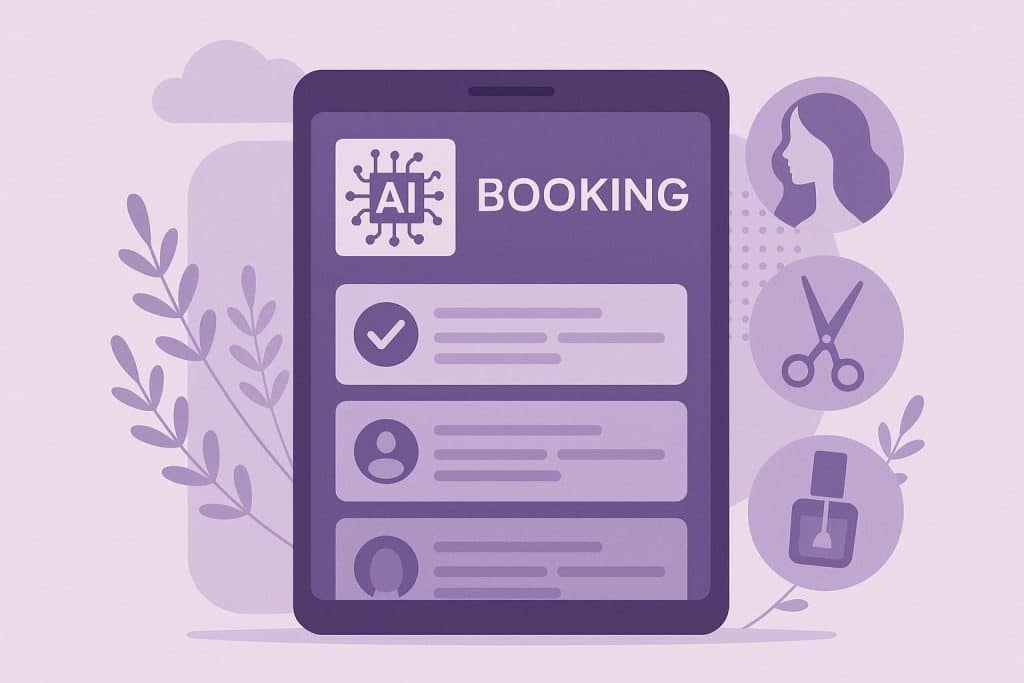
For a long time, the average hair salon and the average dental office had something in common: a paper appointment book, a wall calendar, and a phone that rang constantly. Dentists modernized a decade ago. Salons, mostly, did not. That is finally changing — and the speed of the shift in 2025 surprised even the people building the tools.
A new generation of salon booking software aimed at salons, spas, barbershops and aesthetic clinics is doing what enterprise software did to retail twenty years ago: replacing manual coordination with quiet automation. The interesting part is not that it is happening. It is why it is happening now, and what the next twelve months are likely to look like.
The paper-diary problem
The traditional salon runs on what insiders call “the book”: a leather-bound diary at the front desk, scratched-out appointments, sticky notes for walk-ins, and a phone that has to be answered between blow-dries. It works — until it doesn’t.
The economics are punishing. Industry surveys consistently put no-show and late-cancellation rates between 15% and 25% at salons that rely on phone bookings alone. For a six-chair studio with an average ticket of $90, that is roughly $300 of revenue evaporating per chair per week. Multiply across staff, weeks, and locations, and the cost of “we’ll just call to confirm” runs into six figures a year.
Add the soft costs — receptionists tied up on the phone instead of selling retail, double-bookings that sour client relationships, and the simple fact that 60% of bookings happen outside business hours when no one is at the desk to take the call — and the case for software is no longer subtle.
What “AI-powered” actually means
Most marketing copy in this space throws around the word AI without saying much. In practice, three things have moved from buzzword to baseline:
Smart scheduling. Modern platforms now handle the constraint puzzle that used to take a senior receptionist twenty minutes per booking — matching service duration, room availability, technician skill, equipment requirements, and walk-in buffers without a human reviewing each slot.
Photo-based onboarding. A salon owner can now snap a photo of their existing paper price list and have a working digital catalog in under a minute. ZibaDesk and a small number of competitors use vision models to extract services, prices, durations and categories from a single image — collapsing what used to be a half-day of data entry into a coffee break. For an industry where 70% of operators have never set up a software system before, this single feature has done more to drive adoption than any marketing campaign.
Multilingual interfaces. Salons in cosmopolitan cities employ technicians from a dozen language backgrounds. Tools that ship in eight languages out of the box — and that switch on a per-user basis — remove a barrier that used to push owners back to pen-and-paper after a frustrating onboarding week.
The economics that finally tipped it
Three things converged in the past two years to make the math irresistible.
First, SMS pricing dropped through the floor. Automated reminder texts now cost less than a cent each in most markets. A salon sending 800 reminders a month spends under $10 to recover what used to be $1,000+ a week in no-show losses.
Second, the cloud-stack collapsed. A single platform now handles bookings, point-of-sale, payments, inventory, customer history, loyalty, gift cards, accounting integration and reporting — work that used to require five separate tools and an integrator to wire them together. The all-in-one model means a $40-to-$80 monthly subscription replaces several hundred dollars of overlapping software plus the bookkeeper hours to reconcile them.
Third, mobile-first POS hardware became cheap. iPads with card readers cost under $400. Salons that resisted “computers” for years are comfortable with tablets, and the front desk hardware barrier — once a real obstacle — has effectively disappeared.
The integration effect
What separates the platforms that retain customers from the ones that churn is rarely a single feature. It is the connective layer.
A booking confirmed at 11pm on a Sunday automatically pulls up the client’s history, suggests the right service duration based on their last visit, books a compatible technician, sends a deposit-required SMS, blocks the slot in the calendar, and updates the inventory forecast for the consumables that service uses. None of that is impressive in isolation. All of it happening without anyone touching a screen is what changes how a salon runs.
The result, anecdotally and increasingly in industry data, is a labour reallocation. Front desk receptionists become customer-experience hosts. Owners spend their evenings reviewing reports rather than reconstructing the day. The chair time of senior technicians, which is the actual product the salon sells, increases by an estimated 8-12% in shops that have moved to fully integrated systems.
What’s next
Three trends to watch through 2026:
- Voice-first booking. The “phone agent” use case — an AI that answers the salon line, books appointments, and answers basic questions — is moving from demo to production. Salons that test it report 35-50% deflection of incoming calls within the first month.
- Dynamic pricing. Hotels and airlines have done this for decades. Salons are starting to experiment with off-peak discounts and surge pricing for prime Saturday slots. The data plumbing is finally there.
- Cross-location loyalty. Multi-site chains and franchises are adopting unified loyalty programs that travel with the customer. The salon down the street that is part of a network now has a structural advantage over the independent next door — at least until the independents adopt the same tools.
There is also a quieter trend worth flagging: the back-of-house automation that customers never see. Inventory reorder points that trigger automatically when retail stock dips. Wage reports that generate themselves at the end of each fortnight. Tax reconciliation that happens nightly rather than during a frantic week before the quarterly deadline. None of this is glamorous, none of it is going to feature in a product launch video, and all of it is the difference between an operator who works on the business and one who works in it. The tools that nail the unglamorous parts are the ones earning the long-term subscriptions.
The broader pattern is familiar to anyone who has watched other service industries digitize. Adoption looks slow, then sudden. The salons that will be running in 2030 are the ones quietly making the switch right now.
The wall calendar still has its place. It just isn’t running the business anymore.