

All companies are currently in the race to adopt Artificial Intelligence and see who can do it best, fastest, and most powerfully. But today, the real challenge lies in how to govern AI securely, scalably, and in an auditable manner. It’s not enough to simply implement AI solutions; the key is to do so securely.
And the Model Context Protocol (MCP) is proving crucial in this context, as it is transforming how companies manage the connection between AI models, corporate data, and business tools.
Organizations are facing many challenges as they accelerate AI implementation: poorly controlled access to sensitive business information, a rise in unauthorized tools, a lack of operational traceability, and regulatory compliance issues. This often happens because many companies using AI solutions are doing so without formal governance frameworks, explained Gartner.
What is MCP and why has it gained relevance?
MCP (Model Context Protocol) is “a new standard for connecting AI assistants to the systems where the data resides,” as defined by Anthropic in its documentation. Anthropic is the company behind this standard.
The goal of MCP implementation is to provide AI systems with a simple and reliable way to access the data they need, replacing fragmented integrations with a single protocol.
Before MCP, companies had to contend with fragmented architectures that were difficult to scale and very complex to audit. Now, companies can establish a standard communication layer between AI agents and internal company platforms such as CRMs, ERPs, or any other tools they use in their processes.
MCP introduces a new approach to governance by centralizing aspects such as access policies, authentication, and monitoring of AI interactions.
AI adoption: Does speed or control matter more?
In recent years, many companies have opted for faster AI implementation but with fewer controls. This has led to situations such as a proliferation of isolated initiatives, disconnected models, and what experts call “shadow AI,” referring to employees using external tools without corporate oversight.
This prompted company leaders to ask: how can we ensure that an AI model only accesses the correct information and performs authorized actions?
This is where the MCP standard comes in.
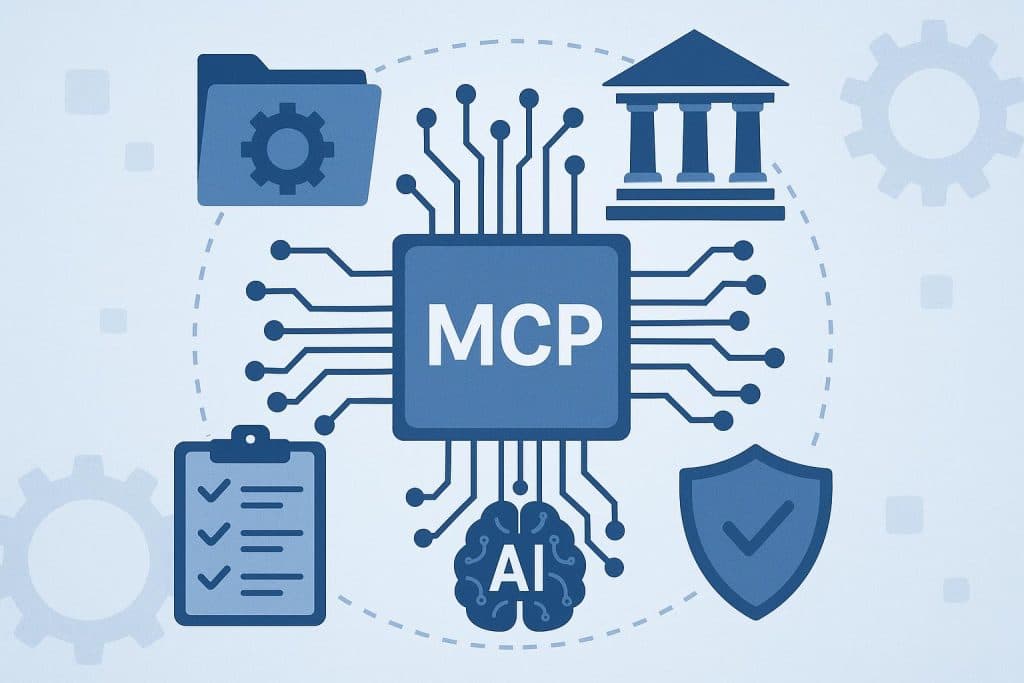
As a standardized layer between models and enterprise systems, the MCP allows you to:
- Define granular permissions by user, system, or agent.
- Log comprehensive audits of interactions.
- Apply centralized security policies.
- Limit execution capabilities based on context.
- Control which tools and data each AI agent can use.
AI Governance: The new strategic requirement in AI implementation
Robust governance frameworks are becoming increasingly essential as the adoption of autonomous agents grows.
According to the AI Risk Management Framework (AI RMF) of the National Institute of Standards and Technology, organizations must incorporate traceability, monitoring, and risk management mechanisms from the very design stage of their AI systems.
And the MCP fits perfectly into this goal because it:
- Facilitates the observability of decisions made by AI agents.
- Aids in centralized risk management.
- Controls inconsistent access.
- Validates external tools.
- Enables real-time operational traceability.
This is especially useful in industries such as banking, healthcare, insurance, and telecommunications, which are sectors with complex and stringent regulations.
The true value of the MCP: interoperability and scalability
Although many companies face technological fragmentation, the MCP reduces this complexity through an interoperable approach. Instead of building specific integrations for each model or vendor, organizations can create a single, reusable connection layer.
This results in:
- Less dependence on specific vendors.
- Lower integration costs.
- Faster agent deployment.
- More sustainable architectures in the long term.
In practice, the implementation of MCP allows governance to keep pace with the growth of AI, preventing organizations from accumulating technical debt or operational risks as they expand their initiatives.
The natural evolution of AI implementation in companies
Organizations must recognize that today it’s not just about implementing the most advanced AI models, but also about finding ways to operate these intelligent systems reliably, scalably, and securely.
MCP represents more than just a technical protocol; it’s becoming a strategic layer for governance, interoperability, and operational control in the next generation of enterprise AI solutions. Companies that adopt it will gain a valuable competitive advantage.
As AI ecosystems continue to grow in complexity, organizations will increasingly need standardized frameworks that allow different models, tools, and enterprise systems to communicate efficiently. In this context, MCP is emerging as a key enabler for sustainable AI adoption, helping companies accelerate innovation while maintaining visibility, compliance, and control across their entire AI infrastructure.