


AI agents have crossed a threshold. They’re no longer research prototypes or glorified autocomplete, they’re production-ready systems that researchers, developers, and business teams are actively deploying to handle real workflows. Two platforms that keep coming up in these conversations are Perplexity Computer and Eigent.
Both are positioned as AI coworkers that go beyond single-turn Q&A. Both can break down complex goals, delegate subtasks to specialized agents, and return synthesized results. But the similarities stop there. Their underlying philosophies where computation happens, who owns the data, and how much you can customize, are fundamentally at odds.
If you want to go deeper on Eigent’s architecture specifically, the team has published their own detailed breakdown of this comparison a useful companion read alongside this article.
This comparison cuts through the marketing to explain what each platform actually does, where each one shines, and which type of team is better served by each approach.
Eigent: An Open-Source AI Workforce That Runs on Your Machine
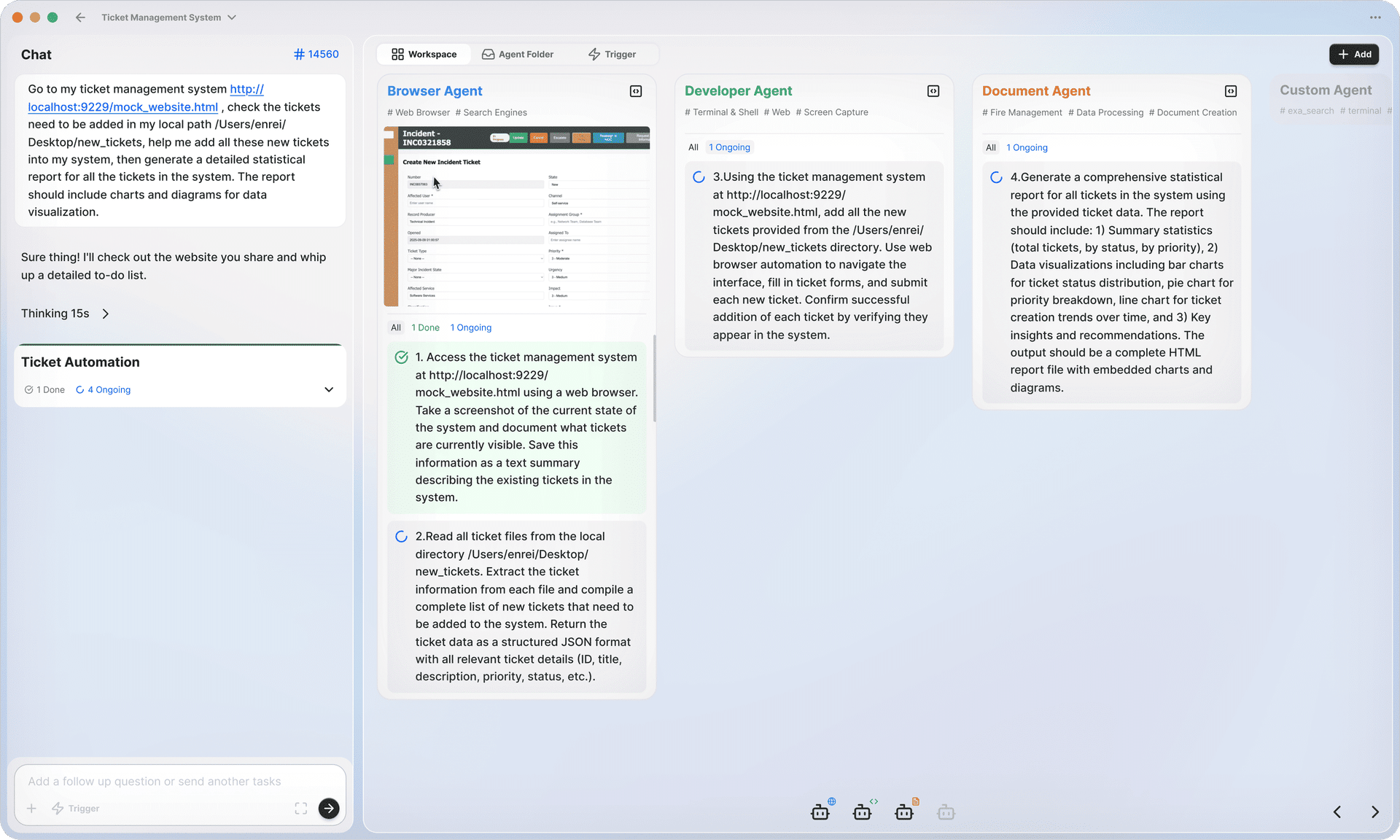
Instead of routing your work to a remote cloud, Eigent brings a multi-agent AI workforce directly to your desktop. The application runs locally on your machine, coordinating a team of specialized agents, Developer, Browser, Document, and multimodal workers that operate in parallel on tasks you assign.
Built on the CAMEL multi-agent framework, Eigent uses a root-planning-agent architecture: a top-level agent decomposes goals and dispatches work to subordinate worker agents, which communicate asynchronously and can tolerate partial failures. This design mirrors patterns from distributed systems engineering and makes Eigent unusually capable at long-running, multi-step workflows.
The technical stack reflects the desktop-first philosophy. Eigent uses a dual Python and TypeScript (Playwright) layer for browser automation, giving it native access to local files, desktop applications, and web sessions not a sandboxed simulation. It also integrates directly with GitHub, supports custom MCP (Model Context Protocol) servers, and exposes developer-friendly benchmarking primitives.
Critically, Eigent is fully open source and free to download. You connect your own LLM API keys whether that’s OpenAI, Anthropic, GLM, MiniMax, or locally hosted models via Ollama and you pay those providers directly for usage. The platform itself has no subscription cost.
Perplexity Computer: A Cloud-Powered Digital Worker
Perplexity Computer is the agentic tier of Perplexity’s AI platform, designed to turn high-level natural language goals into executed workflows. When you hand it a task say, compiling a competitive analysis, building a data dashboard, or drafting a multi-section report, it doesn’t just respond. It spawns a network of specialized sub-agents in its cloud infrastructure, each assigned to a slice of the problem, and assembles the results.
What makes Perplexity Computer technically interesting is its multi-model orchestration layer. Rather than routing everything through a single foundation model, it reportedly draws on roughly twenty models from different providers, using frontier reasoning models for planning, deep research models for synthesis, and specialized models for tasks like image generation or video processing. The platform selects and swaps models dynamically as your task evolves.
From the user’s perspective, the experience is intentionally simple. You describe what you want, and the system handles model routing, task decomposition, tool calls, and output delivery inside a managed cloud sandbox. The entry point is high-level; the inner mechanics are abstracted away.
The trade-off is significant: Perplexity Computer is a subscription-gated service, currently available through Perplexity Max at a price point of around $200 per month for individual users. All computation happens remotely, your prompts, files, and intermediate task states pass through Perplexity’s infrastructure.
Core Comparison: What Actually Differs Between These Two Platforms
Where Your Data Lives
This is the most consequential difference for many teams.
With Perplexity Computer, every task you run including the files, context, and intermediate outputs is processed in Perplexity’s cloud infrastructure. The sandbox is engineered for security, but the data leaves your environment by definition.
With Eigent, tasks run locally on your machine. Your source code, business documents, customer data, and research stay on your hardware unless you explicitly send them somewhere. For teams in regulated industries: healthcare, finance, legal, defense. This distinction isn’t a preference, it’s often a compliance requirement.
Eigent also supports fully offline workflows when combined with locally hosted open-weight models, making it viable in air-gapped environments where cloud connectivity isn’t available or permitted.
Openness and Auditability
Perplexity Computer is a proprietary SaaS platform. You interact with a polished interface, but the underlying orchestration logic, model routing decisions, and data handling are all opaque. You’re trusting the vendor’s documentation and security certifications rather than inspecting the code yourself.
Eigent’s codebase is publicly available on GitHub. Any engineer on your team can read exactly how agents are orchestrated, what external calls are made, and how data flows through the system. This level of transparency matters to compliance officers, security teams, and any organization that needs to understand what their AI tooling is actually doing.
It also means Eigent can be forked. If you need a modified version with custom behavior, internal integrations, or a different orchestration strategy, you can build it something that’s simply not possible with a closed-source SaaS platform.
Cost Model
Perplexity Computer’s pricing is fixed and subscription-based. At roughly $200 per month per user for the consumer tier, costs scale linearly with team size and don’t adjust based on how heavily or lightly you use the system in a given month.
Eigent’s cost structure is inverted. The platform is free; you pay only for LLM API calls, at rates set by your chosen providers. This means costs correlate directly with actual usage, a team running ten tasks a month pays far less than one running hundreds. It also means you can mix providers, using inexpensive models for simpler tasks and reserving premium reasoning models for work that genuinely needs them.
For research teams, startups, and cost-sensitive organizations, this difference in cost architecture is often decisive.
Depth of Automation
Both platforms can execute multi-step workflows, but the depth of what they can touch differs meaningfully.
Perplexity Computer operates through web APIs and cloud-accessible interfaces. It can interact with SaaS tools that have API connectors, retrieve information from the web, and synthesize outputs from cloud-connected services. What it cannot do is access your local desktop, your private network, your local file system, or applications that don’t expose an external API.
Eigent’s agents run with the same permissions as any process on your machine. They can read and write files, automate local applications, interact with private repositories, and control browser sessions with Playwright-level precision including navigating complex dynamic web apps that don’t have clean API surfaces. For software developers, data engineers, and anyone managing workflows that touch local infrastructure, this difference in automation depth is substantial.
Common Eigent workflows that simply aren’t possible in cloud-only architectures include:
- Automating local build pipelines and CI scripts
- Reviewing and summarizing open pull requests across private GitHub repositories
- Generating release documentation from local changelogs and commit histories
- Manipulating local file archives, databases, or proprietary data formats
Extensibility and Ecosystem
Eigent ships with support for custom MCP servers, allowing teams to wire in internal tools, databases, and APIs as first-class capabilities available to the agent workforce. It also inherits the CAMEL framework’s research-grade features: recursive agent architectures, failure-tolerant asynchronous communication, and a benchmark suite for evaluating agent performance.
Perplexity Computer offers a curated set of built-in SaaS connectors integrations with email, calendar, productivity tools, and other cloud services. These work well if your workflow fits the connector catalog. For teams that need to go beyond it, the options are limited; you can’t build arbitrary custom integrations or modify the underlying orchestration layer.
Feature Comparison at a Glance
| Feature | Perplexity Computer | Eigent |
|---|---|---|
| Deployment | Cloud (Perplexity infrastructure) | Local desktop (your machine) |
| Data stays on device | ✗ No | ✓ Yes |
| Open source | ✗ No | ✓ Yes (GitHub) |
| Offline / air-gapped support | ✗ No | ✓ Yes (with local models) |
| Local file & app automation | ✗ No | ✓ Native |
| GitHub workflow integration | Partial (via API) | Native |
| Model flexibility | Provider-managed | Bring Your Own Key |
| Platform cost | ~$200/month subscription | Free |
| Custom MCP servers | ✗ No | ✓ Yes |
| Setup complexity | Low (SaaS login) | Moderate (local install) |
| Best for | Non-technical users, cloud SaaS workflows | Developers, privacy-sensitive teams, OSS builders |
When Perplexity Computer Is the Better Choice
It would be intellectually dishonest to write off cloud AI orchestration as a category. For certain use cases and team profiles, Perplexity Computer genuinely excels:
Rapid deployment without technical overhead. If your team doesn’t have engineers comfortable with local configuration, API key management, and agent frameworks, Perplexity Computer’s zero-installation SaaS experience is a real advantage. You’re operational within minutes.
Non-technical stakeholders. Business users who need to delegate high-level tasks — “research our top five competitors and produce a comparison memo” — benefit from a clean, goal-driven interface that doesn’t require understanding what’s happening under the hood.
Frontier multi-model access. Perplexity’s model harness coordinates capabilities across reasoning, research, vision, and media that would be difficult to replicate locally in 2026. For tasks that genuinely benefit from the best available models working in concert, the cloud layer adds real value.
Cloud-native SaaS workflows. If your entire workflow lives in cloud tools — email, Slack, CRMs, cloud storage — Perplexity Computer’s built-in connectors provide a smoother integration path than manually configuring a local agent to reach each service.
When Eigent Is the Stronger Fit
Eigent occupies a different part of the market, and its advantages are most pronounced in specific circumstances:
Privacy-critical and compliance-driven workflows. When your data can’t leave the building — whether due to regulation, contractual obligation, or organizational policy — local execution isn’t a preference; it’s a requirement. Eigent’s on-device architecture satisfies this constraint without forcing you to give up multi-agent AI capabilities.
Developer-centric automation. Software teams that want AI agents deeply integrated into their development workflows — reading local repositories, running build scripts, triaging GitHub issues, generating documentation — need the kind of close-to-the-metal access that only a locally running system can provide.
Cost-sensitive and experimental teams. Research groups, startups, and teams exploring agentic AI without committed budget benefit from Eigent’s free platform and pay-per-use model. The cost of experimentation is dramatically lower than a fixed premium subscription.
Organizations that need auditability. If your security or compliance team needs to understand exactly how your AI tooling processes data, Eigent’s open source codebase makes that possible. With Perplexity Computer, you can audit documentation not code.
Long-term platform independence. Building critical automation workflows on a proprietary SaaS platform creates vendor dependency. If pricing changes, the product pivots, or the company is acquired, your workflows are at risk. Eigent’s open source foundation means you own the stack.
Conclusion
Perplexity Computer and Eigent are both serious AI agent platforms, but they’re built around fundamentally different assumptions about what matters most.
Eigent optimizes for ownership: it keeps your data local, opens the entire codebase for inspection, gives you deep automation access to real desktops and real file systems, and lets you choose and pay for your own models. The setup requires more from you, but what you get in return is an AI workforce that’s truly yours.
Perplexity Computer optimizes for accessibility: it abstracts complexity, bundles frontier models, and delivers a fast path to value for teams that prioritize convenience over control.
If your work involves sensitive data, developer workflows, or a genuine need to understand what your AI tooling is doing, Eigent’s open source local architecture is worth serious consideration. It’s free to download, active on GitHub, and runs in minutes.
Frequently Asked Questions
Is Perplexity Computer available to all Perplexity users? No. As of early 2026, Perplexity Computer is available exclusively to Perplexity Max subscribers, which is a premium tier priced at approximately $200/month for individual consumers.
Does Eigent require technical expertise to set up? No. Although Eigent is primarily designed for knowledge workers who want to boost productivity. Users can just download and start to use it. For developers, setup involves installing the desktop app, configuring LLM API keys, and optionally connecting GitHub or MCP servers. It’s not as turnkey as a SaaS login, but the Eigent documentation walks through the process step by step.
Can Eigent access the internet and external services? Yes. Eigent’s browser agent can access the public web and interact with external services. The key distinction is that it does so from your local machine, with your credentials and under your direct control — not via a remote cloud sandbox.
What LLM providers does Eigent support? Eigent supports a wide range of providers via its Bring Your Own Key model, including OpenAI, Anthropic, GLM, MiniMax, and locally hosted models through Ollama. Teams can mix and match providers to balance cost and capability.
Is Eigent suitable for enterprise use? Yes, particularly for enterprises with data residency requirements, air-gapped network constraints, or compliance mandates that prevent sending data to external cloud services. The open source codebase also supports internal audits that SaaS platforms cannot provide.
Where can I try Eigent? Eigent is free to download from eigent.ai. The source code is available on GitHub.