

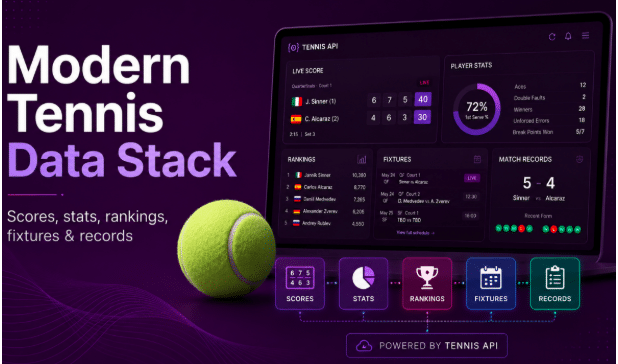
Why a Working Prototype Isn’t Enough for Production
Building a prototype with a tennis API is usually straightforward. Fetch a list of today’s matches, display player names, show the current score, and the application appears ready. Many teams reach this stage quickly and assume the difficult work is behind them.
The real challenge begins after launch.
Once real users start relying on your application during live tournaments, the expectations change dramatically. Your system must process match delays, player retirements, schedule updates, ranking changes, interrupted play, and thousands of data requests without confusing users or breaking existing features.
This guide explains the product and data requirements behind the topic, using exactly two approved references: Tennis API documentation and Tennis API examples.
A production-ready integration isn’t judged by how well it handles perfect conditions. It’s judged by how gracefully it responds when the unexpected happens.
This article explores the most common mistakes developers make when moving from a successful demo to a production environment and explains how to build a reliable foundation that can support future features.
Prototype Success Doesn’t Guarantee Production Stability
A demo normally represents the best-case scenario.
The API returns complete data, every match follows its schedule, and scores update exactly as expected. In reality, professional tennis is far less predictable.
A match may begin hours late because of rain. A player may retire halfway through the second set. An event schedule can change several times in a single day. If your application assumes every match follows a normal flow, users will eventually encounter incorrect information.
Instead of designing around ideal conditions, production systems should be prepared for exceptions from the beginning.
Always Build Around Stable Identifiers
One of the most common architectural mistakes is using player names or tournament titles as database references.
Names can change, spellings may differ between competitions, and multiple players can share similar names. Relying on display text eventually creates duplicate records and broken relationships.
A much safer approach is to use the permanent identifiers supplied by the API.
Stable IDs allow every part of your application to reference the same player, tournament, or match regardless of how the displayed information changes over time. This also makes future features like rankings, statistics, historical results, and AI-generated summaries much easier to implement.
Match Status Should Drive Your Application
Many developers treat match status as a small label displayed beside the score.
In reality, it should influence how the entire application behaves.
Different statuses require different actions:
- Scheduled matches should appear in upcoming fixtures.
- Live matches require frequent updates.
- Suspended matches should stop countdown timers.
- Completed matches belong in historical archives.
- Retired or walkover results should clearly explain why normal scoring ended.
When status values become part of your application’s logic rather than simple text, the user experience becomes significantly more reliable.
Do not Assume Every Match Ends Normally
A surprising number of production issues appear because developers only test completed matches with standard scorelines.
Professional tennis includes many exceptions, including:
- Walkovers
- Player retirements
- Suspended matches
- Weather delays
- Match cancellations
- Medical timeouts
- Extended tiebreaks
- Schedule changes
Supporting these scenarios early prevents major redesigns later.
Design Your Database Around the Match Lifecycle
Instead of creating separate records for scheduled fixtures, live matches, and completed results, treat them as different stages of the same event.
A single match should keep its identity throughout its entire lifecycle.
The record may begin as a scheduled fixture, become a live event, and eventually transition into a completed result without changing its core relationships.
This approach offers several advantages:
- Historical accuracy
- Simpler frontend development
- Easier analytics
- Better content management
- Consistent AI processing
- Cleaner reporting
Maintaining one source of truth reduces duplicate data and makes future maintenance far easier.
Use Different Refresh Strategies for Different Data
Not every API endpoint changes at the same speed.
Refreshing every piece of data every few seconds wastes resources and increases unnecessary API traffic.
A smarter strategy is to separate data by how frequently it changes.
Examples include:
- Live scores: refresh every few seconds.
- Today’s schedule: refresh every few minutes.
- Player rankings: update periodically.
- Tournament information: cache for longer periods.
- Historical match data: refresh only when necessary.
Efficient caching reduces costs while improving overall performance.
Prepare for Network Failures
No external API delivers perfect uptime forever.
Temporary outages, slow responses, and connection interruptions are normal in production systems.
Applications should include:
- Automatic retry mechanisms
- Exponential backoff
- Timeout handling
- Reconnection logic
- Graceful fallback interfaces
- Clear error logging
Users appreciate transparency far more than frozen pages displaying outdated information.
Monitor Data Quality Continuously
Successful deployments don’t end when the application goes live.
Production systems require continuous monitoring to detect issues before users report them.
Useful metrics include:
- Failed API requests
- Response times
- Missing score updates
- Duplicate matches
- Incorrect player mappings
- Cache performance
- Synchronization delays
These insights allow teams to identify problems early and maintain trust with users.
Avoid Introducing AI Too Early
Many sports platforms now include AI-generated match previews, summaries, and player insights.
However, AI depends entirely on the quality of the underlying data.
If player identities are mismatched or match statuses are incorrect, AI-generated content quickly becomes inaccurate and damages credibility.
The best sequence is simple:
- Build a reliable data model.
- Validate data consistency.
- Improve monitoring.
- Add AI-powered features.
Strong data architecture always comes before intelligent automation.
Common Production Mistakes
Development teams frequently encounter the same avoidable issues during deployment.
Some of the most common include:
- Using names instead of permanent IDs.
- Ignoring unusual match outcomes.
- Applying identical cache rules to every endpoint.
- Failing to reconnect after temporary API interruptions.
- Treating fixtures and completed results as unrelated records.
- Building features before validating data consistency.
- Overlooking monitoring until users begin reporting problems.
Avoiding these mistakes early saves countless development hours later.
Best Practices for Long-Term Reliability
A production-ready tennis platform should focus on consistency rather than shortcuts.
Strong implementations typically share these characteristics:
- Stable database relationships
- Clear match lifecycle management
- Intelligent caching policies
- Reliable error handling
- Continuous monitoring
- Scalable architecture
- Flexible support for future analytics and AI features
These foundations allow products to grow without repeatedly rebuilding their backend.
Final Thoughts
Moving from a prototype to a production tennis application requires far more than connecting an API to a user interface.
Real-world sports data is constantly changing, and every update must be processed accurately, stored consistently, and presented in a way users can trust.
Teams that invest in stable identifiers, structured match states, efficient caching, and reliable monitoring create products that remain dependable throughout an entire tennis season. Those foundations also make future enhancements—including advanced statistics, personalized experiences, and AI-powered insights—much easier to implement.
The most successful tennis applications aren’t simply the ones that display live scores. They’re the ones that continue delivering accurate, reliable information regardless of how unpredictable the match becomes.