

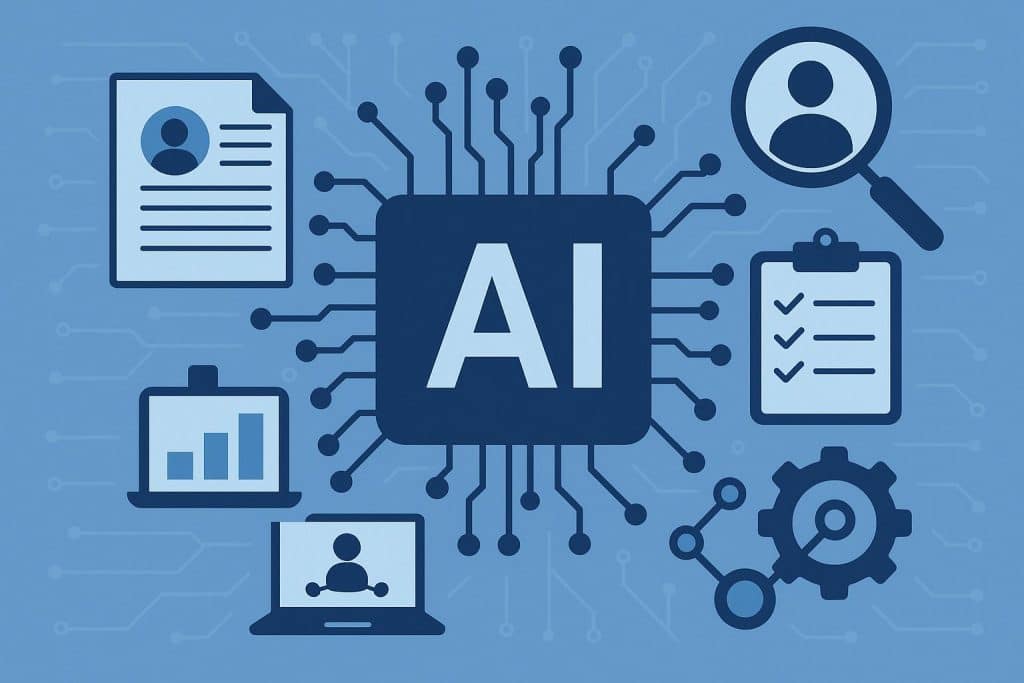
Traditional hiring assessments were not build for today’s talent, and it shows. Resumes pile up and conflicts in scheduling multiply. Quality candidates are often lost in the process as the recruiters waste their days on coordination that does not necessarily involve finding good people. The difference that occurred in 2026 is that more companies have made the decision to leave the initial stages of that process in the hands of AI recruiting agents, which have surpassed expectations in automating the top-of-hiring-funnel.
AI hiring tools that are propelling this change are not the cumbersome applicant tracking systems that recruiting departments have been complaining about over the decades. The advanced AI screening platforms filter resumes, video-interview candidates, score job seekers according to a variety of dimensions, and tie it all together to a single hiring pipeline, frequently by dawn before a human recruiter has finished their morning coffee.
Below is an overview of ten sites that are redefining the process of how organizations discover and select candidates in 2026 and what each of them is actually doing under the hood.
The reason why recruiting teams are deploying AI hiring agents:
Recruitment has never taken a shorter time than it has been budgeted by organizations. One vacant position may receive hundreds of applications. It is costly, haphazard, and time-consuming to screen them manually. Hence, it is no surprise that recruiting teams are increasingly moving toward automating the top-of-hiring-funnel.
AI hiring platforms have proven to be successful in automating:
- Screening and shortlisting of resumes beyond the capability of the human team
- Candidate matching that uses more data than a recruiter dipping in a PDF
- Organized assessment where the same criteria is applied to all the candidates, each time
- Outreach that does not take days of waiting time
As per multiple reports. the time to hire improves significantly for all sizes of companies using AI hiring software. However, companies with large hiring cycles are likely to experience the largest improvements.
10 Powerful AI Tools for Modern Hiring Teams in 2026
Rebecca AI Recruiter by Pete & Gabi
Best works with: Live interviewing and fully automated screening of candidates
Rebecca AI by Pete & Gabi is a part of the recruiting team. Right when a candidate submits an application, the AI hiring agent automates outreach, qualification, and interview, and manages the entire pre-recruiter workflow, without a recruiter being involved.
Key Features:
- AI-powered resume screening and ranking
- Voice and chat-based AI interviews
- Automated candidate follow-ups
- Integration with ATS and hiring pipelines
- Real-time candidate evaluation
Most appropriate for:
- High-volume hiring (BPOs, staffing firms, SaaS companies)
- Pre-screening large applicant pools
- Reducing recruiter workload in early stages
The distinguishing factor between Rebecca AI and most of the tools in this category is the level of autonomy. Rebecca does not simply flag applications to be checked by human beings. It has organized and dynamic discussions and provides graded shortlists. Instead of going through inboxes of applications, recruiters get finalists to go through.
Gem
Ideal fit: CRM recruiting and talent pipeline management
Gem works on an alternative assumption as compared to most hiring tools. Instead of solving speed, it is built for the teams that consider recruiting as a long-term relationship issue. The same candidate who was unsuitable a year and a half ago might be the very suitable one today.
Key features:
- Sourcing of candidates on LinkedIn and others
- Recovery of previous applicants
- Personalized outreach campaigns automation
- Exhaustive hiring funnel statistics
Most appropriate to: Develop passive candidate pipelines, enhance the rate of response to outreach, and monitor the outcomes of diversity hiring over time
The value of Gem increases with time. A team that has a long usage time enriches the database of the candidates.
HireVue
Best fits: Large-scale structured video interviews
HireVue has gone through multiple identity changes. In its present state it can allow organizations to conduct a structured video interview without a human interviewer attending every one
Key features:
- On-demand video interviews
- AI-based candidate scoring
- Cognitive tests in the form of games
- Structured interview forms
Best applied to: Campus and graduate recruitment, large recruitment drives, and companies that require all applicants to be assessed to the same model.
The consistency is the point when companies conduct hundreds of interviews monthly.
Pymetrics
Best for: Soft skills and behavioral hiring
Pymetrics does not enquire regarding experience on the part of the candidates. It has them play games. The neuroscience of the approach is based on the idea that cognitive and emotional patterns, which emerge when an individual is put under mild pressure, can predict job fit than anything said by the candidate in a conventional interview.
Key features:
- Cognitive and emotional gamified assessments
- Behavioral profiling
- Role correspondence on the basis of individual habits
- Bias-audited algorithms
Most appropriate in: Recruitment of early career employees, diversity and inclusion programs, and finding highly promising employees with atypical backgrounds
It is a unique product and has a consistent philosophy, which is, hire based on who you are rather than what you have already accomplished.
Fetcher AI
Best for: Outbound recruiting and automated sourcing
Recruiting operations’ most time-consuming aspect is identifying candidates, not analyzing them. Fetcher addresses that issue by presenting ready candidates on an on-demand basis, and a sourcer does not have to waste hours on LinkedIn.
Key features:
- Candidate sourcing
- Automated email outreach
- Talent pipeline tracking
- Diversity based sourcing filters
Best when there are hard-to-fill positions, passive recruiting candidates, and staffing recruiting teams without increasing headcount.
Fetcher works as a sourcing operation where sourcing is conducted in the background as the recruiters perform other tasks.
Eightfold AI
Best fits: Planning talent and workforce
Eightfold AI is built on the crossroads of recruiting and long-term workforce strategy. It is more focused on how the talent demands of a company will change in the coming few years rather than filling the current position.
Key features:
- Candidate matching according to skills
- Career path prediction
- Ideas of internal mobility and reskilling
- Deep learning-based talent analysis
Applicable to: Large companies with complicated hiring schemes, work force planning, and internal mobility programs.
Eightfold AI can deliver more to organizations that are seriously considering the future of their workforce than most recruiting tools are meant to deliver.
NeoRecruit
Best for: Conversational avatars interview automation
NeoRecruit is closer to the experimental part of this market. It involves avatar-based interviewers as opposed to voice or text, thus providing a user experience that is also unlike any other on this list.
Key features:
- Avatar interview presentation
- Multilingual support
- Semantic resume parsing
- Real-time candidate scoring
Most appropriate in: International recruitment on a time-zone basis, where the organization requires 24/7 access to interviews and reducing scheduling tension in distributed hiring processes
The time issue that has caused most organizations to fail in hiring more people than they would like to acknowledge is eliminated completely.
TestGorilla
Best fit: Pre-employment skill testing
TestGorilla is constructed under a simple agreement: discover what candidates can actually do prior to them coming in to be interviewed. It provides a knowledge base of skill tests with a broad amount of positions and fields.
Key features:
- Skill assessment collection of 300 or more
- Remote proctoring and anti-cheating
- Easy candidate comparison
- Technical and non-technical job coverage
Most appropriate to: Filters before interviews, jobs where demonstrated ability is more important than resume appearance, and minimizing the impact of resume bias when making initial decisions
The platform is not attempting to screen potential. It is trying to verify claims.
Adaface
Best applicability: Technical recruitment and developer tests
Majority of the coding tests feel like punishment. Adaface was created to solve that problem. Its tests are formatted more like a conversation instead of challenging developers with abstract algorithmic problems that are not related to the work.
Key features:
- Assessments of conversational coding
- Problems of real-world programming
- Candidate-friendly interface
- Detailed skill reporting
Most appropriate: Recruitment of software engineers, technical evaluation at scale, and companies who have lost clients to poor assessment processes.
Its popularity in engineering hiring circles has been achieved because of the candidate’s experience improvement alone.
Glider AI
Applicable in: Fraud detection in end-to-end hiring
In glider, the assessments, interviews, and performance benchmarking are incorporated within one platform with fraud detection embedded in the evaluation.
Key features:
- Coding and non-coding exams
- Proctoring and fraud detection remotely
- Role standards benchmarking the candidates
- ATS integration
Best applied to: When the stakes are high, and the technical aspects of the job matter; when the integrity of the assessment is valued; when the end-to-end processes of evaluation have to stand-up in court.
The rigor is important where a bad employee is genuinely expensive.
Frequently asked questions
Which AI hiring tool is the best?
There is no simple answer to this, and any vendor who suggests otherwise is selling something. The correct tool will be determined by the manner in which your recruiting operation will appear.
Hiring volume: Operations with hundreds of roles per cycle are the ones that are likely to benefit the most when using such a platform as Rebecca AI or Fetcher.
Role type: The hiring of engineers and developers should be done with specialized tools.
Company size: What is successful with a team of fifty people might not be successful with a company of five thousand people, and the same.
Integration requirements: There is no option of not being compatible with existing ATS and HR systems.
Experience of the applicants: The treatment of the applicants as shown by a tool will reflect on the organization providing it.
What AI hiring tools offer as compared to traditional hiring process?
- Speed. It does not qualify as a minor improvement to process thousands of applications in the time that a human team would take to get through fifty. It transforms the operation of hiring completely.
- Better pattern recognition. Matching algorithms on more than a single point of data reveal candidates that a resume-skimming algorithm would fail to identify.
- Structural consistency. On different days, there is varying energy of a human interviewer. An effective assessment is not designed that way.
- Faster response times. The applicants that remain silent after 2 weeks are normally dead. That is where automated communication comes in.
- More time for judgment work. Automation is not a substitute of human recruiters but frees up their calendar so that they can be able to work on the activities that actually need them.
Where is AI Recruitment Heading?
The trend in this industry is in the direction of more autonomy. Tools that currently surface and screen candidates are moving toward managing entire workflow stages without human input at each step. Voice-based interviewing, predictive hiring analytics, and real-time candidate engagement are no longer edge cases. They are becoming table stakes.
That change will continue to accelerate. The question for recruiting teams is not how to use these tools but rather how to do it in such a way that allows maintaining what a hiring process is supposed to accomplish: finding the right person to do the work and treat every candidate with dignity.
The Bottom Line
There is a productivity issue with recruiting which cannot be solved through spreadsheets and calendars. The tools discussed here are tangible, individual components of the solution, and the finest of them accomplish it without dementing the experience of the people undergoing the process.
If faster hiring, lower cost-per-hire, and better use of recruiter time are the metrics that matter to your organization, the tools to achieve them already exist.