

When Credentials Actually Matter
There is a version of SPAC analysis that treats the board section of a prospectus as boilerplate — a list of names to be skimmed, credentials to be noted, and then set aside in favor of the financial terms and acquisition criteria. That approach works well enough when the board in question is a standard assembly of former bankers, industry veterans, and governance names cycling through multiple blank check vehicles simultaneously.
It does not work for BTECH Corporation. The S-1 that this Cayman Islands company filed with the SEC on May 21, 2026 — a $200 million offering targeting oil and gas assets across the full value chain, with a specific and commercially grounded mandate connecting hydrocarbons with AI-driven power demand — is built around a pair of central figures whose careers are worth understanding in depth, because they are the reason the deal looks the way it does.
Michal Krupinski and Farbod Pasha Asgharzadeh represent two entirely different kinds of professional formation. One spent his career inside the highest levels of European and global institutional finance, accumulating a network that stretches from Warsaw to Washington to Wall Street. The other spent his career at the physical intersection of engineering and energy construction in the UAE, managing the kind of complex marine and civil infrastructure projects that most people only read about in industry publications. What they share is a direct and specific relevance to the task BTECH has set itself: finding, buying, and improving energy assets in markets that require both institutional credibility and operational depth to navigate.
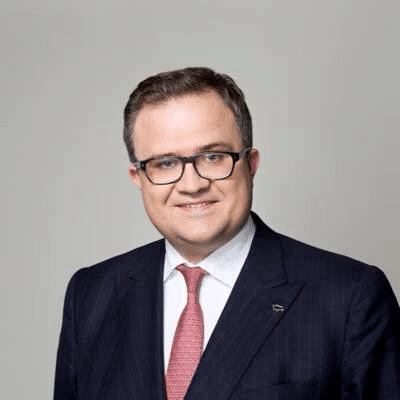
Michal Krupinski: From the Polish Ministry of Finance to the Boards of IBRD, PZU and Pekao
Krupinski was born in Kraków in 1981. By 25, he was Undersecretary of State at the Polish Ministry of Treasury — a position that made him, at that point in time, the youngest person ever to hold a ministerial appointment in the history of modern Poland. The significance of this is not simply biographical. Poland in the mid-2000s was in the middle of a complex transformation: integrating into the EU’s financial regulatory framework, privatizing former state assets, and managing the pressures of rapid economic development on sovereign financial policy. Being the official responsible for treasury affairs in that environment, at that age, required a combination of technical competence and political credibility that is not common in any era.
In 2008, he moved to Washington as Alternate Executive Director at the Board of Directors of the World Bank Group. In this role he represented multiple countries from Central and Eastern Europe and Central Asia at the boards of the International Bank for Reconstruction and Development, the International Finance Corporation, and the Multilateral Investment Guarantee Agency — the three principal lending and guarantee arms of the World Bank Group. He held this position through 2011, spanning the entire period of the global financial crisis. The decisions being made at those boards during those years — emergency lending facilities, sovereign credit lines, development finance restructuring across dozens of countries — were among the most consequential in the postwar history of multilateral finance. Krupinski was present and participating at the level where those decisions were made.
There is a specific kind of institutional credibility that only comes from having sat at tables where sovereign decisions were being made in real time, under genuine pressure. It cannot be simulated, and it cannot be acquired through advisory work alone.
From Washington he moved to Bank of America Merrill Lynch, where from 2011 he led Global Banking and Markets for Central and Eastern Europe. This is one of the most relationship-intensive and technically demanding regional banking mandates in international finance. The CEE coverage universe includes sovereign clients, major state-owned enterprises, privatizing companies, and the banking systems of more than a dozen countries at different stages of capital market development. The M&A, financing, and capital advisory work he was responsible for required both command of complex transaction structures and the kind of long-term relationship capital with government and institutional counterparts that takes years to build and cannot be transferred when a banker moves firms.
In 2016 he became President of the Management Board of PZU Group. PZU is not simply an insurance company — it is the dominant financial group in Central and Eastern Europe, with total assets of over $121 billion, more than 40,000 employees, and operations spanning Poland, the Baltic states, and Ukraine across insurance, banking, and asset management. Running it meant managing relationships with the Polish government as a major shareholder, with international institutional investors, with the bank regulators of multiple jurisdictions simultaneously, and with the complex web of subsidiaries and portfolio companies that a diversified financial group of that scale contains. Krupinski repositioned the firm for growth and deepened its banking presence during his tenure before moving, in June 2017, to Bank Pekao.
Bank Pekao is worth understanding in its own right. Founded in 1929, it is Poland’s second-largest universal bank and its leading corporate and investment bank, with revenues of $5.77 billion and net income of $1.6 billion as of 2025, and total assets approaching $81 billion. It had previously been owned by UniCredit, the Italian banking group, which sold its controlling stake in 2016 in a transaction that returned the bank to Polish state-adjacent ownership via PZU and the Polish Development Fund. Krupinski arrived at Pekao less than a year after that ownership transition, at a moment when the bank needed leadership that could manage the expectations of new Polish institutional shareholders, maintain relationships with the international investor base accumulated during the UniCredit years, and execute a strategic refresh under new governance. He served as President of the Management Board from June 2017 to December 2019.
His academic formation — Warsaw School of Economics, KU Leuven, MBA from Columbia University — reflects a deliberate construction of credentials that spans Polish institutional formation, European academic tradition, and U.S. capital markets training. It is not the background of someone who arrived at senior roles by proximity or timing. It is the background of someone who built a very specific set of capabilities, deliberately, over two decades.
What Krupinski’s Network Actually Means for Deal Flow
It is worth being concrete about what the above biography translates into in terms of practical deal-making capability for BTECH. The Central and Eastern European energy market — which includes upstream assets in Poland, Romania, Ukraine, and the former Soviet republics of Central Asia, midstream infrastructure across the Balkans and the Black Sea region, and downstream processing facilities that were built during the Soviet era and have been partially or fully privatized since — is one of the most relationship-dependent deal environments in global finance.
State-adjacent sellers in these markets do not respond to cold approaches from unknown counterparties. They respond to people who have sat across the table from their ministers, who have structured financing for their sovereign debt, who have appeared at the same international forums year after year and demonstrated continuity and credibility. Krupinski has done all of these things. The institutions he has led — the World Bank, Bank of America Merrill Lynch, PZU, Pekao — are not peripheral to these markets. They are defining institutions of them. His relationships are not a feature of the BTECH deal. They are, in the most literal sense, one of the primary assets the company is bringing to market.
Farbod Pasha Asgharzadeh: Engineering Credentials Built in the Most Demanding Construction Environment on Earth
If Krupinski represents the institutional finance dimension of the BTECH thesis, Farbod Pasha Asgharzadeh represents its engineering and operational counterpart — and his career is, in its own way, equally remarkable.
He holds a BA in Civil Engineering from University College London, one of the world’s leading engineering faculties, situated within one of the world’s leading research universities. The degree is not incidental to the story. Civil engineering at UCL is a rigorous technical formation in structural analysis, fluid mechanics, geotechnics, materials, and project management — the foundational disciplines for anyone who is going to spend their career managing the construction of large-scale physical infrastructure. It is also a formation that develops something that financial training does not: the instinct for what is physically possible, what costs what it costs, and where the gap between a project’s design and its execution is likely to occur.
From there, Asgharzadeh went to work in the UAE — and specifically in the marine contracting and civil construction sector, which is one of the most technically demanding and commercially complex segments of the global construction industry. The Gulf’s development program over the past three decades has required the construction of port infrastructure, offshore facilities, coastal protection works, reclamation projects, and marine terminals at a scale and pace that has no precedent in modern construction history. The companies that have executed this program — Dutco, ARCO, and their peers — are not household names outside the industry, but they are among the most operationally sophisticated construction organizations in the world.
At Dutco, Asgharzadeh was specifically responsible for the marine projects division. Marine construction is a subset of civil engineering that combines the technical complexity of offshore and coastal works with the logistical challenge of managing operations that are partially or entirely at sea. Breakwaters, quay walls, canal edge protection, offshore piling, reclamation, harbor and jetty projects, port developments — these are works that require coordination of specialized marine plant and equipment, management of tidal and weather conditions, integration of geotechnical and structural engineering inputs, and precise sequencing of work packages that cannot be resequenced when something goes wrong. Running the marine projects division of a contractor of Dutco’s scale means managing all of this simultaneously, across multiple active projects.
The gap between understanding an energy project and having managed one through its full construction lifecycle is the gap between being a good analyst and being a genuine operator. Asgharzadeh sits firmly on the operator side of that line.
His subsequent roles deepened the same capabilities in different contexts. At PLC Contracting he served as Division Head; at Overseas AST Co. LLC — a construction company established in 1959 and one of the oldest operating contractors in the UAE — he was Project Director from 2017 to 2020. At ARCO Turnkey Solutions, where he currently serves as Director of the Marine Contracting Division, he leads a division of a firm that has been active in the UAE’s turnkey contracting market since 1984, working across design and construction projects of exactly the type that BTECH’s acquisition mandate targets.
The Combination
The pairing of Krupinski and Asgharzadeh as the institutional anchor and operational lead of BTECH reflects a deliberate and sophisticated understanding of what it actually takes to execute the kind of cross-border energy acquisition this company is targeting. Finance and engineering are, in the context of large-scale energy infrastructure, not separate disciplines that happen to share a balance sheet. They are deeply interdependent. The ability to value a construction-phase asset correctly depends on understanding both its financial structure and its engineering reality. The ability to negotiate its acquisition requires both institutional credibility with the seller and operational credibility with the workforce and regulators who will assess the buyer’s capacity to complete what has been started.
The $200 million in trust — extendable to $230 million with the full exercise of the overallotment option — is the starting point. The 18-month window provides the discipline. The board provides the capability. What BTECH has constructed, at its core, is a mechanism for channeling institutional capital into energy infrastructure opportunities that conventional finance is currently underserving, managed by people who between them have the relationships, the technical judgment, and the institutional experience to convert that access into durable value. In an energy market being transformed by AI-driven power demand and reshaped by the retreat of traditional project finance, that mechanism has specific and current utility. The names at the top of the organizational chart are a large part of the reason to believe it.