

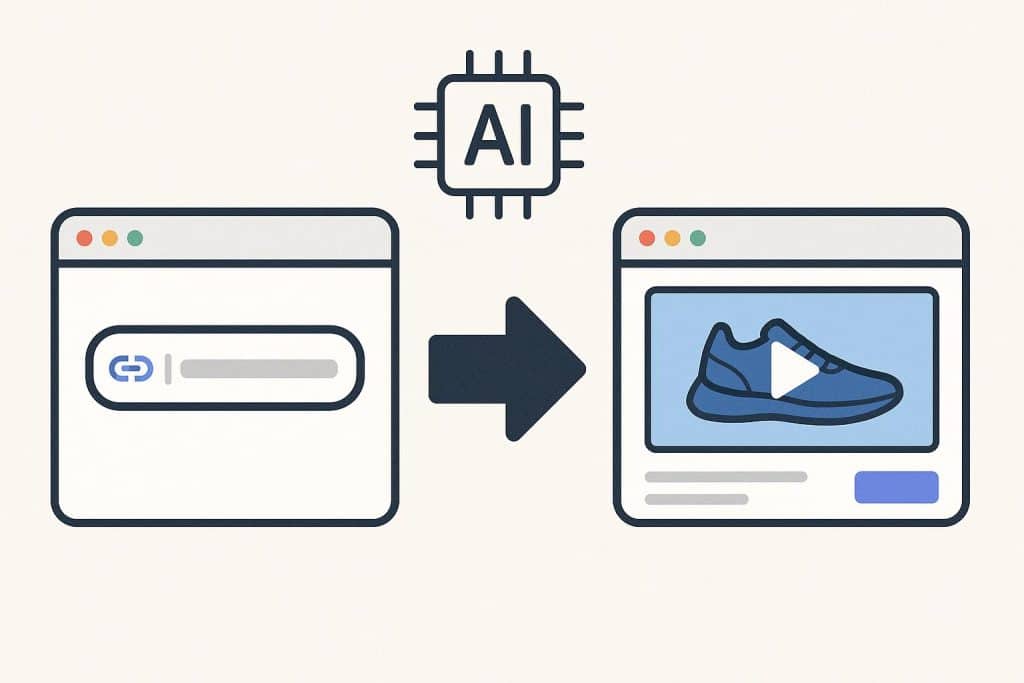
Paste a URL. Obtain a video advertisement. That’s the concept – and for many marketers and e-commerce brands, it’s becoming less of a trick and more of a real workflow. AI ad creators that fetch product data straight from a URL have become amazingly capable of generating eye-catching video content without the need for a production team, a script, or a single second of original shooting.
The issue is not whether this tool is effective anymore. It’s about the ways to leverage it properly, how it can be integrated in your overall marketing mix, and what to realistically expect when you give a URL to an AI and ask it to produce an advertisement for you.
How the URL-to-Video Process Actually Works
When you put a product URL in any of these tools, AI is not merely taking a screenshot from the web page and adding some random text. It harvests product pictures, reads the title and description, deduces the use case and audience, and then based on its findings, it creates a video outline – typically a hook, a product highlight, and a call-to-action (CTA) – to present the product.
The top-tier platforms are those that, in addition to all of these, will also automatically extract price info, customer ratings, and product features. So in other words, if your product page is both well-optimized and informative, the results you get from the tool will be far superior to those obtained from a sparse or poorly written item. The principle of garbage in, garbage out still holds, even with AI.
Mostly, the instruments will even give you the freedom to tailor the final result: you may decide to change the voiceover, modify the speed, substitute the music, edit the text, or select a different AI character. The URL only serves as a starting point, not the last word.
What Makes These Tools Actually Useful
The point about speed is valid. However, it’s not the most compelling aspect. A URL-based AI ad creator primarily changes how much creative content you can experiment with before investing money on production.
Conventional video commercials take a brief filming editing, and client feedback time. If the commercial underperforms, you’ve essentially spent money on the discovery. Conversely, AI-generated commercials can churn out five variants of the same product commercial in one afternoon, run tests, learn what’s hitting the right chord, and ramp up – everything before getting into the entire production cycle.
Creatify is one of the more capable platforms in this space, particularly for e-commerce and direct-to-consumer brands. You paste in a product URL from Amazon, Shopify, or any standard product page, and it generates a complete video ad -voiceover, visuals, captions, and all -within minutes. The level of control over the output is solid too, which matters once you’re past the novelty stage and actually trying to build repeatable creative systems.
The Platforms Where These Ads Perform Best
URL-generated video ads appear to be mainly optimized for social media platforms like TikTok, Instagram Reels, Facebook and YouTube Shorts. They are vertical by nature, very energetic in their messages, and they utilize fast-moving visual storytelling that is most likely to grab users’ attention in feeds.
That doesn’t necessarily mean they can be used only on those networks. Some advertisers deploy AI-created video ads on Google Performance Max campaigns, product listing ads with video extensions, or even on their email marketing strategies. However, if you are a beginner, short-format social media is the best place for the format and where you will most likely see your first results.
It’s also good to mention that ads like these generally deliver the highest performance when they fit in naturally within the platform and don’t look like highly polished brand commercials. The AI-generated look – presenter’s are real, messages are direct from the camera, product demonstrations – it is the kind of content that actually gets traction on TikTok and Reels where people tend to switch off when looking at over-produced content.
Where Marketers Go Wrong With AI Ad Generators
The biggest mistake is to consider the AI’s first output as the final work. What the tool produces is a good initial draft, not a ready-made ad. The hook might not be catchy enough, the script might hide the key benefit, or the pacing might not reflect your brand’s vibe. Editing is important.
Another mistake is disregarding the product page. If your URL leads to a page featuring three stock photos and a vague description, the AI will have almost nothing to work with. Brands that benefit the most from these tools have product pages stuffed with high-quality images, detailed copy, and crystal-clear value propositions. The AI just boosts what’s already there.
The third and perhaps the most common mistake is making one ad and calling it a day. The whole purpose of this workflow is quantity and speed. If you are only producing a single video for each product, you are missing the most beneficial part of the technology. Create multiple variations, test different hooks, use different avatars, alter CTAs, and rely on the performance data for deciding which direction to pursue further.
Building a Repeatable Creative Workflow
After understanding the basics, the main goal comes from making AI ad generation a system rather than a single experiment. So, that involves setting up a system for selecting which products get ads first, the number of ad variations made per product, the duration of testing before making decisions, and how to iterate based on the results.
Most brands follow a process like this: pick the best-selling or highest-margin products, come up with 3-5 ad variations per product using different angles or formats, test them with a small budget, and then double down on the winners. Do this continuously at least once or twice a week.
Creativity at this speed and scale was typically the privilege of brands with large internal teams or agency partnerships. The URL-to-video method levels that playing field. A small e-commerce brand or a single person can now engage in the same type of creative testing cycle that major brands use to maximally optimize their ad spend – just without the overhead.
The Bottom Line
Ad generators powered by AI that receive input from product URLs are not at all outpacing or replacing creative strategy or human decision making. Rather, they are removing the production bottleneck that used to slow down everything. The concepts have to be great. The targeting has to be spot on. But, the transition time from having a product to having a video ad for that product is almost non-existent now.
On the contrary, if you are selling products online and you haven’t started trying this, you will be giving your competitors a big advantage without them having to work for it. The tools are excellent, the threshold for getting started is low, and the profit potential in terms of testing speed and creative output is quite large. Just pick one product URL and check out what the AI can produce. You will figure out the rest from there.