

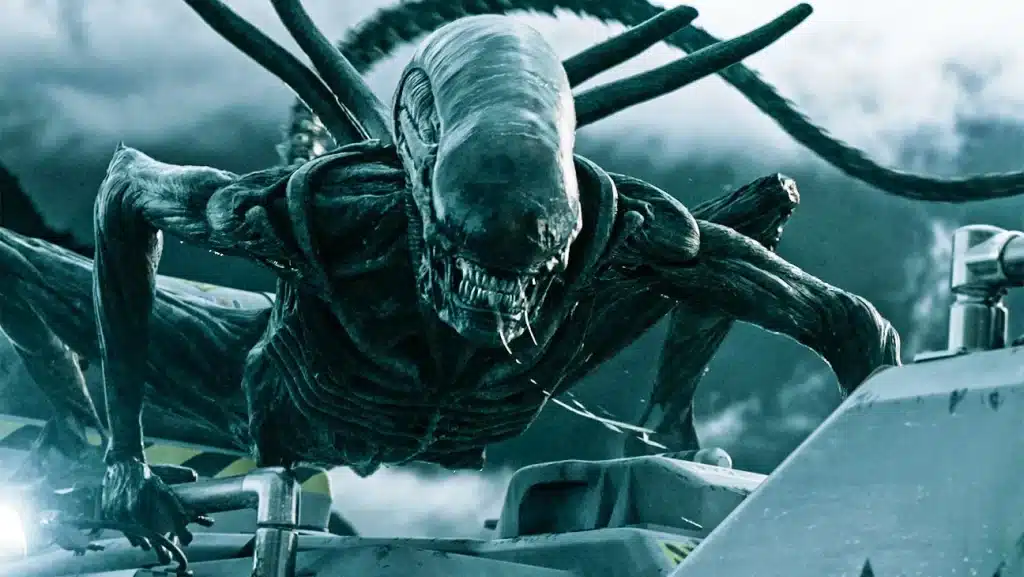
The origins of the Xenomorphs in Alien, expanded by recent cinematic prequels, finally solve a 40-year mystery. While audiences globally recognize the chilling 1979 silhouette, studying the anatomy of the Xenomorph XX121 reveals a biomechanical parasitoid rather than a mere beast. According to cinematic lore, this biological marvel requires a living host, originally engineered as a weapon by an ancient alien race.
Xenomorph: Why the Xenomorph Life Cycle is a Biological Masterpiece
The creature’s true horror lies in how it meticulously grows. The Xenomorph life cycle stages function as a relentless parasitic relay race:
- Ovomorph (Egg): The fleshy, waiting pod.
- Facehuggers: The delivery parasites.
- Chestburster: The violently born infant.
- Adult Xenomorph: The ultimate hunter.
Think of this invasion like a biological computer virus. The parasite uses DNA hybridization to build the infant inside the victim. Consequently, the newborn inherits host-specific traits—like running on all fours if born from a dog—instantly adapting to its new environment.
Attacking this resulting predator only triggers its ultimate trap: a concentrated acid blood defense mechanism capable of melting straight through solid starship hulls. But who designed such an aggressive biological weapon? That answer lies in the dark history of the Engineers and the pathogen known as the ‘black goo’.
The Dark History of the ‘Black Goo’
The terrifying Prometheus black goo origin story begins with an ancient, powerful race known as the Engineers. They developed a dark, transformative liquid armament to seed or destroy worlds. These biological weapons of the Engineers rely on a primordial pathogen, where the Chemical A0-3959X.91-15 properties act as a volatile genetic reset button, violently rewriting host DNA rather than simply poisoning them.
Accidental exposure to this oozing pathogen birthed pale, feral creatures. The primary difference between Neomorphs and Xenomorphs lies in their structural refinement; the fleshy Neomorph acts as a rabid beast born of pure chaos, whereas the classic creature operates as a sleek, biomechanical hunter.
The rogue android David essentially served as a dark sculptor, taking the Engineers’ unguided mutations and refining them through intentional crossbreeding into a focused killer. While his horrific experiments bred a nightmare, corporate greed soon noticed the immense value of this creation.
Xenomorph: Decoding the ‘Perfect Organism’
In 1979, the android Ash admired the creature as a survivor unclouded by morality. The Weyland-Yutani pursuit of the perfect organism isn’t about science—it’s about a biological weapon’s incredible corporate ROI. Looking past the Alien Covenant vs Prometheus lore of its chaotic origins, the company sees a flawless, profitable asset defined by three traits:
- No conscience.
- Rapid adaptation.
- A self-sustaining hive structure.
This unstoppable replication relies entirely on the Xenomorph Queen and hive hierarchy. Functioning like a predatory insect colony, the Queen autonomously lays eggs and converts local populations into instant armies. Because it operates as a self-contained weapons factory requiring no costly supply lines, the corporation considers the creature the ultimate prize, regardless of the human cost.
The Legacy of Terror
Whether born from ancient biology or made through dark experiments, the creature’s terror relies heavily on H.R. Giger’s biomechanical design. This profound influence perfectly captures xenomorph evolution—a chilling blend of organic life and cold machinery. Beyond a mere cinematic monster, this perfect organism endures as a masterful cosmic nightmare.