


Hardware is brutal. You spend months finalizing a board layout, locking in the bill of materials, and getting the firmware right. Then comes the real test of getting it manufactured without blowing your margins or shipping schedule.
Outsourcing printed circuit board production is standard practice now for US companies. But picking a manufacturing partner across the Pacific is a massive risk if you only look at the initial quote.
Looking Past the Initial Quote
Most buyers fixate on the raw assembly quote. They see a rock bottom price per panel and immediately sign the purchase order. They forget to factor in logistics, minimum order quantities, and tariffs.
- Shipping & Freight: Shipping heavy pallets of populated boards by air freight eats up the budget fast. Sea freight is much cheaper but adds four to six weeks to your lead time, which ties up your working capital.
- Hidden Fees: You also need to account for tooling costs, stencil fees, test fixture setups, and potential Section 301 tariffs.
- Yield Rates: A cheap per unit cost often hides heavy front end engineering charges or terrible yield rates. If you save two dollars a board but scrap fifteen percent of the run, you’re losing money.
The Bottom Line: Total cost of ownership is the only metric that matters.
The Southeast Asia Shift
A lot of American buyers are diversifying their supply chains to avoid geopolitical risks and heavy import duties. We see a ton of production moving into Southeast Asia right now. This region is absorbing massive amounts of factory investment and building out heavy infrastructure.
If your bill of materials relies heavily on automotive grade components or consumer electronics, PCB assembly Thailand is increasingly common. The country has built a massive industrial base for auto manufacturing and hard drives over the last two decades.
That existing supply base makes it much easier to source passives and standard ICs locally instead of flying them in from other countries. You get a mature workforce, favorable trade terms, and a very stable operating environment for large scale runs.
Matching Regional Expertise to Your Product
Not all manufacturing hubs do the same things well. You have to match your product requirements with a region’s industrial ecosystem.
- High Volume vs. High Mix: Some areas are built for high volume consumer goods where price is everything. Others are set up for high mix, low volume industrial controls where reliability is the priority.
- Advanced Electronics: If you’re building advanced enterprise modules or complex memory systems, you might look at different parts of Asia. For instance, PCB assembly Korea has become a solid option for companies needing high speed digital boards and dense multi layer layouts. Their domestic infrastructure is heavily geared toward advanced electronics and semiconductor manufacturing.
You pay a bit more for labor than in emerging markets, but the engineering competence significantly reduces the scrap rate on complex builds.
Engineering Communication and Time Zones
You’re going to run into design for manufacturing issues. It always happens. A footprint doesn’t quite match the physical part, or a via is too close to a pad. How the factory handles that discrepancy determines if your project stays on schedule.
Working across a 12 hour time difference means a single unresolved question adds a full day to your timeline:
- They email you at night.
- You answer in the morning.
- They read it the next morning.
Three simple questions can delay a production run by a week if they are asked sequentially. I’ve seen minor footprint discrepancies stall entire product launches simply because of poor communication loops.
You need a contract manufacturer with fluent English speaking project managers who overlap with your working hours. Some factories put a US based liaison in place, which helps immensely. Others expect you to be on an international call at 11 PM on a Tuesday. Know what you’re signing up for before you wire the deposit.
Precision and Mission Critical Applications
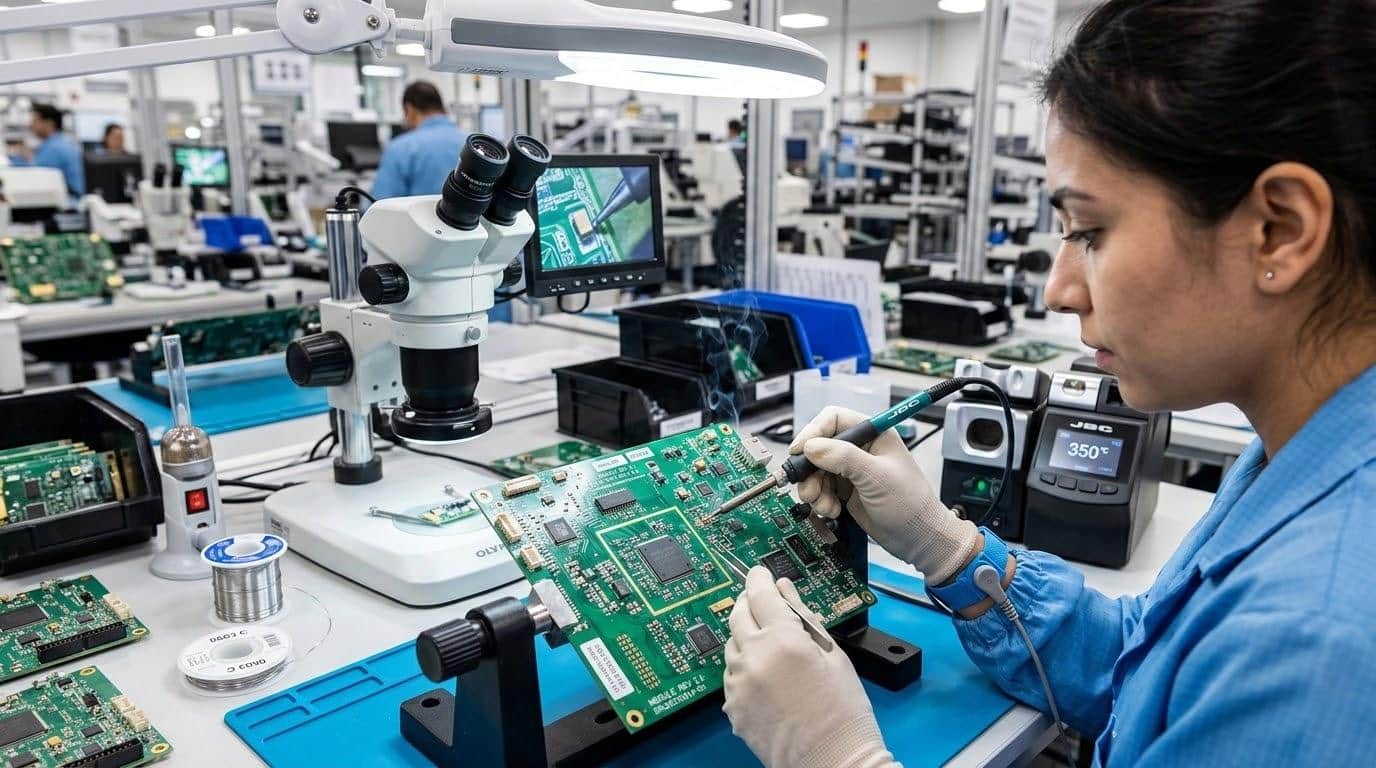
Sometimes you can’t compromise on quality because the end use case is simply too important. Medical devices, aerospace components, and advanced robotics require strict trace tolerances and pristine solder joints. A single cold solder joint can cause catastrophic failure in the field.
In these cases, buyers often bypass the cheaper hubs entirely. Exploring PCB assembly Japan makes sense when you need extremely tight process controls, rigid flex capabilities, or zero defect tolerance. The labor rates are much higher. But when a board failure means recalling a highly expensive piece of equipment or facing regulatory fines, the upfront manufacturing cost is irrelevant. You’re paying for their obsessive quality assurance, advanced automated optical inspection, and pristine facility conditions.
Component Sourcing and Counterfeit Avoidance
Procuring the bare board is only half the battle. Populating it is where things get messy fast. A factory might quote you a great price because they’re substituting your specified components with cheap local equivalents. Sometimes a substitute capacitor is perfectly fine. Sometimes a fake voltage regulator catches fire.
To protect your build, you must take specific precautions:
- Define Your AVL: Define your approved vendor list clearly. Specify exactly which parts can be crossed to alternative brands and which ones must be exact manufacturer part numbers.
- Audit Incoming Quality Control: Ask the factory about their internal protocols. Do they use x-ray machines to verify wire bonds inside the chips? Do they buy directly from franchised distributors, or do they scrape the grey market for deals to pad their margins?
- Weigh Consignment Risks: If you decide to consign parts by buying them in the States and shipping them over, calculate the customs delays and export compliance headaches. Consignment gives you absolute control over the bill of materials but creates massive logistical hurdles.
Testing Requirements You Cannot Skip
Never assume a factory tests your boards unless you explicitly pay for it and define the procedure. Bare board testing checks for shorts and opens, but that doesn’t tell you if the assembled board actually functions.
- Build a Custom Test Fixture: Write a clear testing standard operating procedure.
- Provide Tools: Send them the pogo pins and the software needed to run the diagnostics.
- Catch Failures Early: If a board fails on the line, the factory needs to know immediately so they can fix the wave soldering profile or adjust the pick and place machine.
Finding out you have a 10 percent failure rate after you pay the final invoice and open the boxes in your warehouse is a disaster you can’t recover from quickly.
Securing Your Intellectual Property
Sending your board files, schematics, and raw code to a foreign factory is a nerve wracking process. A non disclosure agreement is basically just a piece of paper. If a factory half a world away decides to clone your product, suing them in their local court system is an expensive, usually pointless exercise.
Strategies for Information Separation
Compartmentalization serves as your most effective defense. Whenever feasible, refrain from providing the final firmware to the fabrication facility. Instead, utilize a rudimentary test firmware designed solely to confirm hardware functionality via the test fixture. The installation of your sensitive, proprietary code should be reserved for after the physical boards have been delivered to your possession.
Mutual Profit
You should also build a relationship based on mutual profit. Factories clone products when they think they can make more money selling it themselves. If you provide them with steady, profitable business, they have very little incentive to ruin a good relationship.
Outsourcing hardware manufacturing takes rigorous documentation, clear communication, and active management. You can’t just throw a zip file over the wall and expect perfect boards to show up a month later. Are you dealing with standard FR4 boards, or does your current project require specialized materials like rigid-flex or high-frequency laminates?