

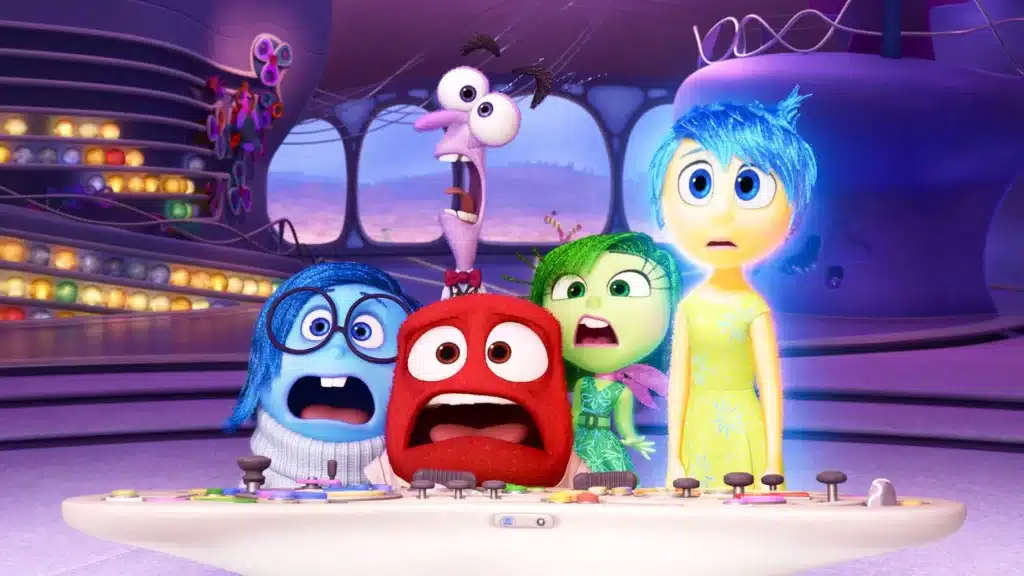
Ever since we first stepped into Riley’s mind, a hilarious and mind-bending question has plagued the internet: Do Inside Out’s emotions have emotions inside their head? Pixar fans “need answers”, and the ongoing franchise has only fueled the debate.
When we watch the beloved inside out emotions navigate Headquarters, we see them laugh, cry, and panic. But if Joy can feel sad, what is driving her? Let’s dive into the fascinating psychology and fan speculation behind this animated paradox.
Inside Out: The Inside Out Meta-Emotions Theory
The internet loves a good rabbit hole, and the Inside Out meta-emotions theory is a favorite. If our emotions experience their own feelings, fans naturally ask: do emotions have their own headquarters?
This sparks the infinite loop of emotions theory—a fun thought experiment suggesting endless layers of tiny minds inside tiny minds. But does this hold up to the logic of the films?
How Pixar Emotions Process Feelings
With the introduction of complex new characters, an Inside Out 2 character logic breakdown becomes essential. Watching the new inside out 2 emotions, like Anxiety, take the reins raises a crucial question: can Joy experience complex secondary emotions?
The short answer is yes, but not because she has tiny people in her head. It comes down to a careful balance of anthropomorphism vs psychological accuracy in Pixar. The characters are personified concepts designed to make abstract psychology relatable.
Inside Out: Comparing Riley’s Brain to Joy’s Brain
To truly grasp this, we have to look at the mechanics of the movie by comparing Riley’s brain to Joy’s brain:
- Riley’s mind console operations: Riley’s feelings are dictated by her physical brain mechanics, memories, and the functional role of emotions in Headquarters.
- Understanding Pixar character design psychology: Joy doesn’t have a brain; she is a piece of a brain. Her “feelings” are natural reactions to her environment, not the result of a microscopic control panel.
- Common fan theories about emotion consciousness: While audiences love the “Russian nesting doll” idea, the emotions are singular manifestations. They process feelings directly, without needing a sub-layer of operators.
What the Creators Say
This isn’t just a fan debate. In a widely discussed Pete Docter emotion recursion interview, the filmmakers addressed this exact puzzle. When directing the Inside Out inner world, the creators had to simplify complex psychology so audiences could easily follow the story.
Giving the emotions their own distinct emotions would infinitely overcomplicate the narrative. Instead, the characters adapt and react as they witness the evolution of personality islands and beliefs within Riley.
Inside Out: Actionable Takeaways for Your Emotional Growth
While we may not have a literal control console in our heads, we can apply the franchise’s lessons to build real-world emotional intelligence:
- Accept complex feelings: Just as Joy learns to cry, realize that your own feelings rarely fit into one neat box.
- Observe your “Headquarters”: When you feel overwhelmed, step back and ask which emotion is currently driving your console.
- Embrace evolution: Allow your own “personality islands” to grow and change as you enter new life stages.
Ultimately, while the emotions don’t have little voices inside their own heads, their nuanced reactions make them deeply human, teaching us that every feeling has a valid purpose.