

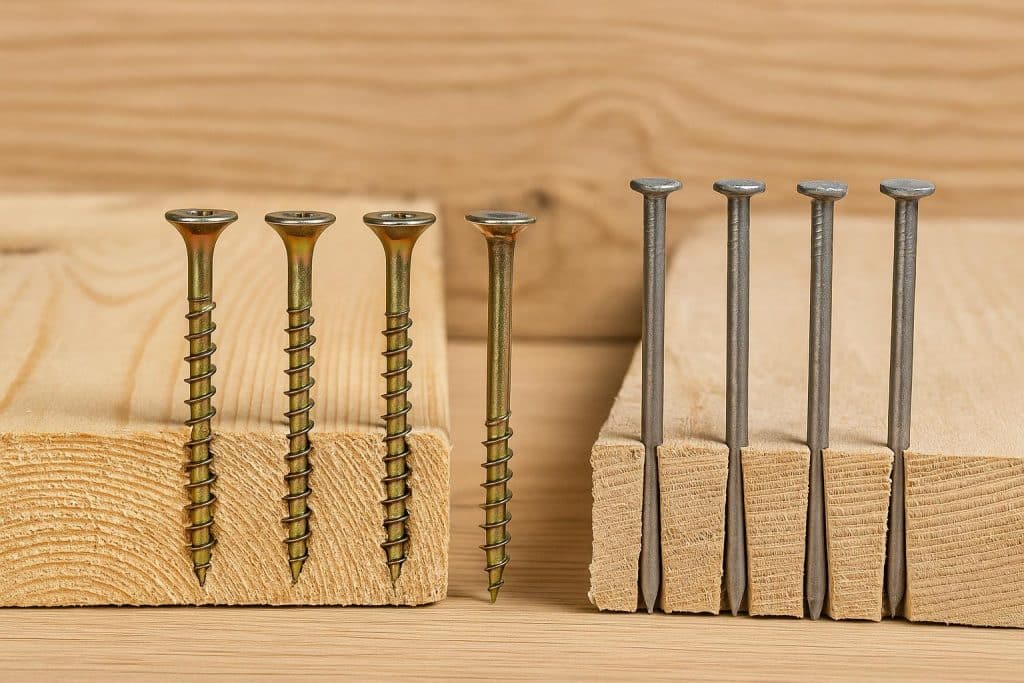
Most people treat nails and screws as interchangeable. They’re not. Reach for the wrong one and you’ll find your joint creaking apart in two seasons, or spend twice as long on a job that didn’t call for that level of effort. The choice comes down to a few fundamentals: the direction of force the fastener will face, the material it’s going into, and whether you’ll ever need to take things apart.
The Core Difference Is in How They Hold
Nails hold through friction. Drive one into wood and the surrounding fibers compress around the shank, gripping it from the outside. That compression handles lateral force well, which is why nails remain the standard for wall framing and subfloors, where the structural load pushes across the fastener rather than pulling against it.
Screws work by physically interlocking with the wood fibers through their threads, which gives them dramatically better resistance to withdrawal. For joints that need to stay tight over years, resist racking, or hold two surfaces face to face without creeping, quality wood screws will outperform nails in most situations where the stress runs perpendicular to the surface.
Shear vs. Withdrawal: The Two Loads That Decide Everything
Think of shear as a sliding force: two boards trying to slide past each other. Think of withdrawal as a pulling force: two boards trying to come apart. Nails handle shear better. Screws handle withdrawal better. Every fastening decision should start with figuring out which load the joint will actually face in real use.
When Nails Are the Right Call
For wall framing, roof rafters, and subfloor sheathing, nails remain the professional default. Speed matters here. Nail guns drive fasteners faster than any drill, and the shear strength of a correctly sized nail matches what structural framing actually demands. Nails also flex slightly under load rather than snapping, which proves useful in applications that experience dynamic movement, like exterior walls in windy regions.
Finish Work Is a Different Story
In trim carpentry, finish nails disappear almost completely once set and filled, making them the natural choice when aesthetics take priority. No screw head, however small, can match a 15-gauge finish nail for invisibility on a painted baseboard or door casing.
When Screws Outperform
Cabinetry, deck boards, outdoor furniture, and anything bearing sustained weight all pull toward screws. The threaded grip holds firm over years of seasonal wood movement, while a nail in the same joint can work loose as lumber expands and contracts with humidity changes.
For exterior applications, material choice matters as much as fastener type. Using standard steel screws in pressure-treated lumber or near saltwater causes corrosion and staining over time. Star Fasteners Plus carries exterior-grade and stainless options specifically engineered for treated wood and harsh outdoor environments. Worth noting: The Engineered Wood Association’s connection design guidelines explicitly caution against using drywall screws in structural connections, and recommend sizing wood screws to match or exceed the equivalent nail specification for any load-bearing joint.
The Rule That Simplifies Most Decisions
When force runs across the fastener, use nails. When force runs along the fastener axis, use screws. Most projects involve both types of stress in different spots, which is why experienced builders keep both on hand rather than committing to one. Material, load direction, and finish requirements should drive the choice. Not habit.