

Picture the last time you struggled with a jar lid. You twisted, applied more force, maybe ran it under hot water or handed it to someone else. Eventually it opened. Problem solved in under a minute.
Now picture a threaded steel connection sitting at the bottom of an oil well, 3,000 meters below the surface. It was tightened to tens of thousands of foot-pounds of torque — far beyond anything a human could apply by hand. It has been sitting there for months or years, exposed to heat, pressure, and corrosive fluids. The steel has settled and the threads have locked themselves in under load.
And now, for one reason or another, it needs to come apart.
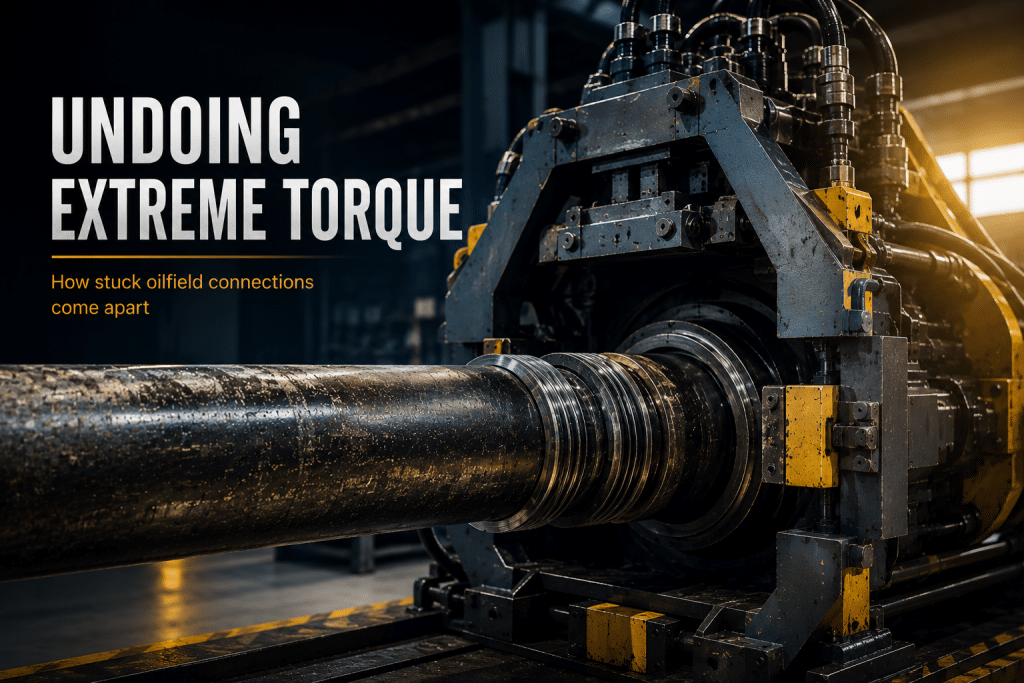
This is not a jar lid problem. This is one of the more demanding mechanical challenges in industrial engineering, and it requires a category of machinery most people have never encountered.
Why Connections Need to Come Apart
Before getting into how, it helps to understand why. The assumption most people make about oil wells is that once the pipe goes in, it stays in. That’s not quite how it works.
Wells require ongoing maintenance, and that means things have to come back up. Downhole tools — the sensors, motors, and measurement instruments that operate thousands of meters underground — have service lives and need to be retrieved, inspected, and redeployed. Drill strings, which are the long chains of pipe used during the drilling process itself, are regularly broken down and reassembled as rigs move between job sites. Pipe that has been used on one well gets inspected, reconditioned, and prepared for the next.
In each of these scenarios, threaded connections that were carefully tightened in a workshop have to be carefully taken apart — ideally without damaging the threads, without cracking the pipe body, and without losing the ability to make the connection again afterward. On expensive pipe grades and premium connections, a damaged thread during disassembly is not just a setback. It can write off a section of pipe worth tens of thousands of dollars.
The Physics of Breaking Out a Stuck Connection
The challenge of disassembly — called “breaking out” in oilfield terminology — is not simply the reverse of tightening. When a threaded connection has been made up under high torque and then exposed to downhole conditions, the initial resistance to movement can be significantly higher than the original make-up torque. Threads can gall — think of it like two surfaces that have been pressed together so hard and so long that they’ve partially bonded — and corrosion products build up in the thread interface over time. The connection resists opening in a way that demands controlled, high-force application at the right speed, in the right direction, without the shock loading that could crack the material.
Applying too much sudden force can shear the connection rather than unthread it. Applying force at the wrong angle can damage the pipe body at the clamp point. On corrosion-resistant alloys and chrome-finished tubulars, even the gripping mechanism of the machine needs to be matched carefully to the pipe material.
This is why purpose-built breakout equipment exists rather than simply running a standard torque machine in reverse. The Galip breakout unit is one example of how manufacturers design around these specific constraints — combining high-force hydraulic clamping with staged torque application and real-time data logging to handle connections that have been in service under demanding conditions.
How a Breakout Unit Works
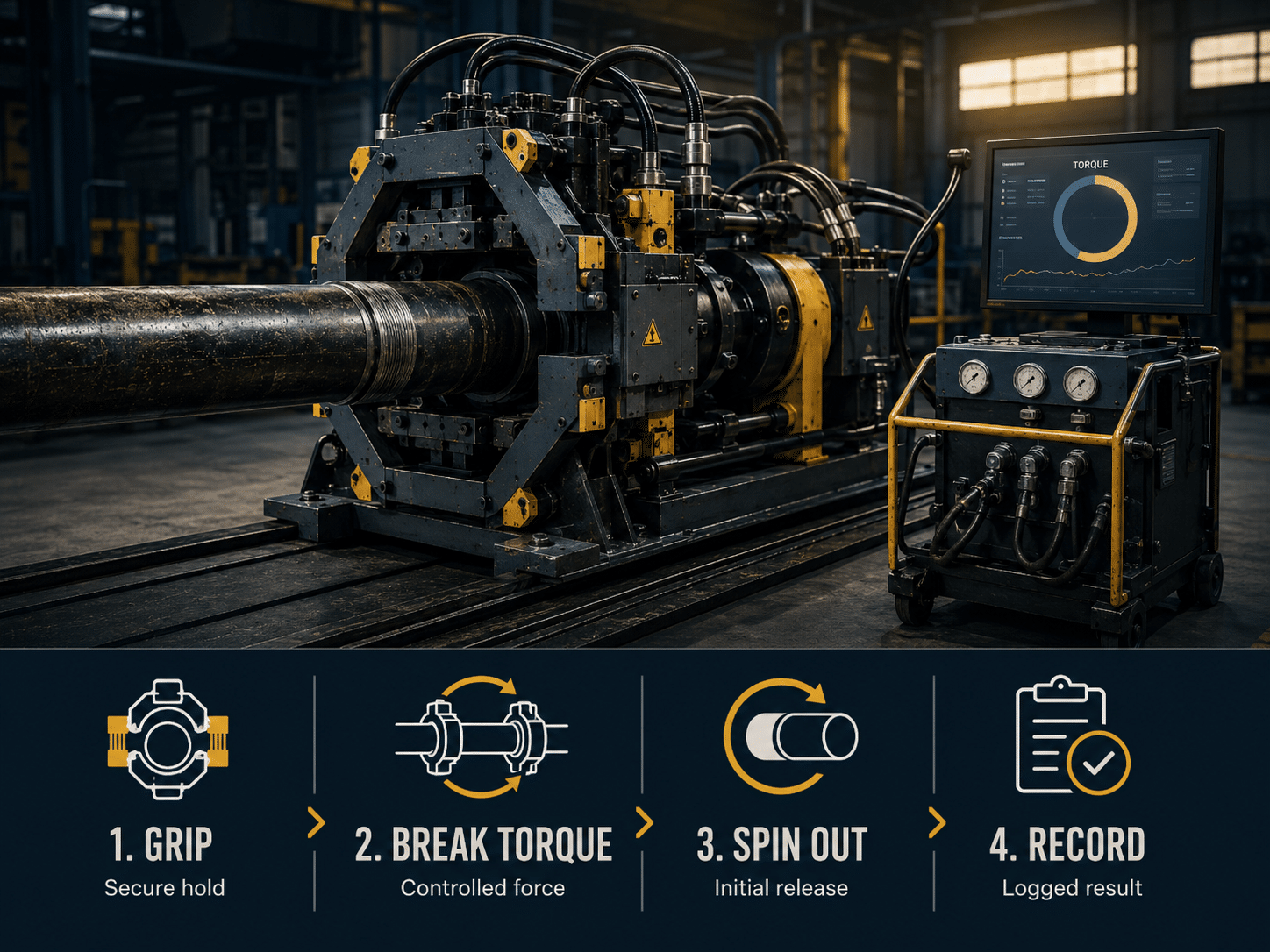
A hydraulic breakout unit is built around two core functions: gripping the pipe securely without damaging it, and applying controlled rotational force to overcome the initial resistance of the connection.
The gripping system uses hydraulic clamping — multiple cylinders applying synchronized pressure around the pipe body. The force is substantial, sometimes exceeding 175,000 foot-pounds of breakout torque, but it has to be distributed carefully enough that it doesn’t leave marks or deformation on sensitive pipe grades. Specialized jaw inserts, matched to the pipe’s outer diameter and material, handle the interface between the machine and the workpiece.
The torque system applies rotational force progressively rather than in a single impact. A spinner mechanism initiates movement at lower torque before the main drive takes over for the final breakout. This staged approach reduces the risk of sudden shock to the connection and gives the operator a clear picture of what the joint is doing before full force is committed.
Because the condition of a connection during removal matters just as much as how it was originally assembled, modern breakout units log the torque applied during disassembly. Those records document the full lifecycle of a joint — not just how it was made up, but how it came apart. For operations running under quality management systems, where every action on a joint needs to be accounted for, that documentation carries real weight at inspection and audit time.
Where Breakout Equipment Gets Used
The most obvious application is oil and gas, where breaking out drill pipe, casing, and downhole tool assemblies is routine workshop work. But the same challenges appear across other industries.
Horizontal directional drilling contractors — the companies that install pipelines and utility cables beneath roads and waterways without surface excavation — regularly break down drill strings between jobs. The pipe diameters and torque ranges overlap significantly with oilfield equipment, and so do the quality requirements, particularly on projects where pipe will be reused across multiple bore installations.
Geothermal energy projects add further complexity. The wells are deep, the pipe is often a specialized alloy chosen for corrosion resistance, and the value of the tubulars makes careful handling during both assembly and disassembly a financial priority as much as a technical one.
Service centers that maintain and repair downhole tools — mud motors, measurement instruments, and drilling jars — use breakout equipment as a standard part of their workshop infrastructure. A tool that comes back from a well needs to be disassembled for inspection, and the connections holding it together were originally made up under controlled torque conditions, which means the breakout process needs to match that care in reverse.
For anyone researching the manufacturer behind these systems, the learn more about Galip Equipment page covers the company’s background, manufacturing approach, and quality certifications in more detail.
Why What Happens in the Workshop Determines What Holds Underground
Infrastructure photography tends to favor the dramatic: the rig on the horizon, the pipeline crossing the river, the geothermal plant against a mountain backdrop. The workshop where pipe gets assembled and disassembled before any of that happens rarely makes it into the frame.
But the work done there — tightening connections to precise specifications, logging the data, and then breaking them apart just as carefully when the time comes — is what determines whether the infrastructure actually holds together once it’s in the ground. The machines that make that possible are unglamorous, highly specific, and genuinely necessary. They’re just not the kind of thing most people think about until something goes wrong.