

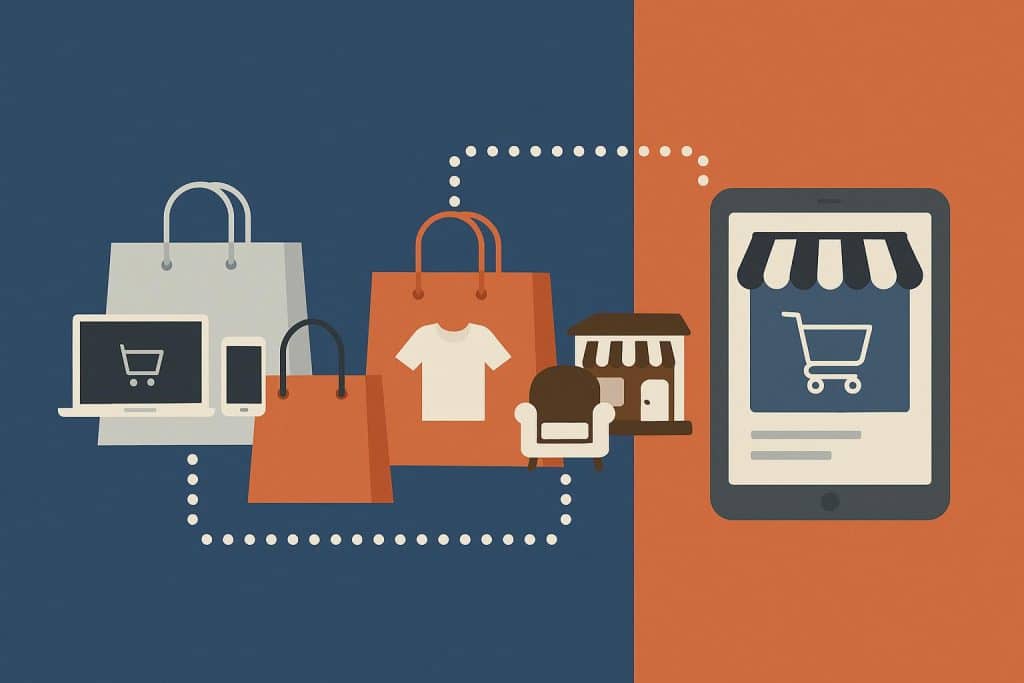
Specialty retail’s migration online has been one of the most consequential consumer-behavior shifts of the last twenty years, and one of the most uneven. U.S. retail e-commerce penetration over the last decade has climbed from under 5 percent of total retail in 2010 to roughly 16 percent by 2024, but the average masks the real story. Books and electronics moved fast. Apparel followed by the mid-2010s. Groceries took twenty-five years and still haven’t fully arrived. Eyewear is mixed. Vapes, CBD, supplements, and other regulated specialty categories sit in their own pattern, with online and physical retail coexisting in ways that don’t track the broader story.
The variation isn’t random. It tracks a small number of structural factors: how well personalization technology substitutes for sensory shopping, how regulated the category is, how much trust the buyer needs in the seller, and how the unit economics of shipping work for the category. Categories where all four favor online migration moved fast. Categories where one or more friction points hold moved slowly or settled into a hybrid retail picture.
The Categories That Moved First
Books were the original case study. Personalization (recommendation engines, search, customer reviews) substituted cleanly for in-store browsing, the unit economics worked, and by 2010, Amazon’s market share had reshaped the entire category. Consumer electronics followed for the same reason: once the technology could surface the right product across thousands of SKUs and present specs, reviews, and price comparisons at scale, the in-store discovery advantage collapsed. Best Buy pivoted hard. RadioShack and Circuit City didn’t survive.
Apparel took longer because of fit, feel, and the fashion-cycle problem. It eventually broke open through return-friendly logistics (Zappos was the consumer-facing example) and improved size personalization across direct-to-consumer brands. By the late 2010s, most apparel was online-native, with physical retail repositioning around experience rather than primary purchase. The common thread is that all three are categories where tech-driven personalization rewires consumer discovery more reliably than a salesperson in a physical store can. When that condition holds, the migration online happens fast.
What Slows the Migration
The categories that moved slowly share specific friction points. Sensory shopping (groceries’ freshness check, eyewear’s fit, mattresses’ feel, fragrance’s smell) requires the buyer to physically experience the product. Regulation adds compliance complexity: alcohol, cannabis, pharmaceuticals, vapes, and firearms layer state-level rules and verification requirements onto every sale. Trust requirements slow categories like high-value jewelry, custom hardware, and certain B2B sales, where buyers want to assess legitimacy in person. Online infrastructure has worked to bridge each, with mixed success.
Unit economics is the underrated friction. Shipping perishables, bulky items, and high-return categories took years for the underlying logistics to solve. The eCommerce platforms that enabled the specialty retail shift also matter: the back-end infrastructure handling inventory, payments, fraud, taxation across jurisdictions, and integration with personalization layers is most of what separates online winners from the ones that never scaled. Where shipping fundamentally doesn’t pencil (fresh-baked goods, perishable florals at scale, services requiring physical presence), the category stays physical regardless of how good the personalization technology gets.
Categories That Settled Into Coexistence
Three categories illustrate the coexistence pattern, each with a different friction profile but the same underlying outcome. The pattern is consistent with what survey data shows about online shopping growth versus in-store purchase behavior: online has grown rapidly across most categories, but the majority of purchases in many specialty categories still happen in stores, with the split varying significantly by what the consumer is buying.
Eyewear is the cleanest version. Warby Parker, launched in 2010, showed that personalization technology, free home try-on, and direct shipping could substitute for some of what optical retail had been selling. But prescription verification, custom lens manufacturing, and fitting adjustments kept friction high. By 2025, Warby Parker itself operated more than 100 physical stores, traditional opticians ran online operations, and independent shops kept loyal customers for prescription work. The category went hybrid by design.
Beauty has split into two tracks. Color cosmetics, skincare, and hair care moved substantially online, with personalization technology doing the work that in-store consultants used to. Fragrance has not — the smell problem is structurally different from any other beauty-subcategory friction. Sephora’s model captures the bifurcation: online for discovery, ingredient education, and repeat purchase; physical for fragrance sampling, foundation matching, and sensory experience. The category is permanently hybrid by design.
The vape category sits at a similar intersection with its own friction profile: regulated (age verification, FDA premarket review, state-level restrictions), flavor-and-format diverse enough to benefit from personalization, and split by trust preference. The online side competes on selection, price, subscription convenience, and recommendations. Physical shops keep weight in early-stage product education, immediate purchase, and the social side of vape culture. Online and in-shop vape buying patterns track this split closely, with the balance shifting modestly toward online but neither channel fully displacing the other. Local flavor bans push consumers online; stricter federal age verification pushes them back to physical.
Across all three categories, the operators winning are the ones who invest in both channels, with each playing to its respective strength. The categories that fully migrated online didn’t require that strategy. The ones in coexistence do.
What the Pattern Tells Us About the Next Five Years
The categories most likely to shift further online are the ones where personalization technology continues to reduce the sensory-shopping advantage and where regulatory infrastructure stabilizes around online compliance: wellness and supplements, more of the eyewear market, and parts of grocery as last-mile infrastructure compounds. Categories likely to retain physical-retail weight are those where the experience is the product (wine, premium fragrance) or where regulation and trust constraints don’t yield to technology fixes (high-end jewelry, vapes).
For brands and retailers operating across either side of the line, the practical implication is that channel strategy needs to match the category’s actual dynamics rather than the broader retail trend. Building digital-first infrastructure for a sensory-heavy or trust-intensive category produces underwhelming results. Building physical retail in a personalization-favoring category produces unfavorable unit economics. Categories sitting in coexistence reward operators who invest in both channels deliberately.
The pattern across specialty retail is that personalization technology and category-specific friction interact to determine migration speed. Categories where personalization fully substitutes for browsing move fast. Categories with sensory, regulatory, or trust friction move slowly or settle into coexistence. Understanding which is which is most of the work in predicting where any specialty category will go from here, and the analysis applies as much to operators planning channel strategy as to investors trying to figure out which category moves next.