

Superlative Claims vs. Mediocre Results: How to Make AI Produce Its Best Work?
Nowadays, visit the website of almost any AI music generation tool, and you will see the same promises: “professional-grade scores,” “works that rival human composers,” or “perfectly aligned with your creative vision”—all achieved with just a few descriptive words. Accompanied by polished demo videos, these claims are enticing. You don’t need to study music theory, master a DAW, or even play an instrument. Anyone, it seems, can create beautiful music.
However, in practice, AI music tools frequently suffer from instruction drift. The generated results often fail to meet expectations. More importantly, adding more detail to a prompt doesn’t always improve the outcome. In fact, information overload can confuse the model, leading to works that stray even further from the target.
You might instinctively think, “Is it my wording?” While possible, the root of this dilemma lies in two deeper technical issues:
- Model Disparity: The underlying capabilities of AI music tools vary significantly. Despite exaggerated marketing, many models lack the textual understanding and execution precision required for complex creative needs. Some simply stitch together audio clips from a library or rely on limited templates, failing to truly “understand” your intent.
- Prompt Design: Even powerful models will deviate if the prompt design is flawed. Unlike a human producer, an AI cannot clarify vague expressions through dialogue or fill in missing details based on experience. It relies solely on your text instructions, parsing and executing them according to a specific logic.
To make AI generate music that truly meets your expectations, you must do two things: first, choose a tool with a powerful underlying model and accurate text understanding; second, master effective prompt engineering strategies to express your intent in a way the AI can comprehend.
This article provides a horizontal comparison of four mainstream AI music generation tools to help you identify which platforms offer professional-grade capabilities. We also provide field-tested prompt optimization methods to help you maximize tool potential and create the most accurate, high-quality music.
The Model is the Foundation: A Comparative Test of 4 AI Music Tools
To verify how different tools handle instructions, we selected four mainstream AI music platforms and compared them using a unified standard. Our core focus was Text-Semantic Consistency—the ability of a tool to accurately understand and execute user commands.
| Evaluation Metric \ Tool | Soundraw | Mubert | Beatoven.ai | MakeBestMusic |
|---|---|---|---|---|
| Instrument Precision | 6/10 | 5/10 | 7/10 | 9/10 |
| Style Consistency | 7/10 | 6/10 | 7/10 | 9/10 |
| Structural Command Precision | 5/10 | 4/10 | 6/10 | 9/10 |
| Mood Accuracy | 7/10 | 6/10 | 8/10 | 8/10 |
| Textual Understanding | 6/10 | 5/10 | 7/10 | 9/10 |
| Total Score | 31/50 | 26/50 | 35/50 | 44/50 |
Metric Definitions
Before analyzing the results, let’s define the five core metrics used in this comparison:
Instrument Precision: Measures if the tool accurately identifies and applies specific instruments. For example, if the prompt asks for “acoustic guitar,” does the track feature it prominently without irrelevant electronic tones? This reflects the model’s depth of timbre understanding.
Style Consistency: Evaluates the ability to recreate genre characteristics. When a user inputs “Bossa Nova” or “Chicago Blues,” does the result follow the typical harmonic progressions, rhythms, and arrangements of that genre?
Structural Command Precision: Assesses the response to musical structure commands. Professional creators often need clear sections like [Intro] – [Verse] – [Chorus] – [Bridge].
Mood Accuracy: Tests the conversion of abstract emotional descriptions into musical parameters—such as mode, tempo, and dynamics.
Textual Understanding: A comprehensive metric evaluating the parsing of complex, multi-layered prompts containing style, instrument, mood, and tempo simultaneously.
Together, these five dimensions form a comprehensive evaluation of the “instruction execution capability” of AI music generation tools. They go beyond the realization of single features, reflecting a tool’s overall adaptability and reliability in real-world creative scenarios.
Soundraw: Template-Driven Quick Scoring
Total Score: 31/50 | Positioning: Best for content creators needing fast background music.
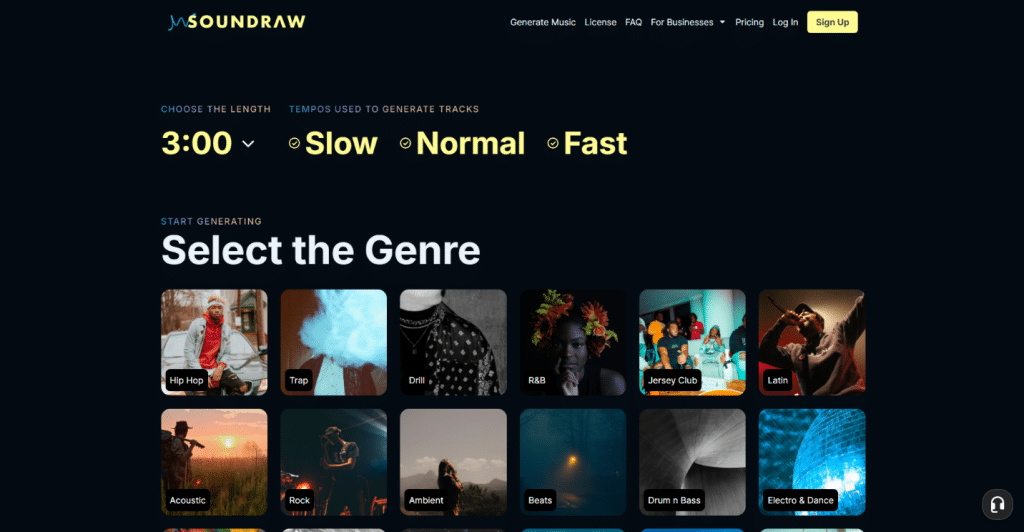
Soundraw uses preset-based logic. Users select mood tags (e.g., “Happy,” “Sad,” “Epic”) and adjust sliders for tempo intensity, melodic complexity, and length. This interaction lowers the entry barrier but limits creative precision.
Soundraw’s instrument:6/10
Soundraw’s instrument control is limited. While it offers broad categories like “Acoustic,” “Electronic,” or “Orchestra,” it cannot pinpoint specific models. In our test, we requested a score led by a “cello.” After selecting the “Orchestra” category, the system generated a full string section (violin, viola, cello, and double bass) playing together. It was impossible to isolate or highlight the specific timbre of the cello.
This coarse-grained control is acceptable for general video scores, but fails for projects requiring specific instrumental textures. Since the platform can at least distinguish broad categories but lacks precise specification, we gave it a 6.
Style Consistency: 7/10
Soundraw performs stably in Pop and EDM. When selecting “EDM” with high intensity, it produces typical Build-up and drop structures with appropriate synth choices.
However, for culturally specific styles like “Flamenco” or “Reggae,” the results feel like generic pop with superficial rhythmic layers. Our Flamenco test featured castanets and guitar strumming but lacked the core “compás” (complex rhythmic cycles) and improvisational spirit. We gave it a 7 based on its mainstream vs. niche performance.
Structural Command Precision: 5/10
This is a major weakness. Soundraw does not support custom structures. All tracks follow a preset “Intro-Main-Outro” framework. While you can adjust the length of segments, you cannot create complex arrangements like “AABA” or “Verse-Chorus-Bridge.”
This makes it difficult to synchronize music with specific narrative turns in a product demo. The score of 5 reflects its “basic structure but lack of flexibility” status.
Mood Accuracy: 7/10
Soundraw utilizes a tag-based design for mood control, offering foundational emotional options such as “Happy,” “Sad,” “Angry,” and “Relaxed.” Our tests indicate a high execution accuracy for these tags—selecting “Happy” consistently generates music with major keys, fast tempos, and bright timbres, while “Sad” results in minor keys, slower tempos, and softer tonal qualities.
The platform also features an “Energy Level” slider, allowing users to adjust intensity within the same mood. For example, the “Happy” mood paired with a low energy level produces light, pleasant music, whereas high energy levels generate spirited and exciting tracks. This two-dimensional control (mood type + intensity) proves to be quite practical in real-world applications.
However, Soundraw’s support for complex or hybrid emotions is weak. When attempting to express contradictory feelings like “melancholic yet hopeful,” the platform fails to provide a corresponding tag combination, forcing creators to make a binary choice between “Sad” and “Happy.” The score of 7 recognizes its accurate execution of basic emotions while highlighting its limitations in emotional nuance and depth.
Textual Understanding: 6/10
Soundraw’s interaction model dictates that its “textual understanding” is primarily reflected in how it parses tags and slider parameters rather than its comprehension of natural language prompts. The platform does not support free-text descriptions; all instructions are conveyed through preset UI elements.
The advantage of this design is the elimination of natural language ambiguity: the system accurately understands the intent behind every tag selected and every slider adjusted. However, when a user’s creative vision falls outside the scope of the existing tags, the intent becomes impossible to communicate, leading to a significant limitation in expressive capability.
During our testing, we attempted to generate a piece of “Jazz-Funk fusion with a syncopated bass line.” While Soundraw provides both “Jazz” and “Funk” tags, it does not allow users to select both simultaneously for a fusion effect, nor can it specify arrangement details like a “syncopated bass line.” Ultimately, we had to settle for the “Jazz” tag, which resulted in a standard jazz track lacking any funk groove. The score of 6 reflects a tool that is “accurate within its presets, yet fundamentally limited in range.”
Target Audience
- YouTube Content Creators: Those who need to quickly match background music to their video content.
- Podcast Producers: Creators looking for concise intro and outro music.
- Small Business Owners: Professionals with scoring needs for social media promotional videos.
- Beginner Music Producers: Individuals who wish to explore music creation through an intuitive, visual interface.
Mubert: Tag-Based Real-Time Music Streams

Total Score: 26/50 | Positioning: Best for podcasters and video creators needing royalty-free music.
Mubert’s core mechanism involves breaking music down into a “tag cloud.” Users define the overall atmosphere by selecting multiple tags (such as “Chill,” “Lofi,” or “Study”), and the system then stitches together audio tracks in real-time from a massive library of audio fragments. The advantage of this approach lies in its extreme generation speed—typically outputting a complete piece of music in under 10 seconds—with slight variations in each result to prevent a sense of repetition.
Instrument Precision: 5/10
Mubert received the lowest score in instrument control due to fundamental limitations in its underlying technical architecture. Because the system relies on pre-recorded audio fragments rather than synthesizing music from scratch, users cannot specify particular instruments. While the platform provides tags such as “Piano,” “Guitar,” and “Synth,” these merely indicate that the audio library contains assets featuring those instruments; they do not guarantee that the instrument will become the lead element in the generated track.
In our tests, after selecting the “Piano” tag, the resulting track did include a piano, but only as a harmonic background layer. The main melody was played by a synthesizer, while the rhythm was provided by a drum machine. This uncertainty makes Mubert better suited as a source for ambient music rather than a tool for precise orchestration. When a project requires a “piano solo” or a “guitar-led arrangement,” Mubert almost entirely fails to deliver. The score of 5 reflects its reality: “capable of recognizing instrument tags but incapable of precise control.”
Style Consistency: 6/10
Mubert performs reasonably well in electronic and ambient genres but offers weak support for traditional instrumental styles. The platform’s audio fragment library is relatively rich in electronic music assets—genres like Techno, House, Ambient, and Lofi Hip-Hop have a large volume of pre-recorded clips, resulting in acceptable stylistic consistency when stitched together.
However, when the “Jazz” tag is selected, the generated tracks often amount to nothing more than Lofi Hip-Hop with a few jazz chord samples layered on top, lacking true improvisational feel and swing. In our “Classical” tag test, the result felt more like “ambient music with classical timbres” rather than a genuine classical work—it lacked core elements such as clear thematic development, counterpoint, and formal musical structure.
This imbalance in style coverage reflects a bias in the composition of Mubert’s audio fragment library; while electronic assets are abundant, recordings of traditional instruments are comparatively scarce. The score of 6 acknowledges its performance in specialized fields while highlighting its significant shortcomings in stylistic breadth.
Structural Command Precision: 4/10
Structural control is Mubert’s greatest weakness. The platform provides zero support for user-defined musical structures; all tracks are generated as continuous, seamless streams of music without distinct sectional divisions. While this design is suitable for looped background music, it fails to meet the needs of scenarios requiring precise timeline control.
In our testing, we attempted to score a 90-second commercial, requiring an emotional climax at the 30-second mark and a fade-out starting at 75 seconds. Although the overall atmosphere of the Mubert-generated track was appropriate, the emotional shifts were gradual and continuous, failing to produce a clear transition at the specified timestamps. Creators are forced to rely on post-production editing and manual fades to achieve timeline alignment, which adds significant extra work.
The score of 4 reflects the reality that Mubert “completely lacks structural control capabilities.” For music creation tasks that demand precise sectional partitioning, Mubert is essentially incapable of the job.
Mood Accuracy: 6/10
Mubert achieves mood control through tag combinations such as “Chill,” “Energetic,” “Dark,” “Bright,” and “Melancholic,” allowing users to select multiple tags simultaneously to define composite emotions. For example, selecting “Chill + Dark” will generate low-frequency, slow-tempo music with a somber undertone.
Testing shows that the execution accuracy of these mood tags is average. Basic emotions like “Chill” and “Energetic” are identified quite accurately, with the resulting tracks meeting expectations in terms of tempo and tonal brightness. However, when it comes to more nuanced emotional descriptions, the expressive capability of these tags falls short. For instance, a track generated with the “Melancholic” tag often features darker timbres and a slower tempo but lacks genuine emotional depth—melodic lines remain flat, and harmonic progressions are overly simple, making it difficult to convey complex emotional layers.
Another issue is the potential for conflict between tags. When choosing contradictory combinations like “Energetic + Melancholic,” the system attempts to balance the two, but the result is often a failure to fully express either emotion—it ends up neither spirited enough nor somber enough, resulting in a blurred middle state. The score of 6 recognizes its usability for basic moods but points out its deficiencies in emotional nuance and the handling of complex feelings.
Textual Understanding: 5/10
Mubert’s “textual understanding” is primarily manifested in its recognition and combination of tags. The platform does not support natural language prompt inputs; users must convey their creative intent by selecting from preset tags. While this design simplifies the interaction process, it severely limits the precision of expression.
In our tests, we attempted to generate a piece described as “Neo-soul with Rhodes piano and fretless bass.” Mubert provides a “Soul” tag but lacks sub-genre tags like “Neo-soul,” and it cannot specify particular instruments like a “Rhodes piano” or “fretless bass.” Ultimately, we had to settle for a “Soul + Chill” tag combination. The result was a generic soul-style ambient track that was a far cry from the intended Neo-soul texture.
A more critical issue is that Mubert’s tag system lacks a hierarchical structure. All tags are treated with equal weight; the system cannot distinguish between core requirements and secondary details. When a user selects more than five tags, the system attempts to satisfy all of them, but each tag is only partially realized. This results in a final output where “everything is present, but nothing is prominent.” The score of 5 reflects its nature: “accurate tag recognition, but limited expressive capability.”
Target Audience
- Livestreamers: Those in need of copyright-free background music for continuous playback.
- Meditation and Yoga App Developers: Creators seeking ambient musical assets and textures.
- Indie Game Developers: Those looking to generate dynamic scores for various game environments.
- Budget-Conscious Content Creators: Users who prioritize cost-effectiveness and rapid production.
Beatoven.ai: Mood-Based Scoring Customized for Video Content

Total Score: 35/50 | Positioning: Best for video creators and advertising professionals.
The design philosophy of Beatoven.ai revolves around a “video-first” approach. Once a user uploads a video file, the platform automatically analyzes the visual content and editing rhythm to generate a score synchronized with the visual elements. This workflow is particularly well-suited for scenarios where video footage already exists and requires matching music.
Instrument Precision: 7/10
Beatoven.ai delivers a balanced performance in instrument control. The platform offers preset instrument ensembles such as “Orchestral,” “Electronic,” “Acoustic,” and “Cinematic,” each containing a typical configuration for that category. For example, “Orchestral” includes strings, woodwinds, brass, and percussion, while “Acoustic” features acoustic guitar, piano, bass, and soft percussion.
Following the generation process, users can utilize the “Instrument Mix” feature to adjust the volume ratios of various instruments. During our testing for a corporate promotional video, the initial string section was overly prominent and somewhat overpowering. By using the Instrument Mix function to decrease the string volume by 30% and increase the piano volume by 20%, we achieved a much more balanced mix.
While this post-production adjustment capability partially compensates for the lack of control during the initial generation, the platform still cannot fulfill highly specific orchestration requests, such as “only use violin and cello.” The score of 7 recognizes the practical design of providing “reasonable instrument groupings combined with post-adjustment capabilities,” while noting the limitations in precise instrument specification.
Style Consistency: 7/10
Beatoven.ai utilizes a “Scene Template” design for style control, featuring built-in presets optimized for different video types—such as “Corporate,” “Travel” (Vlog), “Gaming,” “Romantic,” and “Action.” These templates define more than just the musical genre; they also preset emotional curves and rhythmic patterns.
Testing indicates a high execution accuracy for these scene templates. When using the “Corporate” template for a promotional video, the generated track displayed typical corporate music characteristics—mid-tempo, major key, dominated by piano and strings, with a simple, memorable melody and a professional yet warm atmosphere. When the “Travel” template was applied to a vlog, the music was light, bright, and featured exotic elements with dynamic rhythmic changes that synchronized naturally with the video’s editing pace.
However, Beatoven.ai’s expressive range falters when more specific musical genres are required. The platform does not offer traditional genre tags like “Jazz,” “Blues,” or “Reggae”; instead, all styles are defined around video scenarios. This means that if a creator has a specific genre in mind—such as needing authentic jazz for a jazz club scene—Beatoven.ai may not be able to deliver precisely. The score of 7 acknowledges its strengths in video scene matching while pointing out the lack of coverage for traditional musical genres.
Structural Command Precision: 6/10
Beatoven.ai supports timeline-based sectional partitioning, which is a distinct advantage over platforms like Soundraw or Mubert. Users can mark “Mood Changes” at specific timestamps throughout a video, and the system generates music with clear sectional transitions accordingly.
In our testing for this category, we attempted to score a 2-minute product demonstration video. We marked three transition points—”Introduction,” “Feature Showcase,” and “Call to Action”—at the 0:30, 1:00, and 1:45 marks, respectively. The resulting score from Beatoven.ai indeed featured noticeable structural shifts at these exact points: the first section was calm and steady, the second gradually built energy, and the third reached an emotional climax.
While this timeline-driven structural control is more flexible than fixed templates, it is still less precise than defining structures via text tags (such as “[Verse]” or “[Chorus]”). Beatoven.ai’s partitioning relies primarily on emotional shifts rather than the inherent logic of musical structure. For instance, it is impossible to specify a precise structure like “a 16-bar intro followed by a 32-bar verse.” The score of 6 recognizes its ability to “support timeline-based partitioning” while noting the lack of precise control over formal musical architecture.
Mood Accuracy: 8/10
Mood control is a standout strength of Beatoven.ai. The platform provides fine-grained mood sliders across multiple dimensions, including “Happy-Sad,” “Calm-Energetic,” and “Dark-Bright.” More importantly, these emotional parameters can change dynamically along a timeline.
In our testing, we scored a short film featuring a plot twist. We set the first 30 seconds to “Calm + Bright,” transitioned the middle 60 seconds toward “Energetic + Dark,” and returned to “Happy + Bright” for the final 30 seconds. The music generated by Beatoven.ai accurately realized this emotional curve—the tempo, timbre, and harmonic complexity shifted in sync with the timeline, aligning perfectly with the emotional rhythm of the video content.
This dynamic mood-mapping capability makes Beatoven.ai exceptionally effective for scoring narrative videos. Unlike platforms that only allow a single mood setting for an entire track, Beatoven.ai’s timeline-based mood control significantly enhances the synchronization between music and visuals. The high score of 8 reflects its leadership in emotional precision and dynamic range.
Textual Understanding: 7/10
Beatoven.ai’s “textual understanding” is primarily demonstrated through its interpretation of scene templates and emotional parameters. While the platform allows users to input brief text descriptions to assist in scene identification, the role of this input is limited—the system relies more heavily on its own video content analysis and the user-selected templates to drive music generation.
In our tests, we uploaded a corporate promotional video and entered the keywords “professional, inspiring, modern” before selecting the “Corporate” template. The resulting score effectively embodied these traits: the instrumentation leaned toward a blend of modern electronic and acoustic elements, the melodic lines were concise and powerful, and the overall atmosphere felt both professional and uplifting.
However, when a text description contradicts the selected template, the system prioritizes the template settings. For instance, selecting the “Action” template while entering “calm and peaceful” in the text box still resulted in typical action music—high tempo, strong intensity, and a sense of urgency—with almost no trace of the “calm” qualities described in the text. This indicates that textual understanding in Beatoven.ai serves more as a supplementary reference than a primary control mechanism. The score of 7 acknowledges its ability to “interpret auxiliary text within a video-centric framework” while noting that textual control carries relatively low weight compared to preset templates.
MakeBestMusic: The All-in-One AI Music Creation Hub

Total Score: 46/50 | Positioning: Best for professional producers, songwriters, and advanced creators.
MakeBestMusic is designed as a comprehensive solution for high-fidelity music production. Unlike “video-first” or “loop-based” tools, this platform targets the core of musical composition, offering deep control over melody, harmony, and lyrical integration. It positions itself as a bridge between AI-assisted generation and professional-grade DAW (Digital Audio Workstation) output.
Instrument Precision: 9/10
MakeBestMusic’s performance in instrument specification is significantly superior to its competitors. Its Style Prompt system allows users to describe specific orchestration schemes using natural language. In our tests, entering “acoustic guitar fingerpicking, warm analog synth pad, subtle brush drums” resulted in the system accurately identifying and applying all three instruments. Furthermore, the specific playing techniques and tonal characteristics were clearly preserved—the guitar exhibited the granular texture and dynamics of fingerpicking, the synth pad remained warm and unobtrusive, and the brush drums provided a delicate, airy texture.
This precision stems from the platform’s deep understanding of musical terminology. When prompts include professional terms such as “legato strings,” “staccato brass,” or “palm-muted electric guitar,” MakeBestMusic accurately recreates the acoustic signatures of these techniques. In contrast, Soundraw only offers broad categories like “Strings,” and Mubert relies on the random assembly of pre-recorded loops. While Beatoven.ai allows for post-production volume adjustments, it cannot specify playing techniques during the generation phase.
Particularly noteworthy is the “Exclude Styles” feature within MakeBestMusic’s Advanced Options. During testing, when we sought to generate a jazz track but wanted to avoid the saxophone, we added “saxophone” to the exclusion list. Although completely removing such an iconic jazz instrument poses a challenge, the saxophone’s presence in the output was significantly diminished, with the piano and trumpet taking the lead on the melodies. This negative control capability—the ability to specify what not to include—is a feature absent from the other three tools.
The score of 9 (rather than a perfect 10) is because, under extremely complex orchestration requirements, certain secondary instruments occasionally fail to manifest exactly as described. However, overall, MakeBestMusic’s instrument precision represents the gold standard in the current industry.
Style Consistency: 9/10
In the dimension of style imitation, MakeBestMusic demonstrates a profound understanding of music theory. The platform’s supported style tags span a vast range, from mainstream contemporary genres like “K-Pop” and “Trap” to traditional styles with distinct historical and regional characteristics, such as “Bossa Nova,” “Bebop,” and “Delta Blues.”
Crucially, MakeBestMusic does more than just recognize style tags; it executes the underlying musical rules associated with them. During our testing, we entered the prompt: “Chicago Blues, 12-bar structure, dominant 7th chords, call-and-response vocal pattern.” The resulting track not only utilized appropriate instrumentation like electric guitar and harmonica but also strictly followed the I-IV-V 12-bar blues framework in its harmonic progression. The vocal parts also exhibited the classic “call-and-response” texture between the singer and the instruments. This mastery over micro-level stylistic details proves that the model has undergone deep learning of music theory rather than merely mimicking surface-level timbres.
MakeBestMusic’s advantage becomes even more apparent when handling fusion genres. When testing “Jazz-Funk fusion, syncopated bass line, Rhodes electric piano, 16th-note hi-hat pattern,” the generated track successfully balanced the characteristics of both genres. It maintained the harmonic complexity (extended chords, ii-V progressions) and improvisational feel (melodic freedom and ornamentation) of Jazz, while seamlessly integrating the groove (syncopated bass lines emphasizing the backbeat) and rhythmic patterns (driving 16th-note hi-hats) of Funk. In comparison, while Beatoven.ai also supports style mixing, it often simply overlays surface elements of one style onto another, lacking deep integration of the underlying musical logic.
The score of 9 recognizes its precise execution across the vast majority of styles. The deduction of one point is due to its performance with extremely niche regional genres (such as specific localized folk musics), where training data limitations may cause the output to lean toward a “modern adaptation” rather than a strictly traditional, authentic rendition.
Structural Command Precision: 9/10
MakeBestMusic’s dominance in structural control is rooted in its comprehensive support for Meta Tags. This allows users to insert specific tags within the lyrics or prompts to define the function and duration of every musical segment with surgical precision. During our evaluation, we tested the following structural sequence:
- [Intro 16bars: piano solo]
- [Verse 1: female vocal, acoustic guitar]
- [Pre-Chorus 1: build-up, add drums]
- [Chorus 1: full band, male & female duet]
- [Interlude 8bars: saxophone solo]
- [Verse 2]
- [Pre-Chorus 2]
- [Chorus 2]
- [Bridge: tempo change to 80 BPM]
- [Chorus 3: key change to D major]
- [Outro: fade out]
The generated track executed these complex instructions with remarkable accuracy. The Intro lasted exactly 16 bars with a thematic piano solo; the transition to the female vocals and acoustic guitar in Verse 1 was fluid and natural. The energy build-up in the Pre-Chorus felt intentional, with the drums entering at precisely the right moment. The vocal arrangement in the Chorus featured professional-grade male and female harmonies. Furthermore, the 8-bar Interlude provided a perfect “breathing space” with its saxophone solo. Most impressively, the Bridge successfully slowed the tempo from 120 BPM to 80 BPM to create a stark contrast, while Chorus 3 executed a key change from C major to D major, effectively heightening the emotional impact. The Outro concluded with a smooth, professional fade-out.
This tag system does more than just order segments; it allows for granular customization within each tag—specifying instrumentation, vocal types, tempo shifts, and key modulations for that specific part of the song. This bar-by-bar control allows creators to tailor music perfectly to specific video or advertisement durations, often eliminating the need for post-production editing.
The score of 9 (rather than a perfect 10) reflects that in extremely complex scenarios—such as those involving multiple simultaneous modulations in key, tempo, and time signatures—transitions can occasionally lose some smoothness if instructions conflict. Nevertheless, the structural precision of MakeBestMusic remains leagues ahead of the other three tools.
Mood Accuracy: 8/10
In terms of emotional expression, MakeBestMusic adopts a different implementation path than Beatoven.ai. While the latter uses visual sliders for adjusting emotional parameters, MakeBestMusic allows users to describe moods directly using natural language within the Style Prompt.
In our tests, we entered abstract descriptions such as “melancholic yet hopeful, like watching a sunset alone but feeling grateful.” The system successfully translated this into specific musical parameters: a minor key (conveying melancholy), a slow-to-mid tempo (60–70 BPM, creating a contemplative atmosphere), warm tonal choices (acoustic guitar, piano, soft strings), and an ascending melodic contour (evoking a sense of hope). The resulting track effectively conveyed a complex “warmth within sadness” rather than a simple binary of “sad” or “happy.”
When tasked with generating music that was “anxious and restless, irregular rhythms, dissonant harmonies,” the output displayed rhythmic instability (shifting between 4/4 and 5/4 time signatures) and harmonic tension (frequent use of augmented chords, diminished chords, and unresolved dominant chords). This precise execution of negative emotions is often oversimplified into coarse labels like “Sad” or “Dark” in other tools.
Notably, the platform’s Advanced Options include a “Weirdness” parameter, ranging from 0 to 100. Our testing revealed that at 0–30, harmonic progressions remain conservative and traditional; at 30–60, jazz-inflected extended chords appear; at 60–80, the harmonies become experimental, incorporating polytonal or atonal elements; and at 80–100, the music takes on avant-garde or noise music characteristics. This parameter provides an additional dimension for emotional tailoring, allowing creators to find the sweet spot between “safe but bland” and “adventurous but unique.”
The score of 8 places it on par with Beatoven.ai, though their strengths lie in different directions. Beatoven.ai excels at dynamic emotional shifts across a timeline, while MakeBestMusic specializes in the nuanced expression of complex, multifaceted emotions. The 2-point deduction reflects that with extremely abstract emotional paradoxes—such as “existential dread mixed with childlike wonder”—the generation may only capture one dimension rather than fully realizing the emotional contradiction.
Textual Understanding: 9/10
As a comprehensive metric, textual understanding evaluates a tool’s overall ability to parse complex, multi-layered prompts. MakeBestMusic’s high score in this dimension stems from its intelligent parsing of prompt structures and its ability to synthesize multiple instructions into a cohesive musical output.
The platform encourages a specific prompt formula: “Genre + Core Instruments + Vocal Type + Mood Description,” using commas to separate different attributes. In our testing, we input: “indie folk, fingerstyle acoustic guitar, cello, female mezzo-soprano, intimate and warm.” The system accurately identified all five requirements and integrated them seamlessly. The resulting track was undeniably indie folk (minimalist arrangement, natural timbres, melodic focus), the guitar work utilized fingerstyle patterns with clear note separation, the cello provided a warm low-end foundation, and the vocals perfectly matched the mezzo-soprano range.
More advanced stress tests showed that even when a prompt contains more than 10 specific requirements, MakeBestMusic manages to integrate them without internal conflict. For a prompt like: “neo-soul, Rhodes electric piano, fretless bass, brush drums, female vocal with raspy texture, 90 BPM, 6/8 time signature, minor key, late-night lounge atmosphere,” the system delivered a unified result. The 6/8 swing rhythm worked in tandem with the 90 BPM tempo to create a lazy yet steady groove, while the Rhodes piano and raspy vocals complemented each other’s vintage, soulful qualities.
This ability to coordinate multi-dimensional instructions demonstrates that the underlying model understands the inter-relational logic of musical elements—it knows how BPM affects genre feel and which instruments naturally occupy specific frequency ranges. Unlike Soundraw, which relies on rigid templates, or Mubert, which lacks hierarchical tag logic, MakeBestMusic treats prompts as a holistic blueprint.
The score of 9 recognizes its near-perfect comprehension in most scenarios. The deduction of 1 point is because with excessively long prompts (over 150 words) or contradictory instructions, the system may prioritize the earlier parts of the prompt while under-executing instructions placed at the very end.
FAQ
How can I design prompts to make AI-generated music more logical?
Based on our testing, we recommend using MakeBestMusic’s Structural Tags (such as [Intro], [Verse], and [Chorus]) to provide the AI with a clear song blueprint. You can further specify segment lengths or instrumentation within these tags—for example, [Intro 16bars] or [Verse: acoustic guitar, female vocal]. This ensures smoother transitions and a more coherent narrative. Additionally, incorporating musical terms like BPM, Time Signatures, or Keys (e.g., “70 BPM” instead of “slow,” or “3/4 time” and “C Major”) significantly enhances precision. However, avoid “keyword stuffing”—focus on the 3–5 most critical parameters to keep the AI focused.
Beyond prompts, what else can I do to significantly improve the output?
Utilizing the Reference Audio feature is often a game-changer. By uploading a reference track, the AI extracts specific timbres, rhythms, and harmonic signatures as “anchors,” bridging the gap where text alone cannot describe a unique sound texture. If your reference material is short, pair it with the Extend feature to build it into a full-length, structured composition. This “Audio + Text” dual-input method ensures far greater stylistic consistency and detail fidelity than text-only prompts.
Is a longer, more detailed prompt always better?
Not necessarily. Excessively long prompts (usually over 80–100 words) can dilute the AI’s attention, causing a drop in execution accuracy for instructions placed later in the text. A more efficient approach is the “Draft & Refine” iterative workflow: start with a concise prompt to generate a foundation, and once the style and core structure are locked in, use the Reference or Inpaint features to optimize specific details. This avoids overwhelming the model and aligns with the natural “listen-and-adjust” habit of professional music production.
Which AI tool is best for casual users prioritizing efficiency and ease of use?
For casual users seeking speed, Soundraw is a solid choice. Its template-based interface simplifies music creation to a few clicks, making it ideal for quick background tracks for YouTube or podcasts. The trade-off is lower creative freedom; fixed structures and coarse controls make it difficult to achieve deep personalization. Common use cases include social media shorts, corporate training videos, and personal vlogs.
What is the best tool for scenarios requiring continuous ambient music?
For environments needing non-stop background music, Mubert’s real-time generation is uniquely valuable. Its “never-repeating” music streams are irreplaceable for long-duration needs like live streams, meditation apps, or cafes. However, if you require precise instrumental control or specific structural arrangements, Mubert’s loop-based mechanism may fall short. It shines in yoga studios, commercial spaces, and “study with me” focus sessions.
I am a video creator—which tool fits my workflow best?
For video creators, Beatoven.ai offers the most seamless integration. Its timeline-driven scoring mode and dynamic mood mapping allow you to sync music to visual “points of interest” directly. With style templates optimized for different video types, it’s a powerful asset for corporate promos, product demos, wedding films, and high-end TVCs.
Which tool should I use for the most precise and comprehensive AI music model?
For professional producers, indie musicians, and power users who demand creative depth, MakeBestMusic stands as the clear leader. It offers a complete ecosystem—from text-to-music and vocal cloning to stem separation and style transfer. Its support for iterative creation and advanced structural control makes it the ultimate “one-stop shop” for those who view AI as a sophisticated collaborative instrument rather than a simple generator.
Conclusion
After our deep dive into these four tools, the distinct positioning of each platform is clear.
- Soundraw’s core value lies in speed and ease of use. Its template-driven interface simplifies music creation into a few clicks and slider adjustments, making it perfect for scenarios where efficiency is prioritized over professional depth. While its lower scores in Instrument Precision (6/10) and Structural Command Precision (5/10) highlight its limitations in granular control, its decent performance in Style Consistency (7/10) and Mood Accuracy (7/10) shows it can meet the basic needs of mainstream styles. With a total score of 31/50, we position it as an “Entry-Level Rapid Scoring Tool.”
- Mubert represents the “Real-time Generation” path. Its mechanism of stitching together audio fragments ensures rapid generation but results in the lowest scores across all five dimensions—Instrument Precision (5/10), Style Consistency (6/10), Structural Command (4/10), Mood Accuracy (6/10), and Textual Understanding (5/10), totaling 26/50. These figures reflect the inherent limitations of fragment-based generation regarding instruction precision. Mubert is best as a source for “Ambient Music Streams” rather than a precise scoring tool, excelling in high-volume, cost-effective background music scenarios.
- Beatoven.ai carves out a niche in “Video Scoring.” It earned a high score of 8/10 in Mood Accuracy, tying for first with MakeBestMusic thanks to its timeline-driven dynamic mood mapping. With balanced scores in Instrument Precision (7/10), Style Consistency (7/10), Structural Command (6/10), and Textual Understanding (7/10), its total of 35/50 makes it the “Workhorse” of the group. Its edge lies in its deep integration with the video workflow—automatic visual analysis and scene-optimized templates. However, when used as a pure music creation tool without a video context, its advantages are less pronounced.
- MakeBestMusic stands out as the “All-in-One Powerhouse.” It achieved scores of 9/10 in four out of five dimensions (Instrument Precision, Style Consistency, Structural Command, and Textual Understanding) and an 8/10 in Mood Accuracy. Its total of 44/50, significantly leading the competition. This dominance isn’t just about the precision of individual features, but the breadth and depth of its integrated ecosystem.
- Crucially, MakeBestMusic provides a complete production chain—from initial Generation and Extension to Reference-based adaptation, Vocal Persona customization, Stem Splitting, and AI Voice Covers. This one-stop design allows creators to move from inspiration to final output within a single platform. In contrast, users of Soundraw, Mubert, or Beatoven.ai often must export tracks to a DAW for post-processing or use third-party tools for vocal addition or stem separation, leading to a fragmented and less efficient workflow.
Ultimately, the quality of AI music generation depends on the synergy of three factors: the model’s underlying capability, the quality of the prompt design, and the creator’s understanding of the tool’s specific features. The data and recommendations in this review are designed to help you make informed decisions and unlock the full potential of these tools.
Only then can AI music generation transition from a mere “tool” into a true, indispensable partner in your creative workflow.