


If you ride home from work between October and March in most of North America, you’re riding in the dark. Not “dusk.” Not “low light.” Actually dark.
We’ve been building safety gear for urban cyclists since 2015, and every fall we get the same wave of questions: What lights do I actually need? Is reflective gear enough? Why don’t drivers see me even when I’m lit up? So instead of giving you another generic checklist, we’re going to walk through what actually works—based on how drivers’ eyes work, how cars are built today, and what we’ve learned testing our own gear in real traffic.
Here’s the honest guide we wish someone had given us.
Start with how drivers actually see you — or don’t
The reason “I had a light on” isn’t enough has nothing to do with the light. It has to do with three things most cyclists never think about:
Driver eye height has gone up.
SUVs and pickups now make up the majority of new vehicle sales in the US. The average driver’s eye is 6–12 inches higher than it was in 2005. A rear light on your seat post sits below their natural sightline, especially at close range—exactly where you don’t want to be invisible.
Peripheral motion beats steady light.
Human vision detects movement and contrast far better than static brightness. A 200-lumen steady light is less attention-grabbing than a 50-lumen flashing one, particularly in cluttered urban environments full of headlights, signs, and storefronts.
Drivers don’t scan—they pattern-match.
When a driver checks a mirror, their brain isn’t analyzing every pixel. It’s looking for the visual signatures of “vehicles”: brake lights, turn signals, headlights at expected heights. Anything outside that pattern—including a cyclist with a small rear light at hip height—takes longer to register. Sometimes too long.
This is the foundation. Now let’s talk gear.
The four-layer visibility system
We think about cyclist visibility in layers. Each layer covers what the others miss.
Layer 1: A real front light, not a “be seen” light
If you ride on unlit streets, you need at least 400 lumens up front. If you ride on lit streets, 200 is fine—but the purpose of your front light isn’t just to see, it’s to be seen by oncoming cars at intersections, who are about to make left turns across your path.
Mount it on the handlebar, aimed slightly downward so you’re not blinding oncoming drivers. A blinded driver is a dangerous driver.
Layer 2: A rear light at the right height
This is where most setups fail. A seat-post rear light is better than nothing—but as we covered above, it’s often below the sightline of the vehicle behind you.
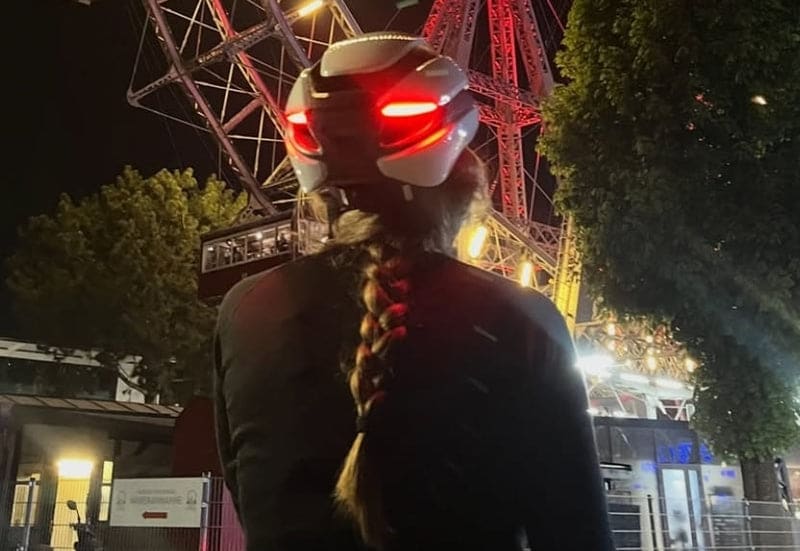
The fix is either a second rear light mounted higher, on a backpack, jacket, or helmet, or a rear light that’s already at head height by design. We built our Lumos helmets around this exact problem: the rear LED sits at 5’5″–6’2″ depending on the rider, putting it directly in the eyeline of drivers in everything from sedans to F-150s.
If you don’t want a smart helmet, at minimum clip a secondary rear light to the back of your bike helmet or pack. Two lights at different heights are dramatically more visible than one bright light at one height.
Layer 3: Side visibility, the layer everyone forgets
Most cyclist-vehicle collisions in cities don’t happen from behind. They happen at intersections, when a driver turning right or pulling out of a side street fails to see a cyclist approaching from the side.
Your front and rear lights do nothing here. What works:
- Wheel reflectors or spoke lights — they create a moving circle of light that’s instantly recognizable as a bicycle.
- Reflective ankle bands — your ankles move in a distinctive up-and-down pattern that drivers’ brains pick up faster than any other reflective surface. This is called “biomotion” and it’s well-documented in visibility research.
- Side-facing reflective strips on your bag or jacket.
This layer costs almost nothing and probably makes the biggest difference per dollar.
Layer 4: Signaling intent
Visibility gets you noticed. Signaling tells drivers what you’re about to do—which is what actually prevents collisions.
Hand signals are the standard answer, and they’re better than nothing. But they fail in the moments you need them most: braking on a wet descent, climbing out of the saddle, or navigating a pothole. They also require the driver behind you to know what they mean, which a meaningful percentage don’t.
This is why we put automatic brake lights and turn signals on our helmets. The brake light brightens when you decelerate, because an accelerometer detects it—you don’t have to do anything. The turn signals fire when you tap a small wireless remote on your handlebar. Both hands stay on the bars. The signaling vocabulary matches what every car on the road already uses.
You don’t have to use a Lumos for this—but you do have to solve the signaling problem somehow. Hand signals alone aren’t a complete answer in 2026 traffic.

What about reflective clothing?
Reflective gear works—but only when headlights hit it directly. On a well-lit city street, ambient light washes out reflective material almost entirely. It’s a complement to active lighting, not a replacement for it.
If you’re going to invest in one piece of reflective clothing, make it something on your lower legs. Biomotion again: a driver will identify a cyclist from reflective ankle bands faster than from a reflective vest, because the up-down motion is unambiguous.
The three mistakes we see most often
After ten years of talking to commuters, these are the patterns:
- One bright light at one height. A 1000-lumen rear light on the seat post is impressive on paper and still gets blocked by a backpack. Layer your lights vertically.
- Steady mode in the city. Steady is for dark trails where drivers need to judge your distance. In urban environments, flash or pulse modes catch attention faster.
- No side visibility plan. People spend $200 on front and rear lights and $0 on the intersection problem that’s statistically more likely to hurt them.
The minimum viable setup
If you want a checklist, here it is:
- Front light, 200+ lumens, aimed slightly down
- Rear light at seat-post height
- Second rear light at head or pack height
- Reflective ankle bands or spoke reflectors
- Some form of turn signaling that doesn’t require taking a hand off the bars
You can build this with separate components, or you can consolidate it. Our Lumos Ultra was designed to handle the rear-light-at-head-height layer and the signaling layer in one piece of gear, which is why we made it. But the principle matters more than the brand: solve all four layers, not just the easy ones.

The thing nobody tells you
Being seen isn’t a feature. It’s a system. The cyclists who get hit aren’t usually the ones with no lights—they’re the ones with one good light who assumed that was enough.
Build the system. Ride home.